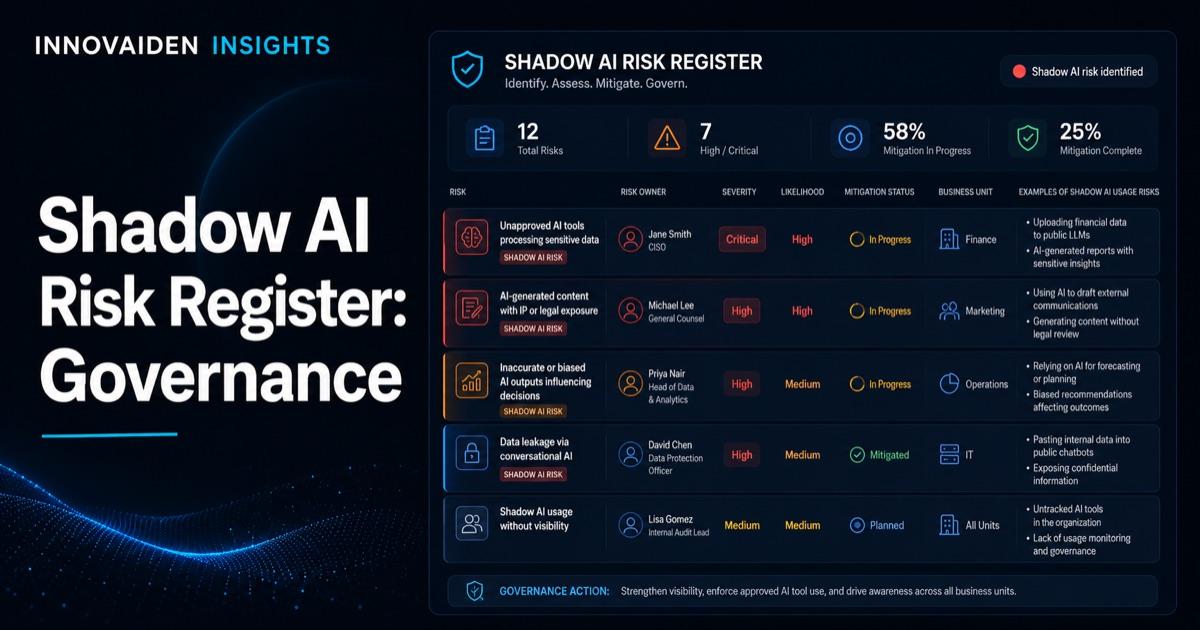
If your risk register still treats AI as a single line item under technology risk, it is already out of date. Shadow AI touches data, vendor, compliance, operational, and reputational risk simultaneously. For boards and executive committees, this is not an IT issue to delegate downward. It is a governance issue that requires a committed position.
Key Takeaways
- 92% of organizations reporting an AI security incident were missing role-based access, multifactor authentication and similar controls on their AI models and applications (IBM, 2026), down from 97% in the 2025 edition
- Close to seven in ten breached organizations lack governance policies for managing AI or spotting unapproved use (IBM, 2026), up from the 63% that had no policy or were still developing one in the 2025 edition
- Workers using unapproved AI tools figured in 43% of security incidents in the 2026 edition, more than double the prior year's share. Those incidents caused data loss or compromise roughly half the time and operational disruption in 40% of cases
- Breaches at high-shadow-AI organizations compromised PII in 65% of cases and intellectual property in 40%
- 80% of enterprises have experienced a negative AI-related data incident, with 13% reporting financial, customer, or reputational harm
From Shadow IT to Shadow AI: What Actually Changed
Shadow IT was primarily a data residency problem. Files ended up on the wrong storage platform, but the data still sat in one location that could be located, recovered, or deleted. Shadow AI is a different class of problem. Data entered into a consumer AI tool does not sit somewhere. It gets ingested into training pipelines, model context windows, caching layers, and vendor logs that the organization has no ability to reach into. Once submitted, the data cannot be recalled.
This single change redefines the risk. It is no longer "data in the wrong place." It is "data that no longer belongs to us." For organizations that have already run a shadow AI discovery sprint, the next step is translating findings into the risk register.
The scale of the problem moved sharply in the 2026 data. IBM's 2026 edition found that workers using unapproved AI tools figured in 43% of security incidents, more than double the prior year's share, with those incidents causing data loss or compromise roughly half the time and operational disruption in 40% of cases. Read that figure carefully before putting it in a board pack: it counts security incidents, not breaches, so it is not the same measure as the 2025 edition's shadow-AI breach premium of $670,000 per incident, which IBM stated against a breach denominator. The 2026 edition states no updated equivalent of that cost premium, so the $670,000 figure stays on the register as a 2025 number and the 43% sits beside it as a differently scoped one. Two datapoints, two denominators, not one trend line.
The Four Risk Categories Shadow AI Touches
The following table maps each risk category to its shadow AI exposure and the governance response required:
| Risk Category | Shadow AI Exposure | Governance Response |
|---|---|---|
| Data risk | Confidential customer information, source code, M&A documents, and HR records routinely submitted to consumer AI. Any data in a consumer tool must be treated as permanently exposed. | Data classification + tiered AI use policy |
| Compliance risk | GDPR, HIPAA, SOX, NIS2 impose obligations on where data can be processed. Consumer AI tools almost never support required data processing agreements. | Regulatory mapping per AI tool + DPA verification |
| Vendor risk | Employees create vendor relationships without due diligence, contracts, or SLAs. If that vendor has a breach, the organization's data is in it. | AI vendor inventory + third-party risk assessment |
| Operational risk | When AI tools become embedded in how work gets done, removing them disrupts operations. The longer shadow AI runs, the more operationally dependent the business becomes. | Sanctioned alternatives + migration path |
Three Commitments Leadership Should Make Now
The first commitment is a mandated AI usage inventory. Not a survey. An actual inventory maintained on the same cadence as the software asset register, with an owner and a review schedule. Any AI tool processing company data without a line in that register is treated as an unauthorized system.
The second commitment is a sanctioned-patterns library. Employees do not need a policy document. They need clear answers to three questions: what AI tools can I use, what data can I put into them, and what do I do when my use case does not fit. Sanctioned patterns answer all three, with examples. Without them, employees will continue to make individual judgment calls that collectively expose the organization.
The third commitment is a defined escalation path. When discovery surfaces shadow AI, there needs to be a process that is neither "ignore" nor "fire the employee." The right response is to assess the tool, classify the exposure, and either bring the use case into the sanctioned estate or retire it with a replacement. Without a defined path, findings sit in a spreadsheet and the risk compounds. For how this connects to the broader AI agent deployment security framework, the escalation path feeds directly into the governance layer.
What the Board Should Expect to See
Three artifacts, at minimum, on a quarterly basis. The AI tool inventory with count, categorization, and data-exposure rating. A breach and near-miss log specific to AI-related incidents. Evidence that sanctioned-patterns guidance is reaching employees, measured by use rather than by the existence of a training module.
If management cannot produce these three artifacts, the right board question is not "what are you doing about AI risk." It is "how do you know what your AI risk is."
The Exposure Question
One question separates organizations that have governance from organizations that have policy documents. If every consumer AI tool your employees used in the last 90 days disclosed a breach tomorrow, what proprietary data would be in it? If the executive team cannot answer that question, the risk register has not yet caught up to the reality of how AI is being used.
The Shadow AI Board Pack Template includes the quarterly reporting structure, the exposure-question methodology, and the risk-register integration framework for AI-specific entries.
Update Your Risk Register for Shadow AI
Innovaiden works with leadership teams deploying AI agents across their organizations, from initial setup and training to security framework alignment and governance readiness. Reach out to discuss how we can help your team.
Get in TouchFrequently Asked Questions
How is shadow AI risk different from shadow IT risk?
Shadow IT was primarily a data residency problem where files ended up on the wrong storage platform but could be located, recovered, or deleted. Shadow AI is fundamentally different: data entered into a consumer AI tool gets ingested into training pipelines, model context windows, caching layers, and vendor logs. Once submitted, the data cannot be recalled. It is no longer 'data in the wrong place' but 'data that no longer belongs to us.'
What four risk categories does shadow AI touch simultaneously?
Data risk (confidential information submitted to consumer AI tools must be treated as permanently exposed), compliance risk (GDPR, HIPAA, SOX, and NIS2 impose obligations that consumer AI tools almost never support), vendor risk (employees create vendor relationships without due diligence, contracts, or SLAs), and operational risk (removing embedded AI tools disrupts operations the business depends on).
What three commitments should leadership make about shadow AI governance?
First, mandate an AI usage inventory maintained on the same cadence as the software asset register. Second, build a sanctioned-patterns library that answers what tools employees can use, what data they can input, and what to do for edge cases. Third, define an escalation path that assesses discovered shadow AI and either integrates it with controls or retires it with a replacement.
What artifacts should boards expect to see quarterly regarding AI risk?
Three artifacts at minimum: the AI tool inventory with count, categorization, and data-exposure rating; a breach and near-miss log specific to AI-related incidents; and evidence that sanctioned-patterns guidance is reaching employees, measured by adoption rather than the existence of a training module.
What is the exposure question that separates real governance from policy documents?
If every consumer AI tool your employees used in the last 90 days disclosed a breach tomorrow, what proprietary data would be in it? If the executive team cannot answer that question, the risk register has not yet caught up to the reality of how AI is being used inside the organization.
Related Insights
Sources
- IBM — Cost of a Data Breach Report 2026. 30 July 2026 (Ponemon Institute; 600+ organizations; breaches March 2025 to February 2026). Source for the 92% access-control figure, the close-to-seven-in-ten governance-policy figure, and the 43%-of-security-incidents shadow-AI figure.
- IBM - Cost of a Data Breach Report 2025. 2025. Source for the $670,000 shadow-AI breach-cost premium, which the 2026 edition does not restate, and for the prior-year 97% and 63% comparisons.
- Cloud Security Alliance and Oasis Security - State of NHI and AI Security Survey. 2026-01-27.
- Komprise - 2025 IT Survey: AI, Data and Enterprise Risk
- Saviynt - 2026 CISO AI Risk Report