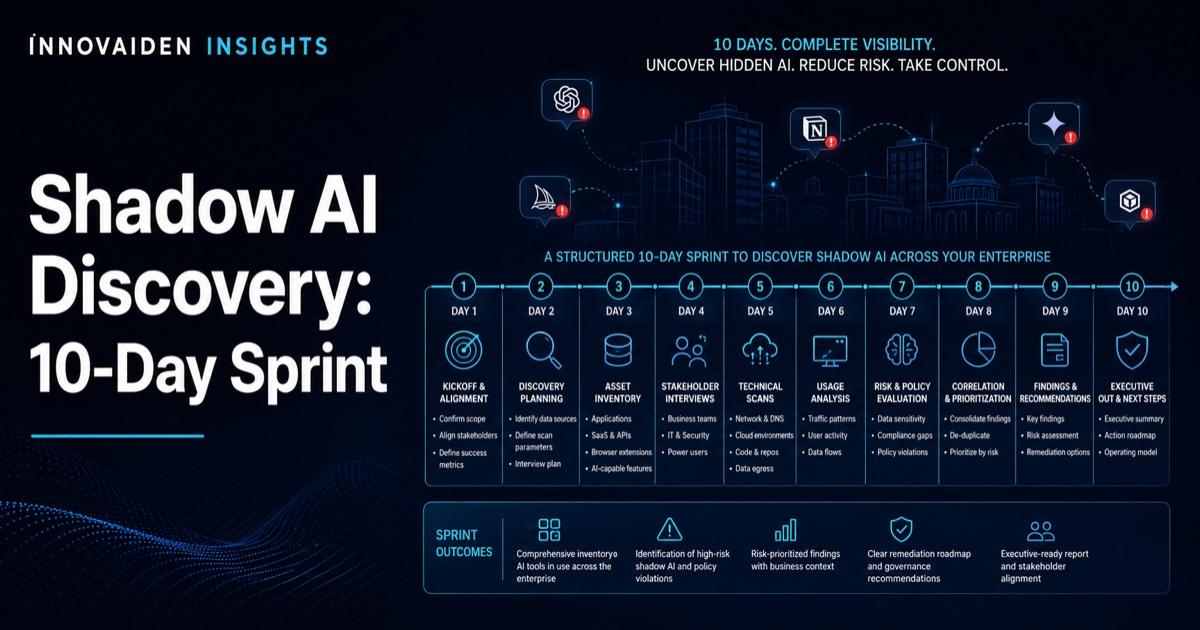
Shadow AI Is Already Inside Your Organization. Here Is How To Find It.
78% of employees who use AI at work bring their own AI tools (Microsoft/LinkedIn 2024 Work Trend Index, n=31,000, fielded February to March 2024), and only 36% of organizations have formal AI governance policies in place. The gap between adoption and governance is not a future risk. It is a current exposure that most security teams cannot see.
Key Takeaways
- 78% of employees who use AI at work bring their own AI tools (Microsoft/LinkedIn 2024 Work Trend Index, n=31,000, fielded February to March 2024); 45% do not disclose usage to their employer
- Organizations with high levels of shadow AI face breach costs $670,000 higher per incident (IBM Cost of a Data Breach 2025; the 2026 edition states no equivalent)
- Workers using unapproved AI tools figured in 43% of security incidents in IBM's 2026 edition, more than double the prior year's share, on a wider denominator than the breach-based 2025 figures
- Only 35% of organizations report full visibility into where unstructured data resides
- Sanctioned alternatives address demand rather than suppressing it, which is why bans push usage further out of view
Shadow IT Was About Software. Shadow AI Is About Data.
The original shadow IT problem was relatively contained. An employee installed Dropbox or used a personal Trello board. The risk was primarily about unsanctioned software and ungoverned file sharing. Security teams could discover it through network monitoring and endpoint management.
Shadow AI is structurally different. When an employee pastes a client's financial model into ChatGPT to reformat a table, or uploads an internal strategy document to Claude to generate a summary, the data leaves the organization's control perimeter entirely. Unlike shadow IT, which moved files between storage locations, shadow AI moves context, logic, and proprietary information into third-party systems that the organization cannot audit, cannot retrieve from, and in many cases cannot even detect.
The following table illustrates the structural differences:
| Dimension | Shadow IT | Shadow AI |
|---|---|---|
| What moves | Files between storage locations | Context, logic, and proprietary information |
| Detection method | Network monitoring, endpoint management | SSL inspection, OAuth audit, expense analysis |
| Data residency | Known (cloud storage providers) | Unknown (AI provider training pipelines) |
| Retrieval | Possible (files can be deleted remotely) | Impossible (data may be retained in model weights) |
| Access pattern | 47% via personal accounts | 47% via personal accounts, plus embedded AI in sanctioned SaaS |
The challenge is compounded by how these tools are accessed. According to Netskope, 47% of generative AI users access tools through personal accounts, completely bypassing enterprise identity and access controls. Standard firewall rules and network monitoring cannot inspect the content of HTTPS interactions without SSL inspection, a control many organizations have not deployed for AI traffic.
Why Existing Policies Fail
Most organizations that have AI policies wrote them for the previous generation of the problem. They address whether employees may use AI tools. They do not address what data flows into those tools, which tools are embedded in existing SaaS applications, or how to govern AI features that vendors are quietly enabling inside products the organization already uses.
The Cloud Security Alliance found 82% of enterprises have unknown AI agents running in their infrastructure (n=418, fielded January 2026). The AI is increasingly not a separate application an employee downloads, but a feature inside tools they already have permission to use. For the broader context on how AI data governance connects to frameworks organizations already have, the shadow AI discovery problem is a prerequisite step.
This means discovery requires more than network monitoring. It requires understanding what data is being processed by AI features within approved platforms, not just tracking standalone AI tool usage.
The 10-Day Discovery Sprint
A practical starting point for any organization is a focused discovery sprint. This is not a full governance program. It is a visibility exercise designed to answer one question: what AI tools are touching our data right now?
The case for doing it now got stronger with IBM's 2026 Cost of a Data Breach edition, published 30 July 2026, which found that workers using unapproved AI tools figured in 43% of security incidents, more than double the prior year's share. Those incidents caused data loss or compromise roughly half the time and operational disruption in 40% of cases. That 43% is measured against security incidents, a wider population than the breaches the $670,000 cost premium above is drawn from, so the two numbers answer different questions: one is how often unsanctioned AI shows up, the other is what it adds to the bill when a breach happens. Both point at the same discovery gap.
| Sprint Phase | Days | Focus | Activities |
|---|---|---|---|
| Expense and procurement review | 1 to 3 | Financial records | Pull expense reports and corporate card transactions for past 6 months. Search for subscriptions to OpenAI, Anthropic, Midjourney, Jasper, Copy.ai, Perplexity, and similar. Check procurement records for purchases outside IT. |
| Identity and access audit | 4 to 6 | IAM and OAuth | Review OAuth grants in identity provider. Audit API keys issued in past 12 months. Review browser extension inventories across managed endpoints. |
| Network and data flow analysis | 7 to 9 | Traffic and DLP | Analyze outbound traffic logs for known AI service domains. Review SSL inspection content patterns for bulk uploads. Review DLP alerts for AI-related data transfers. |
| Classification and decision | 10 | Triage | Categorize every discovered tool: endorse (approve with controls), restrict (allow with data handling rules), or remove (high-risk/non-compliant). Map each tool to data types accessed. |
Banning Does Not Work. Governing Does.
Research consistently shows that blanket AI bans drive usage underground. Nearly half of employees report they would continue using personal AI accounts even after an organizational ban. The more effective approach is to provide sanctioned alternatives that match or exceed the functionality of what employees are using on their own.
Wolters Kluwer Health found 17% of clinicians and administrators admitting to unauthorized AI tool use (n=518, fielded December 2025), and UpGuard found 81% of employees using unapproved AI tools. Sanctioned alternatives are the only control that addresses demand rather than suppressing it. The investment in approved tooling is not just a productivity decision. It is a security control. For organizations evaluating how to deploy AI agents with appropriate security controls, the governance layer starts with knowing what is already in use.
The Shadow AI Discovery Playbook covers the complete discovery sprint methodology, a tool classification framework, policy templates for each tier, and a data flow risk assessment methodology.
Run a Shadow AI Discovery Sprint
Innovaiden works with leadership teams deploying AI agents across their organizations, from initial setup and training to security framework alignment and governance readiness. Reach out to discuss how we can help your team.
Get in TouchFrequently Asked Questions
What is shadow AI and how is it different from shadow IT?
Shadow IT involved employees installing unsanctioned software like Dropbox or personal Trello boards. Shadow AI is structurally different: when an employee pastes client data into ChatGPT or uploads internal documents to Claude, the data leaves the organization's control perimeter entirely. Unlike shadow IT which moved files between storage locations, shadow AI moves context, logic, and proprietary information into third-party systems the organization cannot audit or retrieve from.
How widespread is unauthorized AI use in the workplace?
78% of employees who use AI at work bring their own AI tools (Microsoft/LinkedIn 2024 Work Trend Index, n=31,000, fielded February to March 2024), and 45% do not disclose usage to their employer. Meanwhile, only 36% of organizations have formal AI governance policies in place. The gap between adoption and governance creates a current exposure that most security teams cannot see.
What does a 10-day shadow AI discovery sprint involve?
Days 1 through 3 cover expense and procurement review for AI subscriptions. Days 4 through 6 focus on identity and access audit, reviewing OAuth grants and API keys. Days 7 through 9 analyze network traffic and DLP alerts for AI-related data transfers. Day 10 classifies every discovered tool into three tiers: endorse, restrict, or remove.
Why do blanket AI bans fail as a governance strategy?
Research consistently shows that blanket AI bans drive usage underground. Nearly half of employees report they would continue using personal AI accounts even after an organizational ban. Wolters Kluwer Health found 17% of clinicians and administrators admitting to unauthorized AI tool use (n=518, fielded December 2025), and UpGuard found 81% of employees using unapproved AI tools. Sanctioned alternatives are the only control that addresses demand rather than suppressing it, which makes the investment in approved tooling a security control and not just a productivity decision.
How much more do data breaches cost when shadow AI is involved?
IBM's 2025 Cost of a Data Breach edition found that organizations with high levels of shadow AI face breach costs $670,000 higher per incident compared to organizations with governed AI usage. This premium reflects the expanded attack surface, the difficulty of incident investigation when data flows are unknown, and the regulatory penalties for uncontrolled data processing. The 2026 edition does not restate that cost premium, so it remains a 2025 figure. What the 2026 edition adds is a frequency measure on a different denominator: workers using unapproved AI tools figured in 43% of security incidents, more than double the prior year's share. Security incidents are a wider population than breaches, so the two numbers describe different things and should not be read as one trend.
Related Insights
Sources
- Microsoft and LinkedIn - 2024 Work Trend Index Annual Report: AI at Work Is Here. Now Comes the Hard Part. n=31,000, fielded 15 February to 28 March 2024.
- IBM — Cost of a Data Breach Report 2026. 30 July 2026 (Ponemon Institute; 600+ organizations; breaches March 2025 to February 2026). Source for the 43%-of-security-incidents shadow-AI figure.
- IBM - 2025 Cost of Data Breach Report. 2025. Source for the $670,000 shadow-AI breach-cost premium, which the 2026 edition does not restate.
- Cloud Security Alliance - 82% of Enterprises Have Unknown AI Agents Survey. n=418, fielded January 2026.
- Vectra AI - Shadow AI Risk Analysis
- Wolters Kluwer Health. Survey of clinicians and administrators on unauthorized AI tool use. n=518, fielded December 2025.
- UpGuard. Shadow AI and Unapproved AI Tool Usage in Enterprises. upguard.com. 2025.
- Netskope - Generative AI Usage Patterns Report