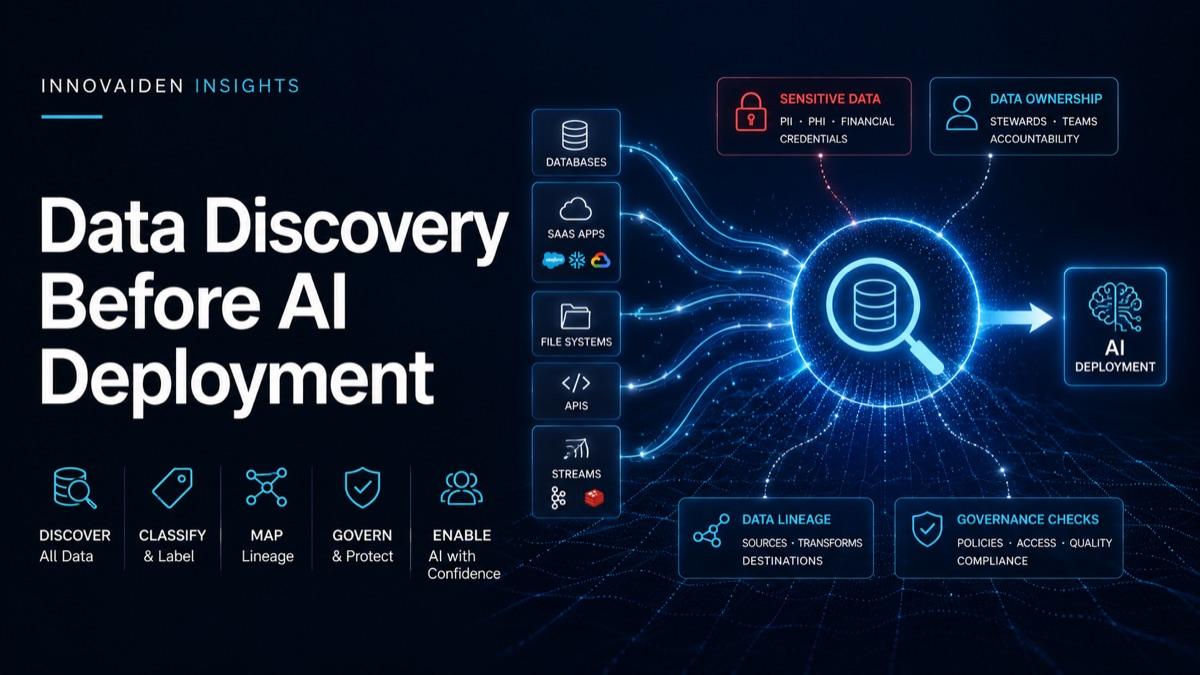
Only 35% of organizations report full visibility into where their unstructured data resides. Just 9% have real-time scanning capabilities. And 23% cannot scan unstructured data for risks at all. These numbers come from a 2026 Cloud Security Alliance report commissioned by Thales, and they describe the foundation on which most organizations are attempting to build AI deployments.
Key Takeaways
- 35% of organizations have full visibility into unstructured data locations; 23% cannot scan unstructured data at all
- 82% of organizations have developed plans to embed generative AI into operations, up from 64% the prior year
- Forrester's Q2 2026 Wave identified data discovery and classification as foundational to Zero Trust, privacy, and AI governance
- The EU AI Act's Article 10 makes data governance a prerequisite for deploying high-risk AI systems
The Sequence Problem
Organizations are deploying AI into environments where they do not have an accurate map of their own data. This creates a sequence problem that no amount of AI security tooling can solve after the fact.
AI agents, whether internal productivity tools or externally deployed customer-facing systems, consume data. They process it, learn from it, generate outputs based on it, and in some architectures, retain elements of it. If the organization does not know where sensitive data resides, it cannot control what AI systems access. If it cannot classify data by sensitivity, it cannot enforce appropriate handling rules. If it cannot trace data lineage, it cannot demonstrate compliance when a regulator asks how a model was trained or what information an agent accessed.
The AI security conversation in most organizations starts with "how do we secure AI?" The correct first question is "do we know what data AI is touching?" For the broader framework on how AI data governance connects to existing enterprise capabilities, data discovery is the foundational step.
Why Discovery Must Come Before Deployment
Data discovery and classification is not a new discipline. It has been a core component of data governance and privacy programs for years. What has changed is the urgency and the scope.
In a pre-AI environment, data classification primarily served compliance and access control purposes. Regulated data (PII, PHI, financial records) needed to be identified and protected. Internal data needed appropriate access restrictions. The classification taxonomy was relatively stable.
AI introduces three new dimensions that make existing classification programs insufficient:
| Dimension | Pre-AI Requirement | AI-Era Requirement |
|---|---|---|
| Provenance | Know where data is stored | Track full lineage: origin, transformations, who accessed it, how it was used in training |
| Access patterns | Static access control lists | Dynamic, cross-system traversal by agents operating at machine speed |
| Data categories | PII, PHI, financial, IP | All of the above plus AI-generated data, embeddings, vector stores, training datasets |
The EU AI Act's Article 10 mandates that high-risk AI systems use training data that meets quality criteria, with documented provenance, bias assessments, and security measures. Organizations cannot meet this requirement without knowing where their data is and how it got there. Multiple U.S. states are enforcing AI-specific statutes in 2026 that require disclosures about training data sources. For how four EU regulatory frameworks converge on vendor data obligations, the data governance requirement spans NIS2, DORA, the Cyber Resilience Act, and the revised Cybersecurity Act simultaneously.
The Five-Step Executive Checklist
For leadership teams preparing to deploy or expand AI capabilities, the following sequence represents the minimum prerequisite work before any AI system touches production data.
| Step | Action | Scope |
|---|---|---|
| 1. Discover | Comprehensive data discovery sweep | All repositories, prioritizing unstructured data sources (file shares, email archives, collaboration platforms) and any AI infrastructure already in place (vector databases, training data lakes) |
| 2. Classify | Apply sensitivity labels based on regulatory and business context | Minimum four to five levels: public, internal, confidential, highly confidential, restricted. Map data categories (PII, PHI, financial, IP) to levels. |
| 3. Set policies | Define AI access rules by classification level | Which levels AI may access, under what conditions, with what controls. Which data may be used for training versus processing versus exclusion. |
| 4. Enforce | Connect labels to downstream security controls | Access restrictions, encryption, data masking, retention policies, handling procedures. Policy without enforcement is documentation, not security. |
| 5. Monitor | Implement continuous monitoring | Data access patterns, classification drift, policy violations. A point-in-time inventory becomes outdated within weeks. |
The Convergence Point
What makes data discovery and classification particularly urgent now is the convergence of privacy, compliance, and security requirements around AI. Data Protection Impact Assessments under GDPR now require AI-specific considerations. The EU AI Act creates explicit data governance obligations for high-risk systems. These are not separate compliance workstreams. They are all asking the same underlying question: do you know what data your AI systems are using, where it came from, and whether its use is authorized?
Organizations that answer that question before deploying AI will move faster, face fewer regulatory obstacles, and avoid the costly remediation that comes from discovering data governance gaps after an incident or audit. For organizations evaluating how to deploy AI agents with appropriate security controls, data discovery is Step 0.
The pre-deployment discovery toolchain now has a concrete enterprise option. Microsoft Purview DSPM for AI reached GA in May 2026, providing unified visibility across traditional and AI environments — including Microsoft 365 Copilot, custom agents, and shadow AI tooling — with native third-party signals from BigID, Cyera, OneTrust, and Varonis. The five executive checklist steps above can now be supported by a deployable product, not just a methodology. Organizations that own Microsoft 365 already pay for much of this; the question is whether the data-governance team has actually turned it on and configured the third-party signals.
The Data Discovery and Classification Guide covers the complete methodology for AI environments, regulatory mapping across EU AI Act, GDPR, and NIS2, and a readiness assessment template.
Assess Your Data Readiness for AI Deployment
Innovaiden works with leadership teams deploying AI agents across their organizations, from initial setup and training to security framework alignment and governance readiness. Reach out to discuss how we can help your team.
Get in TouchFrequently Asked Questions
Why must data discovery come before AI security?
AI agents consume data, process it, generate outputs based on it, and in some architectures retain elements of it. If the organization does not know where sensitive data resides, it cannot control what AI systems access. If it cannot classify data by sensitivity, it cannot enforce handling rules. The correct first question is not 'how do we secure AI?' but 'do we know what data AI is touching?'
What does the Cloud Security Alliance data visibility report show?
The 2026 CSA report commissioned by Thales found that only 35% of organizations have full visibility into unstructured data locations, just 9% have real-time scanning capabilities, and 23% cannot scan unstructured data for risks at all. These numbers describe the foundation on which most organizations are attempting to build AI deployments.
What three dimensions make existing data classification insufficient for AI?
First, AI training data requires provenance tracking under the EU AI Act's Article 10. Second, AI agents access data dynamically across systems, often traversing boundaries that were never designed to be crossed. Third, AI-generated data is itself a new category that most classification taxonomies do not address.
What are the five steps in the executive data readiness checklist?
Step 1: Discover (comprehensive sweep across all repositories). Step 2: Classify (apply sensitivity labels with four to five classification levels). Step 3: Set policies (define which levels AI may access, under what conditions). Step 4: Enforce (connect labels to downstream security controls). Step 5: Monitor (continuous monitoring for access patterns and classification drift).
How does the EU AI Act's Article 10 affect data governance requirements?
Article 10 mandates that high-risk AI systems use training data that meets quality criteria, with documented provenance, bias assessments, and security measures. Organizations cannot meet this requirement without knowing where their data is and how it got there. Data governance is a prerequisite for deploying high-risk AI systems, not an optional add-on.
Related Insights
Sources
- Cloud Security Alliance and Thales - AI Security Risks and Data Visibility, 2026
- Microsoft - 2026 Data Security Index
- Forrester - Q2 2026 Wave: Data Discovery and Classification
- Aparavi - EU AI Act Article 10 Data Governance Analysis
- European Commission - EU AI Act
- Microsoft Security — Secure Data as AI Scales: New Microsoft Purview Innovations at RSA 2026. May 2026 GA.