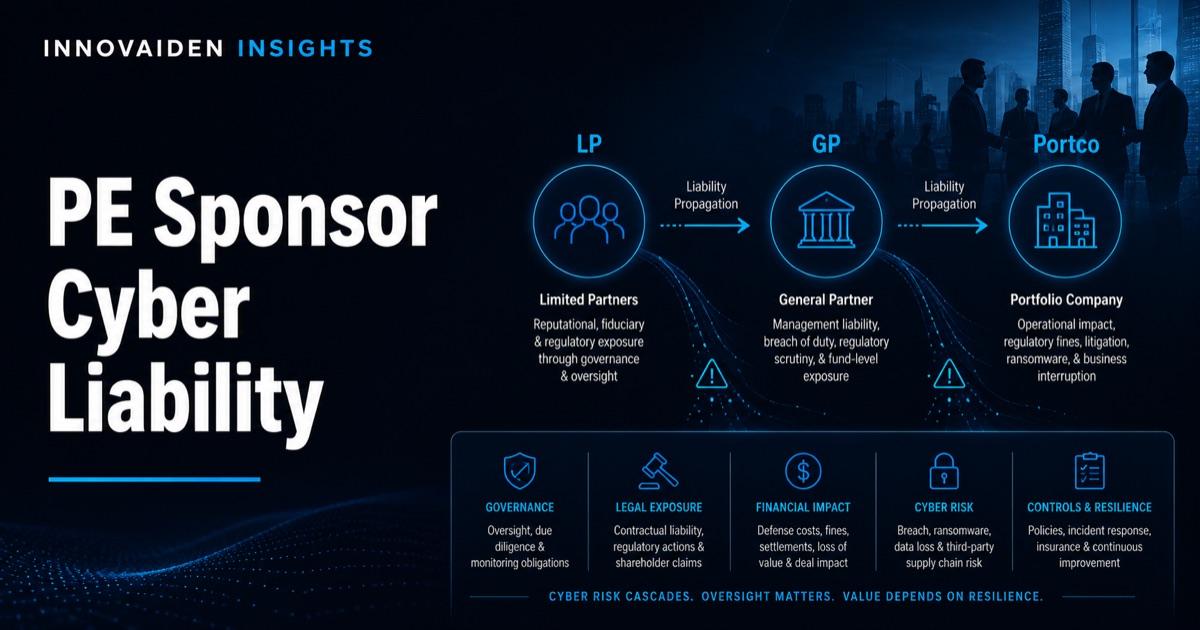
Sponsor Liability for Portfolio Cyber Failures: A Practitioner's Defense Playbook After Bain/PowerSchool
For most of the last decade, weak cyber diligence in M&A was a deal-value problem. A breach in the first 18 months of ownership meant a write-down, possibly an indemnity claim under the SPA, and uncomfortable conversations with LPs. The portfolio company's directors and officers might face derivative claims. The sponsor itself was usually one layer removed from the action.
That changed on March 18, 2026.
A US federal court in the Southern District of California granted in part and denied in part Bain Capital's motion to dismiss in the consolidated PowerSchool data breach litigation, allowing claims for negligence, negligence per se, aiding and abetting, unjust enrichment and violations of California's unfair competition law to proceed. The plaintiffs argued that Bain, as PowerSchool's controlling owner, exercised operational control sufficient to owe a duty of care to the millions of students whose data was exposed in the 2024 breach. The court agreed that the claims could proceed. Bain is now a named defendant, in its own right, in litigation over a portfolio company's cyber failure.
This is not a final liability finding. Bain may still prevail. But the precedent that such claims can proceed is the material development. Plaintiffs' attorneys have a roadmap. PE firms have to assume that operational involvement in a portfolio company's security decisions creates direct sponsor exposure, even before any final adjudication. The cost ceiling for weak diligence is no longer a write-down. It is the sponsor named in the suit.
This is a practitioner's playbook for what changes operationally. It is angled toward how PE sponsors should structure pre-close diligence, post-close governance, and incident response, not toward the legal doctrine itself. The legal frameworks are still developing. The operational decisions you can make this quarter are not.
Key Takeaways
- The cost ceiling for weak cyber diligence is now sponsor-level liability, not just deal-value impairment, holdbacks, or D&O claims at the portco
- The legal theory is operational control plus duty of care. The more the sponsor directs security spend, staffing, or technical decisions, the harder a passive-ownership defense becomes
- The exposure attached pre-close, not post-close. The court relied on allegations that Bain conditioned its offer on cost reductions including cuts to domestic cybersecurity staff, and directed offshoring of security functions. Post-close governance hygiene does not reach that conduct
- Six operational layers limit exposure: screening the value-creation plan for security-relevant cuts, documented pre-close diligence, sponsor-portco governance posture, operational arms-length on technical decisions, standardized incident response playbooks, and a cyber insurance/indemnity stack with the sponsor named
- AI agent governance is the next attack surface this theory will reach. Agents in portcos run autonomously, often without security review, and create exactly the kind of preventable risk surface the Bain theory targets
- The plaintiffs' bar will adapt this theory cross-border. The US ruling is the first to advance it; the operational-control logic exists in most common-law jurisdictions and parallels exist in EU member-state law
What Actually Changed on March 18, 2026
The PowerSchool breach is, by 2026 standards, a fairly conventional incident, with one detail that turns out to carry the entire case. In August 2024, a threat actor gained unauthorized access to the systems of PowerSchool, an EdTech platform serving K-12 districts across North America with data on tens of millions of students, using stolen vendor credentials. PowerSchool disclosed the breach in December 2024; the incident is reported to have affected roughly 50 million people.
The date is the point. Bain's acquisition of PowerSchool closed on 1 October 2024, which means the intrusion began before the deal closed, and a substantial part of the conduct plaintiffs complain of predates Bain's ownership entirely. That is what Womble Bond Dickinson's alert means when it calls the ruling unprecedented: many of the claims rest on conduct that occurred before the acquisition. The offshore contractor whose credentials were implicated, Movate, Inc., is a named co-defendant. The exposed records included names, contact information, and in some cases social security numbers and academic records. Class actions followed in the usual pattern, naming PowerSchool and a range of related entities.
What was unusual is what the plaintiffs did with Bain. Bain had acquired PowerSchool in October 2024 for $5.6 billion. By the time the breach surfaced publicly, the firm had been the controlling owner for a matter of months, and the intrusion itself predated the close. The plaintiffs alleged that Bain, through its board representatives and operational support functions, exercised meaningful control over the security decisions that led to the breach, and therefore owed a duty of care directly to the affected individuals.
Judge Roger T. Benitez's ruling did not find Bain liable. It found that the plaintiffs' allegations, taken as true at the motion-to-dismiss stage, plausibly stated claims for negligence and aiding-and-abetting. That is a low procedural threshold. It is also a meaningful one. The default expectation in PE-sponsored portfolio breach litigation has been that the sponsor is dismissed early; the suit proceeds against the operating company. That default broke on March 18.
The legal theory matters less than the operational implication. What plaintiffs' attorneys need to allege, and increasingly will, is that the sponsor exercised operational control over the security decisions that produced the failure. The more documented control, the stronger the theory. The more the sponsor can point to arms-length governance and delegated authority, the weaker.
Where the control actually attached, and why it should worry deal partners more than CISOs
It is worth being precise about the conduct the court relied on, because it is not the conduct most sponsors are defending against.
The court found that Bain's involvement in PowerSchool's cybersecurity operations went beyond what an ordinary investor would do. The specifics, per the reporting on the ruling: Bain ratified and conditioned its offer on cost-reduction measures, which included laying off domestic cybersecurity staff, and directed the company to offshore cybersecurity functions to contractors. The offshoring in turn required data-management tooling that allowed vendors to bypass consent protocols and reach protected school-district systems.
Read that sequence again with a deal timeline next to it. The exposure did not attach because Bain governed the portfolio company badly after close. It attached because of how Bain structured and conditioned its bid — commitments made in the deal model, before it owned anything, that were then executed against. The novel feature of this ruling, and the reason it is described as unprecedented, is that pre-close deal terms produced post-close tort exposure.
That has an uncomfortable consequence for the playbook below, and it is worth stating plainly rather than leaving implicit. A sponsor can implement every post-close governance control set out here — charters, decision-rights matrices, operational arms-length between operating partners and the CISO, standardised incident response — and still carry the exposure that actually landed in this case, if its investment committee continues to underwrite deals on cost-reduction assumptions that cut security headcount or offshore security functions. The governance layers reduce the surface. They do not reach the conduct at the centre of this ruling.
For deal teams, the practical question is no longer "did our diligence find the issue?" It is "can we defend the operational posture we maintained from close to incident?"
The Three Operating Decisions That Now Carry Direct Exposure
Three categories of decision now create the strongest evidentiary trail in any future plaintiffs' case. Each is a place where the operational-control theory finds traction.
1. Pre-close cyber diligence: was the issue findable?
If the breach trace leads back to a control gap that competent diligence would have surfaced, the plaintiffs' theory becomes direct. The sponsor is not being faulted for the breach itself. It is being faulted for proceeding with the deal without remediating a known issue, or for treating diligence as a cosmetic exercise.
The implication: the diligence file has to be defensible as a process, not a deliverable. A 60-page report with a green/yellow/red dashboard is fine; what matters is what is behind it. Did the team test for the relevant categories? Was there access to the right systems? When findings were identified, what happened? Were they remediated pre-close, holdbacks taken, or accepted with a documented rationale?
The questions a future deposition will probe:
- What was on the diligence checklist?
- What was actually tested versus self-reported?
- For the issue at the center of the breach, was it identified in diligence?
- If yes, what was the documented mitigation?
- If no, was the category covered at all?
A clean documented answer is a defensive moat. A handwave is the opposite.
2. Governance posture: sponsor-portco decision rights
After close, the sponsor's involvement in security decisions is the central battleground. Most PE firms use some combination of board representation, formal observer rights, operating partner involvement, and informal participation in major decisions. The legal question is which of these crosses into "operational control" sufficient to create a duty of care.
The operational answer: document the structure. A written charter for the IT/security committee at the portfolio company, a decision rights matrix that specifies what the sponsor approves vs. what management decides, and meeting minutes that show the sponsor receiving information rather than directing technical choices, these are the artifacts that build a passive-ownership defense.
The opposite, informal direction by operating partners, ad hoc directives on security spend, sponsor staff inserting themselves into vendor selection or hiring decisions, builds the plaintiff's case.
3. Incident response: the decisions made during the crisis
The breach itself is rarely the most-litigated phase. The response is. How quickly was the incident triaged? Who decided when and how to disclose? What public communications were made? Were affected individuals notified within statutory windows?
Sponsor involvement in these decisions is unavoidable in practice. A $5B+ portfolio company breach will reach the LP letter, and the GP can't be uninvolved. But the form of involvement matters. The sponsor receiving updates and concurring in recommended actions is different from the sponsor making the call.
The artifact that matters here is the incident response playbook, signed off pre-incident, that defines who decides what during a breach. If the playbook says "the portco CEO and CISO own incident response decisions, the sponsor is informed," and the documented response matches, the operational-control theory has less to grab onto.
A Six-Layer Defense Playbook
Each layer addresses a different stage where the Bain/PowerSchool theory could be applied. None is sufficient alone. Together they constitute the operational stance of a sponsor that takes this exposure seriously.
Layer 0: The value-creation plan itself
This layer is first because it is the one the PowerSchool ruling actually reached, and because it sits with the deal team rather than with security.
If the investment thesis contains cost-reduction commitments, know before signing whether any of them touch the security function — headcount in the security organisation, offshoring or outsourcing of security operations, tooling consolidation that removes controls, or vendor-access changes that widen who can reach production data. Those are the specific measures that appear in the allegations here.
Three practical disciplines follow:
- Screen the value-creation plan for security-relevant cuts before the offer is conditioned on them. A cost line labelled "IT rationalisation" or "offshore support functions" is where this hides; it rarely says "cybersecurity" on the page
- Document the security review of the cost plan. If the plan reduces security capacity, record who reviewed it, what compensating controls were required, and on what basis the residual risk was accepted. The absence of that record is what makes "ratified and conditioned its offer on cost reductions" a clean allegation
- Treat vendor-access architecture as a deal-model question, not an integration detail. The offshoring here required tooling that let vendors bypass consent protocols. That is a control decision embedded in a cost decision, and it was made at the top
The remaining layers reduce the surface after close. This one addresses the conduct the court found went beyond what an ordinary investor would do.
Layer 1: Pre-close diligence as a documented process
The cyber diligence package needs to be reconstructable from the file two years post-close. For practical purposes:
- Scope-of-work signed off pre-engagement, listing the eight assessment domains (governance, infrastructure, applications, data, identity, incident response, third-party risk, compliance) and what each will test
- Evidence trail for every finding. Not just a claim of "outdated TLS configurations" but the specific systems tested, the methods used, and the artifacts (scan output, configuration screenshots, policy documents) that support it
- Remediation tracking for every material finding. What was the response: pre-close fix, holdback amount, indemnity, or accepted with rationale. Each track has its own artifact.
- Residual risk acceptance if the deal closes with known issues unfixed. A documented rationale signed by the deal partner. This is the artifact that addresses "you knew and proceeded anyway" theories.
The deeper context for what this looks like in practice: see our practitioner's framework for M&A cybersecurity due diligence and what PE firms typically miss before close.
Layer 2: Sponsor-portco governance posture
The governance documents in place at close are the foundation of any passive-ownership defense. Three documents matter most:
- Board charter specifying the sponsor's representation rights, observer rights, and meeting cadence
- IT/security committee charter at the portco specifying who attends, what decisions the committee makes, and what is escalated to the full board
- Decision rights matrix specifying which decisions require sponsor approval vs. portco management discretion. Critical: security spend, CISO hiring, incident response authority, and major vendor selection should sit with portco management, not the sponsor.
These are not contractual instruments. They are operating documents. They have to match what actually happens. A charter that says "portco management owns security decisions" and a fact pattern showing the operating partner directs vendor selection from the sponsor's office is worse than no charter at all.
Layer 3: Operational arms-length on technical decisions
This is the layer most PE firms fail. The temptation is real and structural. Operating partners want to add value. Cyber is a topic where most operating partners feel comfortable having opinions. Vendor recommendations cross the line easily. So does suggesting the CISO is "not the right fit." So does pushing back on a security spend request because EBITDA needs to land.
The discipline that prevents this is hard to maintain but defensible to operate:
- No sponsor-side personnel in the technical decision chain. The portco CISO does not report to the operating partner. The sponsor does not run the SOC, does not select tools, does not interview security hires unilaterally.
- All sponsor inputs go through formal channels. A board-level concern about security investment goes via a board agenda item with portco-recommended response, not via a side conversation.
- Security budget pressure is mediated. If the sponsor wants to constrain security spend, the portco's risk committee documents the trade-offs and the residual risk acceptance.
The test: if a plaintiff's attorney subpoenas the email between the operating partner and the CISO, does the trail show the sponsor receiving information or directing decisions?
Layer 4: Standardized incident response across the portfolio
Most PE-backed portfolio companies have insufficient incident response capability. The portfolio-wide remediation is itself a defensive layer. A sponsor that maintains a playbook that all portcos use, that runs annual tabletop exercises, that has pre-negotiated forensics and PR retainers, and that documents the decision authority during incidents is in a materially stronger position than one that treats each breach as bespoke.
The playbook content is now relatively standardized. The legal artifact that matters is the adoption: every portco signs an addendum to the management services agreement specifying that they will use the playbook, that they own the incident response decisions, that the sponsor receives updates per a defined cadence, and that disclosure decisions sit with the portco's general counsel and CEO.
For organizations starting from a blank slate, our companion analysis on how cybersecurity due diligence protects deal value covers the FTI Consulting figures published March 2026, from fieldwork conducted 12–26 August 2025: 42% of executives in deals affected by cyber incidents reported significant deal-value reduction, 58% said financial targets were impaired. Those figures used to be the worst case. After Bain/PowerSchool, sponsor-level claims are the new ceiling above them.
Layer 5: Insurance and indemnity stack with the sponsor named
The financial protection layer has to be rebuilt around the new exposure profile.
- Sponsor-named cyber insurance. The sponsor as named or additional insured on the portco's cyber policy, with explicit coverage for sponsor-directed claims.
- D&O coverage for sponsor board reps. A separate Side A policy for the individual operating partners and managing directors who hold portco board seats, covering their personal exposure.
- SPA reps and warranties. The cyber-specific reps in the purchase agreement should trigger indemnity for any pre-close issue that surfaces post-close, with carve-outs for known issues that were specifically diligenced.
- Master indemnity from the GP fund. Most fund agreements already provide this, but the operational question is whether the indemnity reaches sponsor-level claims arising from portco breaches. Counsel review is recommended.
- Cyber reps and warranties insurance. RWI for the cyber reps specifically, increasingly available as a separate sub-policy from major underwriters.
This layer is not a substitute for the first four. Insurance covers payment; it does not prevent the named-defendant status, the deposition cycle, the LP communication, or the reputational damage. But it is the floor.
The AI Agent Surface That's Coming Next
The Bain/PowerSchool theory will reach AI agent risk before it reaches any other emerging category. The reason: AI agents in portfolio companies are exactly the kind of preventable, increasingly-known risk surface that plaintiffs' theories thrive on.
Three specific characteristics make AI agent exposure especially attractive to the operational-control theory:
- They're being deployed without security review at most portcos. Line-of-business teams adopt AI agents with credentials and system access; security teams find out after the fact. This is exactly the "should have known" pattern that makes a duty-of-care argument.
- They have system-level access by design. AI agents read databases, send emails, modify records, and execute code. A compromised agent has the blast radius of a privileged employee, and the theory of liability is correspondingly expansive.
- The risk is increasingly documented in the public record. Project Glasswing, the Cursor CVE-2026-26268, the MCP server vulnerabilities Ox Security disclosed in April 2026, and the browser AI assistant attack surface are all publicly-documented threat categories that plaintiffs will cite to argue the risk was foreseeable.
For sponsors with portfolio-wide exposure, the operational implication is straightforward: the security-first AI agent deployment framework is now a portfolio-wide governance requirement, not a per-portco choice. The questions the board should be asking about AI agents need a clean answer at sponsor level: what AI capabilities are in production across the portfolio, who owns them, what's the inventory.
If the answer to those questions is incomplete in 2026, it will be evidence in 2027 or 2028.
What the Litigation Theory Actually Requires
A clean reading of the underlying theory helps the operational decisions stay calibrated. Plaintiffs do not need to prove the sponsor caused the breach. They need to plausibly allege that the sponsor:
- Owed a duty of care to the affected individuals, arising from operational control
- Breached that duty by acting (or failing to act) in a way that fell below the standard a reasonable controlling owner would meet
- Caused harm through that breach, with direct causation between the sponsor's act or omission and the eventual injury
The duty-of-care question is the gateway. Without it, the rest doesn't reach. With it, the entire factual record of sponsor involvement becomes discoverable.
This is why the operational-arms-length layer is the most strategically important. It directly addresses the duty-of-care prong. A sponsor that maintains documented arms-length on technical decisions can argue that no duty arose; a sponsor that does not has to fight on the facts.
The aiding-and-abetting prong (also at issue in the Bain ruling) is a separate path. It requires plaintiffs to show that the sponsor knew of the underlying tort and substantially assisted it. This is a harder allegation in most cases, but it's the one that gets legs when the diligence record shows the sponsor knew about the security weakness and proceeded without remediation.
What to Expect Over the Next 12–18 Months
Three downstream developments are likely.
Plaintiffs' bar will expand the theory. The Bain/PowerSchool template will be applied to more breaches. Class action firms have a roadmap they can copy. Expect filings against PE-backed portcos with breaches in 2024-2025 to increasingly name the sponsor.
Case law will diverge. Different US courts will apply different operational-control thresholds. Some will find the theory compelling; others will dismiss aggressively. The fact pattern that matters most is the documented decision authority. Sponsors that documented arms-length will win more dismissal motions.
Insurance and indemnity terms will adjust. Cyber underwriters will reprice based on portfolio-wide exposure. Sponsor-named coverage will become standard rather than premium. Side A D&O for portco board reps will see capacity tighten.
The cross-border question is the most uncertain. EU and UK courts have parallel duty-of-care doctrines, but the procedural posture is different. The US class action mechanism is far more permissive than equivalent EU proceedings. The legal theory may translate; the volume of litigation it generates will be jurisdiction-specific.
For PE firms operating in multiple jurisdictions, the operational defense is jurisdiction-agnostic. The six layers above protect against the underlying theory regardless of where it's litigated.
What This Means for Deal Teams Right Now
Three things are worth doing this quarter, regardless of where the case law lands:
- Audit the cyber diligence file on every portco closed in the last 36 months. If the file does not pass the "reconstructable in deposition" test, document the gaps and remediate now, not after a breach.
- Review the governance posture across the portfolio. A spreadsheet showing which portcos have documented IT/security committee charters, decision rights matrices, and incident response playbooks. The portcos with gaps are the highest exposure.
- Inventory AI agent deployment across the portfolio. This is the next surface where the operational-control theory will find traction. A sponsor that cannot answer "what AI capabilities are running across our portfolio companies" in 2026 will not be able to answer it in deposition.
For organizations evaluating the broader pattern of how cyber findings translate to deal economics, the holdbacks, indemnification structures, and post-close monitoring obligations, see our framework for how cybersecurity due diligence protects deal value. For the technical-risk lens, five technology risks that determine M&A deal outcomes covers the cyber-vulnerability category alongside the four others most commonly missed.
The PE Sponsor Cyber Defense Playbook covers the complete six-layer defense framework, the documentation templates for each layer (board charter, IT committee charter, decision rights matrix, incident response playbook addendum), the cyber insurance gap analysis worksheet, and the portfolio-wide AI agent inventory template.
Get the PE Sponsor Cyber Defense Playbook
Innovaiden works with PE deal teams and sponsors on pre-close cyber diligence, portfolio-wide security posture, and incident response playbooks designed to limit sponsor-level liability exposure. Reach out to discuss your portfolio.
Get in TouchFrequently Asked Questions
What is the Bain/PowerSchool ruling and why does it matter for PE firms?
On March 18, 2026, a US federal court in the Southern District of California (In re PowerSchool Holdings, Inc. and PowerSchool Group, LLC Customer Security Breach Litigation, No. 3:25-md-03149-BEN-MSB) granted in part and denied in part Bain Capital's motion to dismiss, allowing negligence, negligence per se, aiding-and-abetting, unjust enrichment and California unfair-competition claims to proceed in litigation over the 2024 PowerSchool data breach. The plaintiffs argued that Bain exercised operational control over PowerSchool sufficient to owe a duty of care to the plaintiffs. The court agreed that the claims could proceed. This is the first US ruling to advance sponsor-level liability claims for a portfolio company's cyber failure, a category change from deal-value impairment to direct sponsor exposure.
Is the Bain/PowerSchool ruling a final liability finding?
No. The court denied a motion to dismiss, meaning the plaintiffs cleared the threshold to proceed with discovery and trial. Bain may still prevail on the merits. But the precedent that such claims can proceed is the material development. Plaintiffs' attorneys now have a roadmap, and PE firms have to assume that operational involvement in a portfolio company's security decisions creates direct liability exposure even before final adjudication.
How can PE sponsors limit their direct cyber liability exposure?
Six layers, and the first one is the one this ruling actually reached: screening the value-creation plan for cost reductions that touch the security function, since the court relied on allegations that Bain conditioned its offer on cuts including domestic cybersecurity staff and directed offshoring of security operations. Then: pre-close diligence as a documented process (not a checklist), formal sponsor-portco governance with documented decision rights, operational arms-length on technical security decisions, standardized incident response playbooks across the portfolio, and a cyber insurance and indemnity stack with the sponsor named as additional insured. Each layer addresses a different stage where the legal theory in Bain/PowerSchool could be applied.
Does this ruling apply to non-US PE firms or non-US portfolio companies?
The ruling is from a US federal court applying state-law negligence principles, so its direct precedential effect is in US litigation. But the legal theory, that operational control creates a duty of care, exists in most common-law jurisdictions and is recognized in EU member states under different doctrinal labels. PE firms operating cross-border should assume that the underlying duty-of-care logic will surface in EU and UK courts as plaintiffs' bar adapts the theory.
How does AI agent risk in portfolio companies change this calculus?
AI agents deployed across portfolio companies create a new attack surface that most sponsor-level governance doesn't yet cover. An AI agent in a portfolio company has system-level access, runs autonomously, and is being deployed by line-of-business teams without security review. If a portfolio company suffers a breach via a poorly-governed AI agent, the same operational-control theory applies, and the sponsor's documented stance on AI governance becomes evidentiary.
Related Insights
Sources
- Womble Bond Dickinson — Unprecedented: Private Equity Firm Potentially on the Hook for Portfolio Company's Data Breach. 2026.
- Bloomberg Law — Bain Struggles to Dismiss PowerSchool User Data Breach Claims. March 2026.
- In re PowerSchool Holdings, Inc. and PowerSchool Group, LLC Customer Security Breach Litigation, No. 3:25-md-03149-BEN-MSB (S.D. Cal.), Hon. Roger T. Benitez, March 18, 2026 (order granting in part and denying in part Bain Capital's motion to dismiss).
- FTI Consulting — CISO Redefined III: Cybersecurity Attacks an Increasing Threat to M&A. March 17, 2026.
- Anthropic — Project Glasswing. 2026.
- Ox Security — The Mother of All AI Supply Chains: Critical Systemic Vulnerability at the Core of the MCP. April 2026.