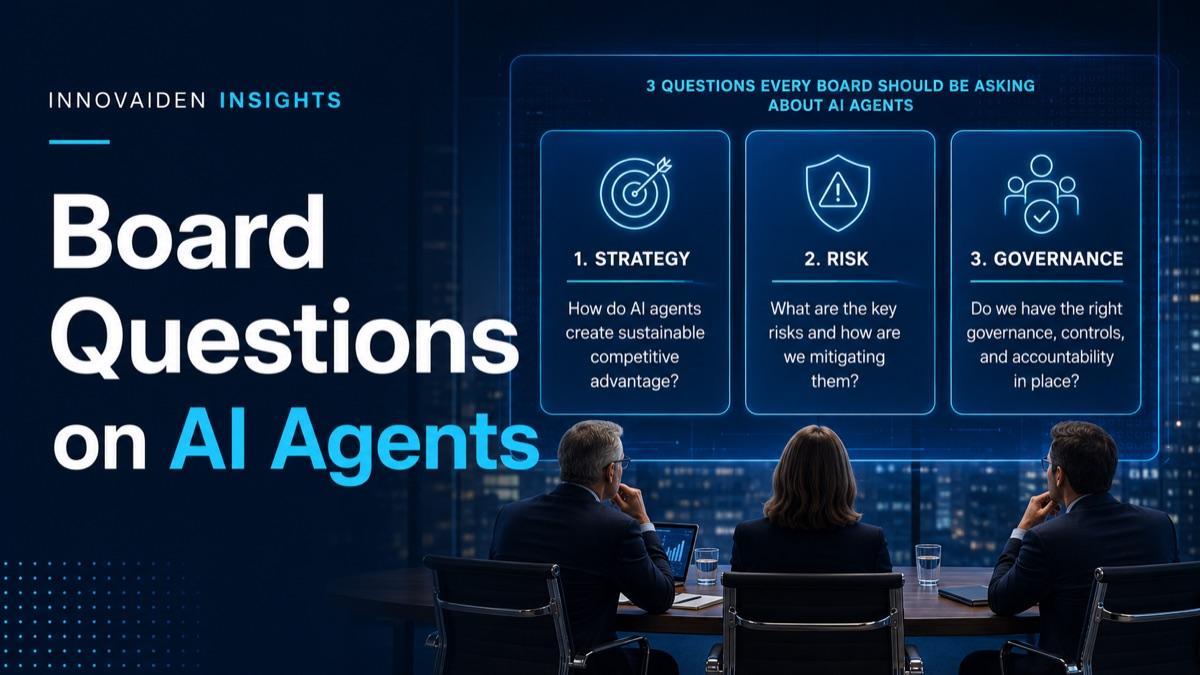
Most boards are hearing a version of the same management pitch: the organization is adopting agentic AI to drive productivity and margin. What boards typically do not hear is the identity, permission, and accountability model underneath. Three questions, asked directly, surface whether management has an AI agent strategy or an AI agent problem.
Key Takeaways
- Only 5% of CISOs feel confident they could contain a compromised AI agent
- 92% of organizations lack confidence that their legacy IAM tools can manage AI and NHI risks
- Gartner predicts 40% of enterprise applications will include task-specific AI agents by end of 2026, up from under 5% in 2025
- Industry analysts are forecasting the first major enterprise breach traced directly to an over-privileged AI agent in 2026
Question One: Where Will AI Agents Be Making Decisions or Taking Actions?
The right board question is not "are we using AI." It is "where does AI take action autonomously, and what authority does it have." Every agent in production needs a line on this list: what it does, what systems it touches, what decisions it can make without human review.
The management answer to watch for: a vague statement about "productivity tools" or "using copilots." The answer a board needs: a specific inventory of agents, classified by the sensitivity of what they can do, with a clear boundary between advisory (the agent recommends, a human decides) and executive (the agent acts on its own authority). For the technical reference on how AI agent identity models differ from human IAM, the structural mismatch between what agents require and what legacy systems provide is the root issue.
Question Two: Who Owns the Risk of Machine Actors?
In traditional operations, every high-risk action has an accountable human. That human has authority to act, training to use it, and consequences if they act outside their authority. For AI agents, the analogue is less clear. An agent has authority (its credentials) but no training in judgment and no personal consequence for misuse.
The board should ask: for every agent taking action on our behalf, who is the named human owner, and what is their authority to approve, pause, or retire that agent. "IT operations" is not an owner. A named individual is an owner.
This also addresses the concentration problem. If one team owns 40 agents with broad access, the organization has delegated an enormous amount of operational authority to a handful of people. That is worth the board knowing. For how the AI agent deployment security framework structures ownership across six operational domains, the accountability model maps directly to these board questions.
Question Three: What Evidence Can Management Provide That Agents Are Controllable?
The third question is the evidence question. Management can say the organization has controls. The board needs artifacts that prove it. Three are sufficient to separate policy from practice:
| Artifact | What It Proves | Red Flag If Missing |
|---|---|---|
| Current agent inventory | Management knows what agents exist, who owns them, and what they can access | Agents are operating without visibility or accountability |
| Permission review cycle | Access has been reviewed in the last 90 days, with documented dates | Permissions were set once and never revisited; scope creep is unchecked |
| AI agent incident log | Unintended actions, unauthorized access attempts, and policy violations are being tracked | Either incidents are not occurring (unlikely) or they are not being detected |
An organization that cannot produce these three artifacts does not have agent governance. It has agent deployment with hope.
The artifacts now have concrete reference implementations to compare against. Microsoft's Agent 365 reached general availability on 1 May 2026, and Copilot Cowork, which integrates Anthropic's Claude Cowork technology, followed on 16 June 2026. Microsoft positions Agent 365 as an agent control plane covering identity, policy and audit, which is the shape these questions ask for. Boards do not have to invent the format; they can ask "what does our equivalent of an Agent 365 audit log look like?" If the answer is "we don't have one," that is the gap. If the answer is "we use Agent 365," the next questions are about who manages the policies and how exceptions are reviewed.
What the Board Does With the Answers
If all three questions yield concrete answers, the agent program is being managed. If one or more yields vague answers, the board should set a timeline for remediation, typically 90 days, and return to the question. The cost of pressing on this early is management discomfort. The cost of not pressing is that the organization becomes the case study the next industry report cites.
The AI Agent Board Question Pack includes the full question set, escalation triggers for unsatisfactory answers, and a quarterly reporting template for ongoing oversight.
Get the Board Question Set for AI Agents
Innovaiden works with leadership teams deploying AI agents across their organizations, from initial setup and training to security framework alignment and governance readiness. Reach out to discuss how we can help your team.
Get in TouchFrequently Asked Questions
Why should boards ask specifically about AI agents rather than AI in general?
AI agents take autonomous actions using credentials and permissions, unlike passive AI tools that only respond to prompts. An agent can read customer data, modify configurations, invoke APIs, and chain actions across systems. The board question is not 'are we using AI' but 'where does AI take action autonomously, and what authority does it have.'
What is the difference between advisory and executive AI agents?
Advisory agents recommend actions for a human to decide on. Executive agents act on their own authority without human review. The board needs a clear boundary between these two categories for every agent in production, because the risk profile is fundamentally different. An advisory agent that hallucinates produces a bad recommendation. An executive agent that hallucinates produces a bad outcome.
What three artifacts prove AI agent governance exists?
A current agent inventory with counts, owners, and access scope. Evidence of a permission review cycle with dates in the last 90 days. An incident log specific to AI agent behavior, including unintended actions, unauthorized access attempts, and policy violations. An organization that cannot produce these three artifacts does not have agent governance.
What should boards do when management gives vague answers about AI agent controls?
Set a timeline for remediation, typically 90 days, and return to the question. The cost of pressing on this early is management discomfort. The cost of not pressing is that the organization becomes the case study cited in the next industry breach report.
Related Insights
Sources
- Saviynt - 2026 CISO AI Risk Report
- Cloud Security Alliance and Oasis Security - State of NHI and AI Security Survey Report, January 2026
- Cloud Security Alliance - 82% of Enterprises Have Unknown AI Agents in Their Environments (Shadow AI Survey, April 2026)
- Gartner Predicts 40% of Enterprise Apps Will Feature Task-Specific AI Agents by 2026, Up from Less Than 5% in 2025. Gartner press release, 26 August 2025.
- One Identity - 2026 Threat Predictions
- Microsoft — Microsoft Agent 365 now generally available. 1 May 2026.
- Microsoft — Copilot Cowork is now generally available. 16 June 2026.