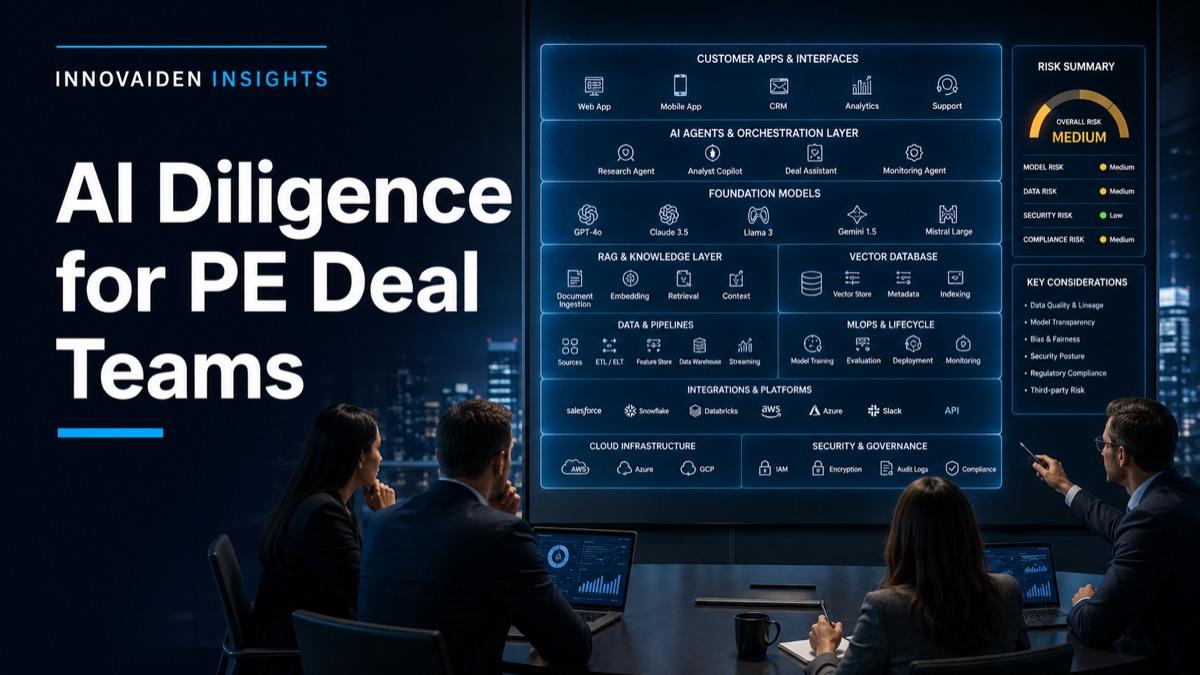
AI Boom, Security Bust: How Deal Teams Should Diligence AI-Heavy Targets
Private equity and corporate deal teams are seeing a rising share of targets whose value story depends on AI capability. Enterprise software portfolios now include AI-native products. Industrial targets are pricing in automation. Service businesses are projecting margin expansion from AI-driven efficiency. In nearly every case, the diligence process was not designed for any of this.
Key Takeaways
- 53% of surveyed IT and business decision makers say their organisation has encountered a critical cybersecurity issue or incident during an M&A deal that put the deal in jeopardy (Forescout, The Role of Cybersecurity in M&A Diligence, June 2019, n=2,779). That is a share of respondents, not a share of deals
- Only 29% of organizations feel ready to deploy agentic AI securely despite 83% planning to do so (Cisco, State of AI Security 2026). Both figures are shares of the same surveyed population, so on those base rates an acquisition target is more likely than not to be in the unready group
- The Salesloft-Drift OAuth compromise potentially impacted over 700 organizations downstream (Google Threat Intelligence Group, August 2025); AI-heavy targets introduce similar concentration risk
- EU AI Act high-risk obligations now apply 2 December 2027 (Article 6(2) Annex III) and 2 August 2028 (Article 6(1) Annex I) under the Digital Omnibus deferral, with fines up to 3% of global turnover or EUR 15M for high-risk obligations, and up to 7% or EUR 35M for the Article 5 prohibited practices; the Commission's 19 May 2026 draft Article 6 guidelines read the 6(3) exceptions narrowly — target AI non-compliance transfers on close
- 86% of corporate/PE organizations have integrated GenAI into their M&A workflows (Deloitte, 2025), but 67% cite data security as the leading deployment barrier — meaning the buyer's own diligence stack now has the same risk surface it's evaluating in targets
The Diligence Stack Is Now AI-Augmented On Both Sides
Two reference points published since this article was first drafted reset the landscape. Deloitte's 2025 GenAI in M&A Survey (released late 2025) reports that 86% of corporate and PE organizations have integrated generative AI into M&A workflows, with synthesis, document review, and red-flag detection the leading use cases. 67% cite data security as the leading deployment barrier — the same concern deal teams should be raising about their targets is the concern those teams are wrestling with internally. In March 2026, DiligenceSquared raised a $5M seed to build commercial-DD AI tooling specifically for PE deal teams — a fundable signal that AI-native diligence is moving from optional accelerator to expected capability.
The implication for the diligence framework below: every question you ask about a target's AI hygiene now has a mirror question about your own. If your AI vendor stack handles the deal data differently than the target's AI vendor stack handles customer data, the integration risk lands inside your own walls before it lands in the portfolio.
Where AI Risk Hides in a Typical Data Room
AI risk rarely shows up in the data room tree as a folder labeled "AI risk." It is distributed across four locations that deal teams routinely review without connecting them.
| Data Room Section | What to Look For | AI Risk Signal |
|---|---|---|
| Product / Technology | Architecture diagrams, third-party service listings, API documentation | Every reference to a model provider, vector database, agent framework, or LLM orchestration tool is an AI risk surface |
| Vendor / Contracts | AI vendor contracts (OpenAI, Anthropic, Google, hosting providers) | Data processing terms, residual training-data rights, termination clauses |
| Legal | Regulatory filings, correspondence, IP litigation, privacy complaints | AI-related matters the target may have minimized in the management narrative |
| HR / Operations | Employee agreements, customer terms, vendor agreements | Language governing AI use on the platform; mismatches between stated and contractual AI permissions |
Red-Flag Patterns Deal Teams Should Surface
Ungoverned agent sprawl. The target has deployed AI agents across functions without an inventory, permission reviews, or a lifecycle process. Surfacing question: how many agents are in production, who owns each, and when was the last access review. If the answer is partial, the sprawl is the finding.
Data residency chaos. The target processes regulated data through AI providers whose infrastructure sits in jurisdictions that do not match data residency obligations in customer contracts or applicable regulation. Particularly acute when the target sells into EU markets and uses US-based AI providers without appropriate data transfer mechanisms.
Vendor lock-in with weak controls. The target depends on a single AI vendor for a critical capability with no fallback, no exit terms, and no internal capability to replicate the function. If the vendor changes pricing, terms, or availability, the target's economics change materially.
Training data provenance gaps. The target cannot produce, on reasonable notice, the source and licensing posture of the data used to train its proprietary models. The IP and regulatory exposure is enforcement-ready for EU AI Act Annex III obligations from 2 December 2027 and Annex I product-route obligations from 2 August 2028 under the Digital Omnibus deferral.
"Out of scope by contract" claims that do not survive the new guidelines. The European Commission's 19 May 2026 draft Article 6 classification guidelines read the four Article 6(3) exceptions narrowly and require that instructions, technical documentation, and marketing materials all describe the same intended purpose. Targets with portfolios of AI tools labelled "not for high-risk use" via terms-of-service disclaimers — but marketed or deployed for Annex III contexts (CV screening, credit scoring, essential services) — carry an undiagnosed compliance liability that transfers on close. For the full read of the draft and what it changes for procurement and deployment, see the EU's high-risk AI filter: inside the May 2026 draft guidelines.
Agent-to-production access without human approval. The target has AI agents with direct write access to customer environments, financial systems, or production databases with no human approval layer. This is an incident vector, not a capability. For the security baseline shift that AI has created, uncontrolled agent access in a target is a material finding.
The Six-Question AI/Cyber Diligence Framework
Six questions, applied to every AI-relevant target:
| # | Question | Output |
|---|---|---|
| 1 | What AI capabilities are in production, and what do they depend on? | Inventory (not a summary) |
| 2 | What data do those capabilities process, and under what legal basis? | Regulatory map |
| 3 | Who has accountability for each AI capability, and what is the governance process? | Named owners (not functions) |
| 4 | What incidents have occurred in the last 24 months, disclosed or not? | Incident register (non-disclosure becomes a representation issue) |
| 5 | What contractual obligations does the target have regarding AI use, and are they being met? | Gap map |
| 6 | What integration risks exist when connecting acquirer and target environments post-close? | Agent access scope, vendor concentration, data flow exposure |
The output is a red/yellow/green assessment by category, supported by diligence evidence, usable in the investment committee conversation. For the complete cybersecurity due diligence methodology and how PE firms typically miss critical findings, AI diligence extends rather than replaces the existing framework.
How This Integrates With Existing Cyber Diligence
AI diligence is not a separate workstream. Every AI system is a cyber asset. The cyber asset inventory and the AI inventory are the same list. An AI incident is a cyber incident. Remediation of AI-specific issues uses the same framework as general cybersecurity. Deal teams that fold AI into a consolidated cyber diligence process produce an investment committee narrative that is clearer and more defensible.
The AI/Cyber Diligence Framework includes the red/yellow/green assessment matrix, the integration risk checklist, and the post-close remediation scoping template.
Strengthen Your AI/Cyber Due Diligence
Innovaiden works with leadership teams deploying AI agents across their organizations, from initial setup and training to security framework alignment and governance readiness. Reach out to discuss how we can help your team.
Get in TouchFrequently Asked Questions
Where does AI risk hide in a typical data room?
AI risk is distributed across four locations that deal teams routinely look at without connecting them: the product/technology section (architecture diagrams revealing AI dependencies), the vendor/contracts section (AI provider terms with residual training data rights), the legal section (AI-related regulatory filings minimized in the narrative), and the HR/operations section (employee and customer agreements governing AI use).
What are the top red-flag patterns in AI-heavy targets?
Five patterns: ungoverned agent sprawl (agents deployed without inventory or lifecycle management), data residency chaos (regulated data processed through AI providers in non-compliant jurisdictions), vendor lock-in with weak controls (single-vendor dependency with no exit terms), training data provenance gaps (inability to document data sources for proprietary models), and agent-to-production access without human approval gates.
What six questions form the AI/cyber diligence framework?
What AI capabilities are in production and what do they depend on (inventory, not summary). What data do those capabilities process and under what legal basis. Who has accountability for each AI capability. What incidents have occurred in the last 24 months. What contractual obligations exist regarding AI use. What integration risks exist when connecting acquirer and target environments post-close.
Why should AI diligence be integrated into cyber diligence rather than run separately?
Every AI system is a cyber asset. The cyber asset inventory and the AI inventory are the same list. An AI incident is a cyber incident. The incident logs should be the same log. Deal teams that treat AI as a separate diligence category end up doing the work twice. Teams that fold AI into consolidated cyber diligence produce an investment committee narrative that is clearer and more defensible.
What is the post-close integration risk specific to AI-heavy acquisitions?
Three specific risks: the target's AI agents gain access to acquirer systems (blast radius of a compromised agent expands), vendor relationships combine and create concentration risk (a single AI vendor now supports a material share of portfolio operations), and data flows integrate creating new regulated-data exposure (a US target whose AI capabilities now process EU customer data under the acquirer's ownership).
Related Insights
Sources
- Forescout. The Role of Cybersecurity in M&A Diligence. June 2019 (n=2,779, seven countries).
- Datasite - Virtual Data Room Insights 2026
- Cloud Security Alliance and Oasis Security - State of NHI and AI Security Survey Report, January 2026
- Cloud Security Alliance - 82% of Enterprises Have Unknown AI Agents in Their Environments (April 2026)
- European Commission - EU AI Act Implementation and Enforcement
- McKinsey - Gen AI in M&A, February 2025
- Deloitte. 2025 GenAI in M&A Survey (1,000 senior corporate and PE leaders). 2025.
- Fintech Global — DiligenceSquared targets PE due diligence with $5M raise. March 10, 2026.
- European Commission — Draft Commission guidelines on the classification of high-risk AI systems. 19 May 2026.
- Cisco. State of AI Security 2026. 2026. The 83%/29% readiness pair draws on the Cisco AI Readiness Index 2025 (8,000+ senior IT and business leaders, 30 markets, double-blind, published 14 October 2025); both percentages are shares of the same surveyed population.
- Google Threat Intelligence Group — Widespread Data Theft Targets Salesforce Instances via Salesloft Drift. August 2025. 700+ organizations potentially impacted.