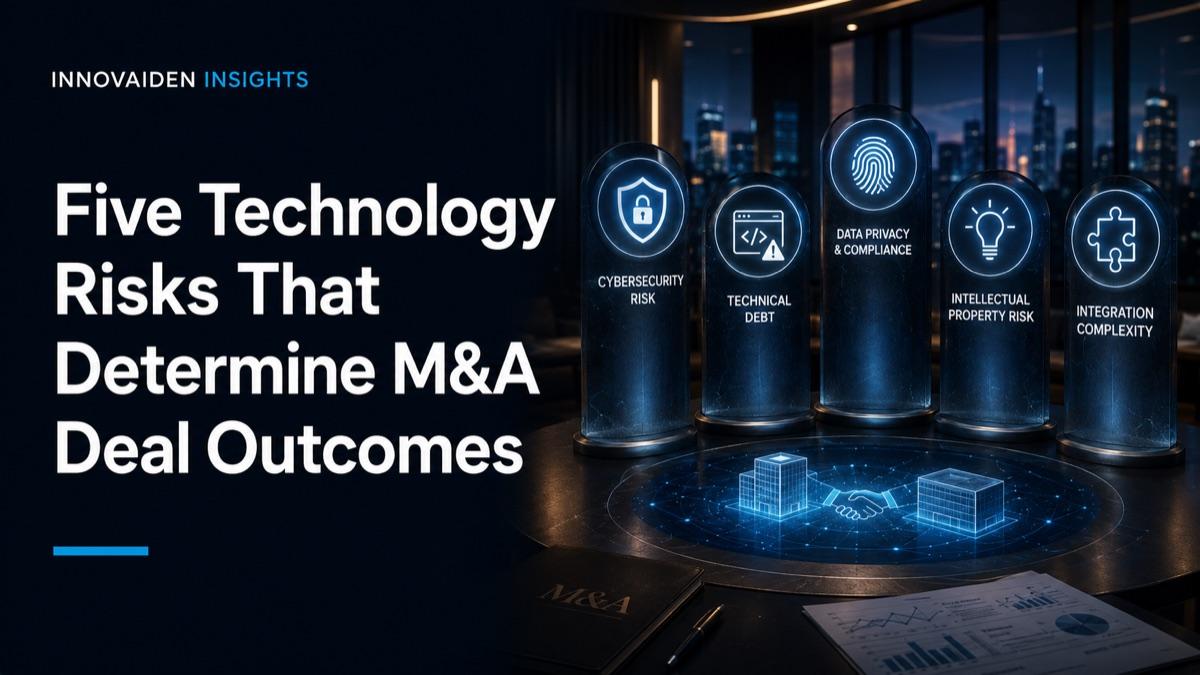
Five Technology Risks That Determine M&A Deal Outcomes
Five technology risk categories consistently determine whether M&A transactions achieve their projected returns, and they surface repeatedly across middle-market deals regardless of industry. Identifying and quantifying them during diligence protects buyer economics; in our engagements, missing them post-close has reduced IRR by an average of 8-12 percentage points.
Key Takeaways
- Five risk categories dominate: cybersecurity vulnerabilities, technical debt, privacy compliance gaps, IP ownership ambiguity, and integration complexity, each capable of driving 8-25% valuation adjustments in our engagement experience
- Expected Annual Loss (EAL) modeling translates cybersecurity findings into financial deal terms: probability × impact across identified scenarios produces the $2-8M risk exposure figures we typically see for material findings
- Technical debt directly constrains growth, and in the high-debt organizations we have assessed, companies spending 55%+ of engineering time on maintenance (against a roughly 30% norm) cannot execute the product roadmap underpinning the acquisition thesis
- Privacy compliance gaps create non-negotiable regulatory risk: GDPR fines reach 4% of global revenue; CCPA penalties run $7,500 per intentional violation; first-year remediation for mid-market SaaS targets runs $500K-900K
- Integration complexity is routinely underestimated: in our engagements, monolithic architectures with shared databases have extended integration timelines from a planned 9-12 months to 18-36 months, with cost overruns of 50-100%
Risk 1: Cybersecurity Vulnerabilities
Cybersecurity risks are present in virtually every middle-market M&A target. The relevant question is not whether vulnerabilities exist, they always do, but whether management knows about them, whether systematic remediation processes are in place, and what the financial exposure looks like if exploited.
Common findings include unpatched systems with publicly known exploits, absent multi-factor authentication on administrative accounts, misconfigured cloud storage exposing customer data, and former employee accounts still active months after termination. Each has a predictable financial consequence.
For a mid-market SaaS company with 100,000 customer records and inadequate security controls, a single breach has typically generated costs across the categories below. The ranges reflect Innovaiden's own engagement experience rather than a published benchmark study:
| Cost Component | Estimated Range |
|---|---|
| Customer notification | $2M-$5M |
| Credit monitoring (2 years) | $3M-$8M |
| Forensics and legal response | $0.6M-$1.4M |
| Regulatory penalties | $0.5M-$2M |
| Total direct exposure | $6M-$16M |
In our middle-market engagements, material cybersecurity findings have typically driven 8-25% purchase price adjustments and $3-8M holdbacks over 24 months.
The PowerSchool/Bain inflection. On March 18, 2026, a US federal court (S.D. Cal., In re PowerSchool Holdings, Inc. and PowerSchool Group, LLC Customer Security Breach Litigation, No. 3:25-md-03149-BEN-MSB) let plaintiffs' negligence and aiding-and-abetting claims against Bain Capital itself proceed over the 2024 PowerSchool breach. This is the first US ruling to advance sponsor-level liability claims for a portfolio company's cyber failure. The cost ceiling for weak diligence is no longer a write-down or a holdback — it is the sponsor named in the suit. For the five-layer operational defense, see the practitioner's playbook after Bain/PowerSchool; for the broader PE diligence methodology, see cybersecurity due diligence in M&A.
Risk 2: Technical Debt and Scalability Constraints
Technical debt, accumulated shortcuts, outdated architecture, and deferred modernization, directly constrains the growth plan underpinning most M&A valuations. In the high-debt engineering organizations we have assessed, teams spend 55%+ of capacity on maintenance, leaving insufficient bandwidth for the product development that justifies acquisition price.
Warning signals visible in external assessment: monolithic architecture for a SaaS product, outdated runtime versions, large numbers of open source dependencies without version tracking, and absence of CI/CD infrastructure.
Remediation investment scales with platform age:
| Architecture Age | Modernization Investment | Timeline |
|---|---|---|
| 3-5 years | $500K-$2M | 6-12 months |
| 5-8 years | $2M-$5M | 12-18 months |
| 8+ years | $5M-$15M | 18-36 months |
These costs should enter the financial model as working capital adjustments, not post-close surprises.
Risk 3: Privacy Compliance Gaps
Privacy compliance gaps create categorical regulatory risk. GDPR fines reach 4% of global annual revenue. CCPA penalties run $7,500 per intentional violation. HIPAA settlements average $2-5M per violation category per year. Companies operating across EU, US, and APAC markets frequently accumulate compliance debt without realizing it.
Common patterns: consent mechanisms that don't meet GDPR's "freely given" standard, retention schedules that exceed legal limits, and third-party data sharing without adequate contractual protection. None of these appear on management balance sheets.
First-year remediation for a SaaS company with meaningful EU exposure typically runs $500K-900K. The ongoing compliance program adds $200K-500K annually, a permanent operating cost the financial model must reflect.
Risk 4: Intellectual Property Ambiguity
IP ambiguity is among the most frequently underestimated risks in technology M&A. The core value of most software companies sits in code, and that code's legal ownership is often less clear than founders assume.
Three patterns appear regularly:
| Issue | Prevalence | Risk |
|---|---|---|
| Founder IP not formally assigned to company entity | Common in early-stage development | Core codebase may not be owned by the target |
| GPL/AGPL components in proprietary products | Frequent in full-stack applications | "Copyleft" obligations can void commercial licensing |
| Contractor-developed code without work-for-hire agreements | Widespread pre-2018 | IP ownership contested without written assignment |
IP ambiguity does not always kill deals, but in our experience it has consistently required escrow arrangements in the $2-5M range until legal remediation is confirmed, creating timeline risk and deal uncertainty.
Risk 5: Integration Complexity
Integration complexity is the risk most frequently underestimated in LOI negotiations because it depends not just on the target's architecture, but on the acquirer's. A target with well-designed microservices may present trivial integration challenges to one buyer and substantial ones to another.
Patterns that drive integration overruns: flat network architectures incompatible with the buyer's SOC 2 compliance requirements, incompatible identity platforms requiring SSO migration, SIEM conflicts requiring platform consolidation, and data governance practices that violate the acquirer's privacy commitments.
In our engagement experience, integration cost overruns of 50-100% are common when diligence relies on architectural documentation alone. Technical assessment that identifies specific incompatibilities at the domain level enables accurate budgeting and credible revised IRR projections.
What This Means in Practice
Deal teams that quantify these five risk categories during diligence, not after close, make informed pricing decisions, build appropriate deal structures, and avoid post-close surprises that erode the returns they projected. Each category has a translation into deal terms: EAL modeling for cybersecurity, working capital adjustments for tech debt, escrow requirements for IP ambiguity, and integration cost revisions for architecture gaps. For the complete cybersecurity assessment methodology, see our practitioner's framework for M&A due diligence. For how findings translate into deal structure and valuation protection, see how cybersecurity due diligence protects deal value. For targets deploying AI agents, an emerging risk category, see the enterprise AI agent security risks.
The M&A Technology Risk Assessment Checklist covers the evaluation framework for each category, including specific data points to request, questions to put to management, and remediation cost benchmarks for deal modeling.
Download the M&A Technology Risk Assessment Checklist
Reach out and we'll send the M&A Technology Risk Assessment Checklist directly to your inbox.
Request M&A Technology Risk Assessment ChecklistFrequently Asked Questions
What are the five technology risks that most commonly determine M&A deal outcomes?
Cybersecurity vulnerabilities, technical debt and scalability constraints, privacy compliance gaps, intellectual property ownership ambiguity, and integration complexity are the five categories that consistently surface across middle-market deals. In our engagement experience, each is capable of driving 8-25% valuation adjustments, and technology-related post-close surprises have reduced IRR by an average of 8-12 percentage points. Those figures reflect Innovaiden's own middle-market deal work rather than a published benchmark study.
How is technical debt quantified in an M&A valuation?
Technical debt translates into working capital adjustments based on modernization investment estimates scaled to platform age: $500K-$2M for platforms 3-5 years old (6-12 month remediation), $2M-$5M for 5-8 year old platforms, and $5M-$15M for architectures 8 or more years old requiring 18-36 months of work. Warning signals visible externally include monolithic SaaS architecture, outdated runtime versions, and absence of CI/CD infrastructure.
What privacy compliance issues commonly surface during technology due diligence?
The most common findings are consent mechanisms that do not meet GDPR's freely given standard, data retention schedules exceeding legal limits, and third-party data sharing without adequate contractual protection. GDPR fines reach 4% of global annual revenue; CCPA penalties run $7,500 per intentional violation. First-year remediation for a SaaS company with meaningful EU exposure typically costs $500K-$900K, with an ongoing compliance program adding $200K-$500K annually.
How does intellectual property ambiguity affect deal structure?
IP ambiguity - where core codebase ownership is unclear due to unassigned founder IP, GPL or AGPL open-source components in proprietary products, or contractor-developed code without work-for-hire agreements - consistently requires $2-5M escrow arrangements until legal remediation is confirmed. It does not always kill deals but creates timeline risk and adds deal uncertainty until resolved.
Related Insights
Sources
Figures attributed to Innovaiden engagement experience reflect our own middle-market deal work and are not drawn from a published benchmark study.
- IBM - Cost of a Data Breach Report 2023
- European Commission - GDPR Fines and Enforcement
- California Attorney General - CCPA Enforcement and Penalties
- HHS OCR. HIPAA Enforcement Actions and Settlements. hhs.gov. 2025.
- AICPA - SOC 2 Type II Reporting Framework
- Womble Bond Dickinson — Unprecedented: PE Firm Potentially on the Hook for Portfolio Company's Data Breach (Bain / PowerSchool). 2026.
- Bloomberg Law — Bain Struggles to Dismiss PowerSchool Data Breach Claims. March 2026.