The Apollo Breach Shows PE Sponsors Are Now the Target
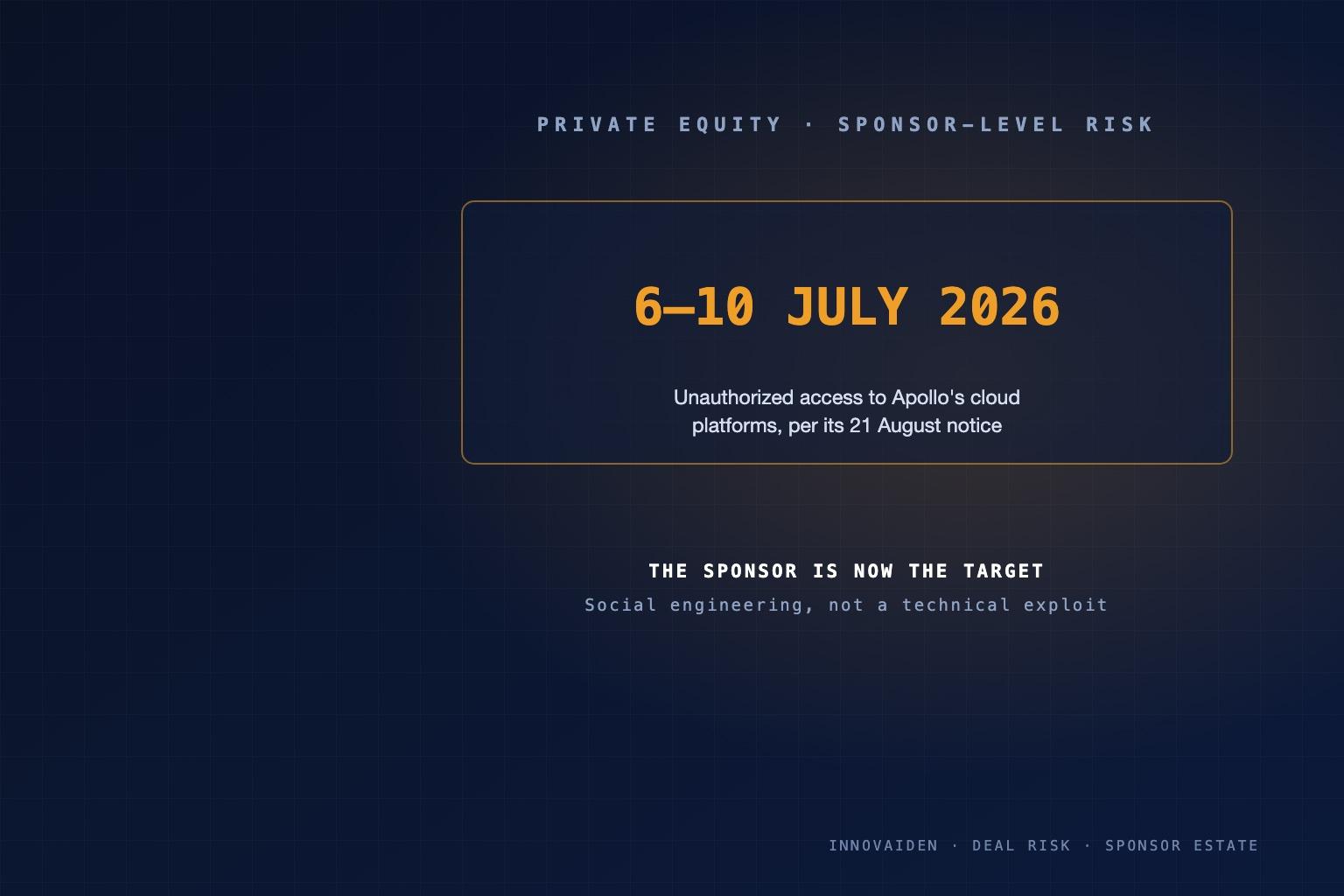
On 21 August 2026, Apollo Global Management confirmed that hackers had reached its cloud platforms. In a notice of data breach filed with California's attorney general and signed by Matthew Breitfelder, the firm's Global Head of Human Capital, Apollo said it had experienced a social engineering incident and had determined that there was unauthorized access to certain cloud platforms between 6 July and 10 July 2026. It said it learned on 12 August that the potentially affected information included names, dates of birth, contact information, home addresses and Social Security numbers.
Fifteen days earlier, on 6 August 2026, Google Threat Intelligence Group published a report on an extortion cluster it tracks as UNC6671, which by July had narrowed its targeting to private equity firms, law firms and financial rating agencies. The entry technique in that report is a phone call: callers pose as the firm's IT helpdesk, reach an employee on a personal mobile, and talk them through a fake security enrolment.
Private equity firms are used to treating the portfolio as their cyber exposure. This summer's campaign is aimed one level up, at the sponsor's own estate: the firm's cloud tenancy and everything a single employee login can reach inside it, from deal files and investor records to HR data and the credentials operating partners hold for portfolio systems.
Key Takeaways
- Apollo's notice, dated 21 August 2026, reports unauthorized access to certain cloud platforms between 6 and 10 July 2026 through social engineering, with names, dates of birth, addresses and Social Security numbers potentially affected. It does not state how many people are affected or name an attacker
- Apollo has not attributed the breach. Reuters reported on 6 August that hackers had built password-stealing sites aimed at employees of Apollo, Blackstone, KKR and others, and could not establish which firms were compromised
- The entry point is a conversation. Google describes callers posing as IT helpdesk staff, reaching employees on personal phones, with a pretext of urgent passkey or MFA enrolment. Google's analyst told Reuters: "Sophisticated is not the right word. It is just really effective"
- The economics are documented. Google reviewed 18 BlackFile Bitcoin wallets that received about 10.69 million dollars between 7 January and 12 May 2026
- Notification duties are already in force. Amended Regulation S-P sets a 30-day outer limit for notifying affected individuals, and has applied to larger registered advisers since 3 December 2025 and smaller ones since 3 June 2026
- Limited partners already have the question. The ILPA Due Diligence Questionnaire 2.0 asks for five years of cyber breach history at the firm and its portfolio companies, including what was communicated to limited partners
What Apollo Disclosed, and What It Did Not
The notice is short. Apollo wrote that, "similar to other financial services firms," it had recently experienced a social engineering incident. On detecting it, the firm said, it notified law enforcement, engaged outside forensic experts and opened an investigation, which remains ongoing. Apollo said it had no evidence that the information had been publicly posted or used for identity theft or fraud, and offered recipients 24 months of credit monitoring.
The access window was 6 to 10 July. Apollo says it learned which data types were potentially involved on 12 August. The letter is dated 21 August. The notice does not say when the intrusion was detected.
The gaps are as informative as the content. The letter does not say how many individuals are affected. As TechCrunch noted, it does not say who they are, whether Apollo employees or individuals at companies it owns. It does not describe the technique, name an attacker, or mention an extortion demand. TechCrunch reported that an Apollo spokesperson did not immediately answer questions, including whether the firm paid a ransom.
The link between Apollo and the wider campaign is therefore circumstantial. Apollo's name appeared among the firms Reuters identified on 6 August as targeted, and Reuters described it on 21 August as one of many US financial institutions recently targeted by ransom-seeking hackers who use phone calls. Apollo itself has said only "social engineering".
The Campaign Around It: UNC6671 and the BlackFile Brands
Google's 6 August report describes a cluster, UNC6671, that it says kept operating after the announced retirement of the BlackFile extortion brand in May 2026, spreading across further brands named Redact, Pink, Helix and Falcon. Google assesses that a common group of threat actors is affiliated with those brands and that the activity "most likely reflects a coordinated group of threat actors operating multiple public extortion brands", while noting that splintered affiliates or shared phishing-as-a-service infrastructure are also plausible.
The targeting moved in stages, per Google. By July, the profile "narrowed to focus on the financial and legal sectors, with observed infrastructure directed at private equity firms, law firms, and financial rating agencies." Google's reading of the motive is that organizations involved in mergers, acquisitions, capital deployment and litigation hold confidential data that maximises extortion leverage. Austin Larsen, principal threat analyst at Google Threat Intelligence Group, told Cybersecurity Dive that the primary driver is the extreme sensitivity of the data these firms hold, and that their cyber insurance feeds a perception that they will pay.
Reuters added the names. Using Google's list of 72 malicious websites and web intelligence platforms, it reported on 6 August that hackers had built sites designed to steal passwords from employees of Blackstone, Bridgewater Associates, Apollo Global Management, Bain Capital, KKR, TPG, CME Group, Clearlake Capital and Moody's, among traps set for more than 200 companies in the preceding five weeks. Reuters could not establish which were successfully compromised, and Larsen told the agency the subdomains were likely used in attempted intrusions that "were not all successful". A target list is not a victim list.
Google reviewed 18 BlackFile Bitcoin wallet addresses that received 141.65 BTC, about 10.69 million dollars at the time of the transactions, between 7 January and 12 May 2026. Initial demands typically ran from 1 million to upwards of 3 million dollars, and operators often agreed to reductions of 50% to 75%.
Why the Entry Point Is a Phone Call, Not an Exploit
The technique Google describes has no software vulnerability in it. Callers reach targeted employees on their personal mobile numbers, circumventing corporate security controls, and in at least some recent cases spoof the firm's legitimate helpdesk number. The pretext is an urgent helpdesk mandate to enable FIDO2 passkeys or update multi-factor authentication enrolment. The employee is directed to a lookalike domain, where an adversary-in-the-middle panel captures credentials and authentication tokens. Automated scripts then extract data from enterprise cloud environments, with Microsoft 365 and Okta named in the report, and the operators delete password-reset confirmations and security alerts to delay discovery.
Note the direction of the impersonation. The attacker is not persuading the help desk to reset an account. The attacker is the help desk, as far as the employee can tell, and the story is a security upgrade. A firm that has trained its service desk to verify callers has addressed the inbound half of the problem. This campaign runs on the outbound half: whether an employee has any way to verify that a call from IT is genuine.
Google's first recommendation is accordingly architectural. Phishing-resistant authenticators bind the credential to the genuine domain, which Google says renders lookalike domains and adversary-in-the-middle proxies ineffective. The rest of its list includes session controls, sign-in restricted to managed devices, and monitoring identity-provider logs for new factor enrolments.
What the Sponsor's Own Estate Contains
A private equity firm is a small organization holding a dense concentration of other people's confidential information: live deal material under NDA, valuation models, investor records, personnel data, and the access its professionals hold to portfolio company systems, board portals and data rooms. Google's assessment is that this density is the point of the targeting.
It also means the exposure we examined in the Bain Capital and PowerSchool ruling now runs in both directions. That case concerns a sponsor named in litigation over a portfolio company's breach. A breach of the sponsor is the inverse: the firm is the entry point, and whatever it holds about targets, portfolio companies and investors is what leaves. The diligence disciplines set out in what PE firms miss before close and in our AI diligence framework for deal teams were written to be pointed at targets. They apply equally to the firm doing the pointing.
Notification Duties That Already Apply at Firm Level
The Apollo letter is a notice to individuals, filed with a state attorney general. For SEC-registered advisers, a federal layer now sits alongside state breach law.
Amended Regulation S-P, adopted by the SEC on 16 May 2024, requires covered institutions to maintain written policies and procedures for an incident response program designed to detect, respond to and recover from unauthorized access to customer information. It requires notice to individuals whose sensitive customer information was, or is reasonably likely to have been, accessed or used without authorization, as soon as practicable and not later than 30 days after the institution becomes aware. Service providers must be required to notify the covered institution no later than 72 hours after becoming aware of a breach of a customer information system they maintain.
The compliance dates have both passed: 3 December 2025 for larger entities, which for registered investment advisers means 1.5 billion dollars or more in assets under management, and 3 June 2026 for smaller entities. The adopting release is explicit about private markets: registered advisers to private funds are covered institutions, while private funds relying on sections 3(c)(1) or 3(c)(7) of the Investment Company Act are not themselves subject to the rule, though they may fall under the FTC Safeguards Rule. Apollo's notice does not say which regimes it was made under, and we draw no conclusion on that point.
Two consequences follow for a sponsor. First, the rule's notice duty concerns information about individuals. Deal files and an institutional investor's commercial information are governed by contract: NDAs, limited partnership agreements and side letters. Second, the examination programme is already looking. As we noted in our reading of the SEC's fiscal year 2026 examination priorities, the Division of Examinations listed access controls, account management, responses to cyber incidents and compliance with the 2024 Regulation S-P amendments among its priorities. Willkie Farr and Gallagher's 17 August client alert on the vishing wave makes the practical point: decide in advance who assesses regulatory notification obligations, contractual notices and law-enforcement engagement.
What Limited Partners Will Ask in the Next DDQ
Limited partners do not need a new instrument. The Institutional Limited Partners Association (ILPA) Due Diligence Questionnaire 2.0, published in November 2021, asks at item 18.5 whether the firm or any of its portfolio companies has had any cyber breaches in the last five years. Item 18.5.1 asks for the scope, cause, detection, response and resolution, the fixes implemented, and "the communication provided to Limited Partners surrounding the breach."
After August 2026, a general partner should expect those questions to be read against the firm itself, and a contained attempt to draw the same curiosity as a breach. The credible answer is specific: what authentication is enforced, how an enrolment or reset is verified, when the pattern was last exercised, and what investors were told and when.
What the Managing Partner, COO, CCO and Operating Partners Should Verify
Managing partner: make the firm's own estate an agenda item. Ask for a one-page answer to a single question: if one professional's account were taken over on a Friday evening, what could be read and exported by Monday?
COO and CCO: test the outbound help desk channel. Confirm that phishing-resistant authentication is enforced for every user, partners included, and that there is one published way for staff to verify a call claiming to be IT, such as hanging up and calling back through a known internal route. Confirm that any new authentication factor enrolment generates an alert someone reviews. Then run the exercise: a controlled call to personal mobiles using the passkey enrolment pretext Google describes.
COO and CCO: write the notification map before it is needed. One page listing each obligation, its trigger, its clock and its owner: Regulation S-P where it applies, state breach laws, limited partnership agreement and side letter clauses, NDAs covering live deals, and the cyber insurance policy's notice conditions. Willkie recommends a tabletop exercise that includes human resources alongside legal, compliance and information security. Apollo's letter was signed by its head of human capital.
Operating partners: inventory the access you carry. List every portfolio company system, board portal and shared workspace reachable from a sponsor identity, and remove what is not in use. A sponsor login that opens a portfolio company's environment makes the sponsor's help desk problem the portfolio's problem. Then draft the answer to ILPA item 18.5 as it would read today.
The Sponsor Estate Vishing Readiness Review covers that ground as a defined exercise: identity enrolment and reset controls, the reach of a single compromised account, a live help desk impersonation test, and the notification map with named owners.
Test the Sponsor's Own Estate Before a Caller Does
Innovaiden reviews the private equity firm's own environment against the help desk impersonation pattern now aimed at sponsors: how identity enrolment and resets are verified, what a single hijacked account can reach across deal, investor, HR and portfolio systems, and whether the notification map for regulators, individuals and limited partners is written down before it is needed. Reach out to scope it against your firm.
Get in TouchFrequently Asked Questions
What did Apollo Global Management disclose on 21 August 2026?
In a notice of data breach dated 21 August 2026 and filed with California's attorney general, Apollo said it had experienced a social engineering incident and had determined there was unauthorized access to certain cloud platforms between 6 July and 10 July 2026. Apollo said it learned on 12 August 2026 that the potentially affected information included names, dates of birth, contact information, home addresses and Social Security numbers. The letter is signed by Matthew Breitfelder, Global Head of Human Capital. Apollo said it had no evidence the information had been publicly posted or misused. The notice does not say how many people are affected or name an attacker.
Was the Apollo breach part of the extortion campaign against private equity firms?
Apollo has not attributed the incident to any group. What is established is narrower. On 6 August 2026, Google Threat Intelligence Group reported that a cluster it tracks as UNC6671 had shifted by July 2026 to private equity firms, law firms and financial rating agencies. The same day, Reuters reported that hackers had built password-stealing websites aimed at employees of firms including Apollo, Blackstone, Bain Capital, KKR and TPG, and said it could not establish which firms were compromised. On 21 August, Reuters described Apollo as one of many institutions recently targeted by ransom-seeking hackers who use phone calls. Apollo's own letter says only that it was hit by social engineering, similar to other financial services firms.
How does the help desk vishing attack on private equity firms work?
According to Google Threat Intelligence Group's 6 August 2026 report, callers reach employees on their personal mobile numbers, posing as IT helpdesk staff and in some cases spoofing the firm's legitimate helpdesk number. The pretext is an urgent mandate to enable FIDO2 passkeys or update multi-factor authentication enrolment. The employee is sent to a lookalike domain running an adversary-in-the-middle panel that captures credentials and authentication tokens. The operators then use automated scripts to pull data from enterprise cloud environments, with Microsoft 365 and Okta named in the report, and delete password-reset confirmations and security alerts from the mailbox to delay detection. An extortion demand follows.
What does amended Regulation S-P require of a private equity adviser after a breach?
The SEC's amended Regulation S-P, adopted on 16 May 2024, requires covered institutions, which include SEC-registered investment advisers and therefore registered advisers to private funds, to maintain a written incident response program and to notify individuals whose sensitive customer information was, or is reasonably likely to have been, accessed without authorization. Notice is due as soon as practicable, and not later than 30 days after the institution becomes aware. Larger entities, including advisers with 1.5 billion dollars or more in assets under management, had to comply by 3 December 2025; smaller entities by 3 June 2026. Private funds relying on sections 3(c)(1) or 3(c)(7) are not themselves subject to the rule.
What should limited partners ask a general partner about firm-level cyber incidents?
The Institutional Limited Partners Association's Due Diligence Questionnaire 2.0, published in November 2021, already contains the question. Item 18.5 asks whether the firm or any of its portfolio companies has had any cyber breaches in the last five years, and item 18.5.1 asks for scope, cause, detection, response and resolution, the fixes implemented, and the communication provided to limited partners about the breach. After August 2026, the useful supplements are specific: how identity enrolment and resets are verified, whether phishing-resistant authentication is enforced firm-wide, and when the last help desk impersonation exercise was run.
Related Insights
Sources
- Apollo — Notice of Data Breach, as filed with the California Attorney General. 21 August 2026. Supports the 6 to 10 July 2026 access window, the 12 August determination, the data types, the 24 months of credit monitoring, the signatory and the quoted wording.
- TechCrunch — Private equity firm Apollo confirms data breach amid hacking wave targeting financial giants. 21 August 2026. Supports the California filing, the observation that the letter does not say who was affected, and the unanswered ransom question.
- Reuters via The Star — Apollo Global reveals data breach after hackers target financial firms. 21 August 2026. Supports the description of Apollo as one of many institutions targeted by ransom-seeking hackers who use phone calls.
- Reuters via The Star — Hackers targeted US private equity, other firms including Blackstone, CME, data shows. 6 August 2026. Supports the named target firms, the 72 websites, the more than 200 companies, the statement that Reuters could not establish which firms were compromised, and the Larsen quotations.
- Google Threat Intelligence Group — UNC6671 Rebrands: Multi-Brand Vishing Extortion Targets Financial Services and Enterprise Cloud Environments. 6 August 2026. Supports the UNC6671 attribution and its hedges, the sector timeline, the technique, the 18 wallets and 10.69 million dollar figure, the demand and reduction figures, and the mitigations.
- Cybersecurity Dive — Former BlackFile affiliates linked to extortion campaign targeting private equity. 11 August 2026. Supports Austin Larsen's title and his comments on data sensitivity and cyber insurance.
- Willkie Farr and Gallagher — Vishing, The New Phishing: Different Tactics, Same Strategic Goals. 17 August 2026. Supports the recommended legal notification workflow and tabletop exercise participants.
- SEC — Enhancements to Regulation S-P: A Small Entity Compliance Guide. 2024. Supports the 30 days notice limit, the 72-hour service provider notice, and the 3 December 2025 and 3 June 2026 compliance dates.
- SEC — Regulation S-P: Privacy of Consumer Financial Information and Safeguarding Customer Information, Release No. 34-100155. 16 May 2024. Supports the 1.5 billion dollar larger-entity threshold for registered investment advisers and the treatment of private funds and their registered advisers.
- SEC — SEC Adopts Rule Amendments to Regulation S-P to Enhance Protection of Customer Information. 16 May 2024. Supports the adoption date, the covered institutions and the 30 days notice requirement.
- ILPA — Due Diligence Questionnaire 2.0. November 2021. Supports the wording of items 18.5 and 18.5.1.