CRA Exposure in M&A: A Proportionate Diligence Lens, Not a Conformity Audit
A product company with European customers now carries a regulatory obligation that did not exist three years ago, with a hard market-access deadline attached to it. For deal teams running technology and cyber diligence on those targets, the question is not whether the EU Cyber Resilience Act matters. It is how much diligence it warrants, and what to do with the answer.
The instinct to commission a full CRA conformity review in the diligence window is the wrong one. A conformity assessment is the target's own compliance project, measured in months and owned by its engineering and product organizations. It cannot be reproduced inside a deal timeline, and attempting it burns budget on certainty the transaction does not need. The proportionate move is the opposite: a small number of questions and observations that read the room, layered onto the tech and cyber diligence already underway, that produce a defensible hypothesis about the target's exposure. That hypothesis is then carried into the two places where it actually protects the buyer: the sale and purchase agreement, and the warranty and indemnity tower.
This is the same discipline that governs the rest of technology diligence. No one audits every line of a target's code; they sample, they read the signals, they form a view, and they price and paper the risk. CRA exposure belongs in that workflow as a lens, not as a new workstream.
Key Takeaways
- A full CRA conformity assessment is disproportionate in diligence and usually impossible in the timeline. The deal-team objective is a defensible hypothesis, not a certificate
- The CRA makes product-security posture a datable financial and market-access risk: from 11 December 2027, an in-scope product cannot be CE-marked, and cannot be sold in the EU, without conformity
- The screen is a lens on existing tech and cyber diligence, not a separate exercise. The signals you already gather (component hygiene, vulnerability handling, support commitments) feed the CRA view directly
- A few targeted questions read the room: in-scope status and role, SBOM maturity, vulnerability-handling evidence, support-period commitments, and dependence on unmanaged third-party code
- Findings flow into the SPA (product-compliance reps, disclosure scrape, price chip or specific indemnity for known gaps) and the W&I tower (where an un-diligenced gap is commonly an exclusion, and therefore uncovered)
- For platforms and buy-and-build, CRA remediation is multiplied across every product line and becomes a Day-100 integration cost
- Escalate to a scoped deep-dive only when the thesis depends on EU product revenue near the deadline, or the screen surfaces material gaps
Why CRA Is a Deal Issue, Not Just a Compliance One
The Cyber Resilience Act applies to products with digital elements placed on the EU market, and it carries two features that make it a diligence concern rather than a post-close compliance task.
The first is market access. From 11 December 2027, an in-scope product requires conformity to the CRA's essential requirements, a complete technical file, and CE marking to be placed on the EU market. A target whose European revenue depends on products that will not clear that bar in time does not have a compliance gap; it has a revenue-at-risk problem that lands inside the buyer's hold period. That is a valuation input.
The second is cost shape. Closing a CRA gap is not a single line item. It is conformity assessment, technical documentation, a formalized vulnerability-handling process, software-bill-of-materials tooling, and, for some product classes, third-party assessment by a notified body. For a single product that is a contained cost. For a platform acquisition or a buy-and-build thesis, it is that cost repeated across every acquired product line, plus the integration work to harmonize them onto one standard. The aggregate is the kind of capex and opex that belongs in the model, not in a surprise the operating partner meets at the first board meeting.
There is also a timing dimension that rewards looking early. The conformity-assessment bodies that the December 2027 deadline depends on are being designated across Member States through 2026, and every in-scope manufacturer in Europe is converging on the same date. A target that has not started is buying into a capacity queue at the worst possible moment. None of this is visible in a data room unless the diligence is scoped to look for it.
The Proportionate Principle
The governing idea is that diligence sizes the question to the deal, and the CRA question is almost always answerable at the level of a hypothesis rather than a verdict.
You are not certifying the target. You are forming a defensible view of three things: whether the target's products are in scope and under which provision, how far its current product-security posture is from what the CRA will require, and roughly what it would cost to close the distance. A hypothesis at that resolution is enough to decide whether CRA exposure is immaterial, whether it is a price-and-paper item, or whether it warrants a scoped deep-dive before signing. It is the same resolution at which deal teams already handle most technology risk.
This framing matters because it keeps CRA inside the diligence budget and timeline instead of competing with them. The screen does not add a workstream; it adds a reading to the workstream that is already running.
Reading the Room: The Few Questions That Matter
A CRA exposure screen rides on the tech and cyber diligence already commissioned. The signals it needs are mostly signals a competent technology review is gathering anyway; the screen reinterprets them through the CRA lens and adds a handful of targeted questions.
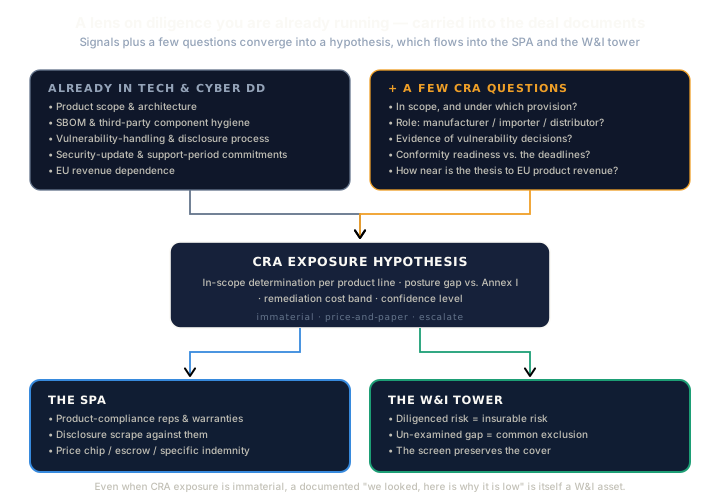
The questions that read the room, in roughly the order they pay off:
- In scope, and under which provision? Which products carry digital elements placed on the EU market, and is the target a manufacturer, importer, distributor, or open-source steward for each? This is the single most diagnostic question, and a target that cannot answer it crisply has told you something.
- Component hygiene. Is there a software bill of materials? Is third-party and open-source dependency managed, or merely present? The CRA's Annex I Part II makes this a process obligation, and its absence is a reliable proxy for broader unreadiness.
- Vulnerability handling, on the record. Is there a coordinated disclosure channel and a documented intake-to-remediation process, or activity without evidence? The September 2026 reporting clock cannot be met by an informal process, and the evidence trail is exactly what a buyer will want represented.
- Support and update commitments. Has the target defined and honored security-update support periods for its products? Vague or absent support commitments signal both a CRA gap and a customer-contract exposure.
- Thesis dependence. How much of the target's value rests on EU product revenue, and how near is that revenue to the deadline? This calibrates how much the answer matters.
These do not require source-code access or a compliance auditor. They require the diligence to be pointed at the right signals and a reviewer who knows what the answers imply.
From Signals to Hypothesis
The screen's output is a short, defensible read, not a compliance report. Its shape is consistent: an in-scope determination per material product line, a posture gap expressed against the two parts of Annex I, and a remediation cost band.
The translation is direct. No SBOM and unmanaged dependencies imply a build-out cost and a component-risk unknown. Informal vulnerability handling implies process work and a September-2026 readiness risk. Undefined support periods imply both engineering commitment and contract remediation. Each signal maps to an order-of-magnitude cost and a confidence level, and the aggregate is a hypothesis the deal team can act on: immaterial, price-and-paper, or escalate.
This is also where CRA exposure connects to the rest of the technology risk picture rather than sitting beside it. The same diligence that surfaces CRA signals is the diligence that surfaces architectural debt, security weaknesses, and integration cost; CRA is one more lens on the same evidence. For the broader frame on how product and cyber risk move deal value, see how cybersecurity due diligence protects deal value and the top technology risks in M&A due diligence. And because the CRA does not act alone, the same product evidence shapes a target's exposure under NIS2, DORA, the revised CSA, and the AI Act; the cross-framework picture is in Five Frameworks, One Vendor.
Carrying It Into the SPA and the W&I Tower
A hypothesis only protects the buyer if it changes the documents. CRA exposure has two destinations, and the second is the one most often missed.
In the SPA, the screen shapes the product-compliance and cybersecurity representations: conformity status, vulnerability-handling practice, open-source and SBOM hygiene, and the absence of known unremediated exposures. It drives the disclosure scrape against those reps, so that what the target knows is on the record. And for gaps the screen has already identified, it informs the remedy: a price adjustment, an escrow against remediation cost, or a specific indemnity for a known, quantified exposure. A general warranty is the wrong instrument for a gap you already found; a specific indemnity or price chip is the right one.
In the W&I tower, the point is sharper and frequently overlooked. Warranty and indemnity insurers cover the unknown, not the known, and they increasingly scrutinize cyber and compliance representations during underwriting. A risk that was not diligenced is commonly excluded from cover, and a CRA exposure that no one examined can therefore fall outside the policy entirely, leaving the buyer holding it with neither a priced remedy nor insurance behind the warranty. The proportionate screen is what keeps that from happening. It is the evidence that the representation was diligenced, which is the precondition for the insurer to stand behind it rather than carve it out. In other words, the light-touch work is not just about finding the gap; it is what preserves both the warranty position and the insurability of the risk.
This is why the screen earns its place even on deals where the CRA exposure turns out to be immaterial. A documented "we looked, and here is why it is low" is itself a W&I asset. The absence of that record is what converts a manageable risk into an uncovered one.
When to Go Deeper
Proportionality cuts both ways. A handful of deals do warrant more than a screen, and the trigger is the thesis, not the regulation.
Go deeper when the investment case depends materially on EU product revenue near the December 2027 deadline, when the target sells important or critical product classes that face third-party conformity assessment rather than self-assessment, or when the screen itself surfaces material signals: no SBOM, no disclosure process, unclear support periods, or a product assembled largely from unmanaged third-party components. Even then, the proportionate response is a scoped deep-dive on the specific products that carry the thesis, not a portfolio-wide audit. The goal remains a deal position, now with tighter cost bands and firmer confidence, not a conformity certificate the buyer does not need.
How Innovaiden Approaches It
The screen is designed to fold into a live process rather than sit alongside it. It takes the signals a technology and cyber diligence is already producing, adds the few CRA-specific questions that read the room, and returns a defensible in-scope hypothesis, a remediation cost band per material product line, and the specific reps, disclosure requests, and W&I positions that follow. On the operator side, the same instrument doubles as a readiness baseline for the target post-close, which is the subject of our companion piece, the CRA's first obligation gate and what readiness actually requires. The objective on the deal side is narrow and practical: make sure CRA exposure is read, priced, and papered before signing, so it never becomes the risk the buyer discovers after close and cannot recover.
Run a Rapid CRA Exposure Screen Inside Your Diligence
Innovaiden runs a short CRA exposure screen as a lens on the tech and cyber diligence you are already commissioning. It produces a defensible in-scope hypothesis, a remediation cost band, and the specific reps, disclosure requests, and W&I positions that follow. Reach out to fold it into a live or upcoming process.
Get in TouchFrequently Asked Questions
Does an M&A deal need a full CRA conformity assessment in diligence?
Almost never, and usually it is not possible inside the timeline anyway. A full conformity assessment is the target's own multi-month compliance project, not a diligence exercise. What a deal team needs is proportionate: a small set of questions and observations, layered onto the tech and cyber diligence already running, that produce a defensible hypothesis about the target's CRA exposure and a rough remediation cost band. The output is a deal position, not a certificate.
Why should deal teams scope CRA into tech and cyber diligence now?
Because the Cyber Resilience Act converts product-security posture into a datable financial and market-access risk. From 11 December 2027, an in-scope product cannot carry the CE marking, and therefore cannot be placed on the EU market, without conformity. A target whose EU revenue depends on products that will not be conformant in time has revenue at risk, a valuation input rather than a footnote. Remediation across a product portfolio is real capex and opex, and notified-body capacity is finite as every manufacturer converges on the same deadline. None of that is visible unless someone looks.
How does CRA exposure flow into the SPA and W&I insurance?
Two channels. In the SPA, CRA exposure shapes specific reps and warranties (product compliance, conformity status, vulnerability handling, open-source and SBOM hygiene), the disclosure scrape against them, and the remedy for known gaps, whether a price chip, an escrow, or a specific indemnity. In the W&I tower, the critical point is that risks which were not diligenced are commonly excluded from cover. An un-examined CRA gap can fall outside the policy entirely, leaving the buyer carrying it. The light-touch screen is precisely what preserves the option of cover and the strength of the warranty position.
When does a deal warrant deeper CRA review beyond the screen?
When the investment thesis itself depends on EU product revenue near the deadline, when the target sells important or critical product classes that face third-party conformity assessment, or when the screen surfaces material signals: no SBOM, no coordinated disclosure process, unclear support periods, or a product built largely on unmanaged third-party components. In those cases the proportionate move is a scoped deep-dive on the specific products that carry the thesis, not a portfolio-wide audit.
Is CRA exposure material enough to affect valuation?
It can be, and for product companies with EU market dependence it increasingly is. The mechanism is direct: non-conformity by December 2027 threatens the ability to sell the product in the EU, which puts a defined slice of revenue at risk and creates a remediation cost the buyer inherits. For a platform or buy-and-build, that cost is multiplied across every acquired product line and becomes a Day-100 integration item. Whether it moves price depends on the size of the exposed revenue and the cost to close the gap, which is exactly what the screen is designed to estimate.
Related Insights
Sources
- Regulation (EU) 2024/2847 (Cyber Resilience Act) — full text on EUR-Lex. 2024.
- European Commission — Cyber Resilience Act: Implementation (phased application timeline). 2026.
- European Commission — The Cyber Resilience Act: summary of the legislative text. 2026.
- Open Source Security Foundation — EU Cyber Resilience Act (scope, roles, SBOM). 2026.
- Pillsbury — The EU's Cyber Resilience Act: new cybersecurity requirements for connected products and software. 2026.