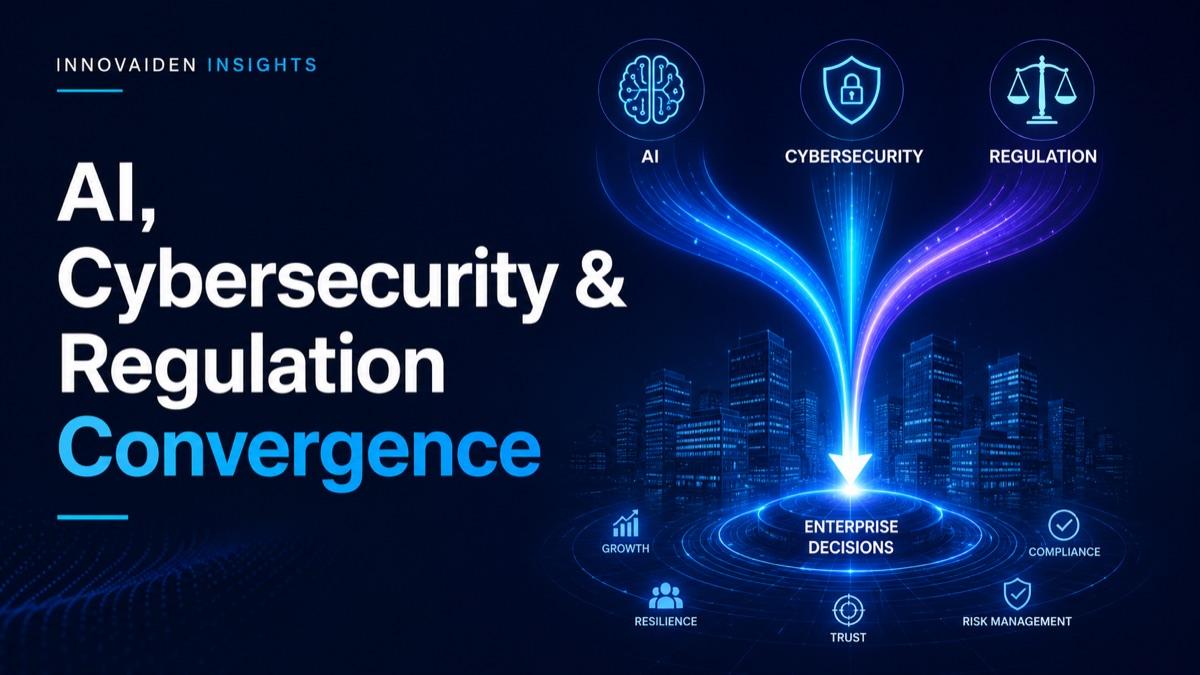
Three Convergence Points Reshaping Enterprise Security Intelligence
The intersection of AI, cybersecurity, and regulatory policy is producing developments faster than any single professional can track. A new vulnerability disclosure, a regulatory enforcement action, a vendor acquisition, or an AI capability announcement can shift the landscape in a single week. The challenge for CISOs, PE deal teams, and board members is not access to information. It is separating signal from noise.
Key Takeaways
- AI agent deployment, data governance, and regulatory enforcement are converging into a single operational challenge
- Structured intelligence organized around recurring pillars is more actionable than reactive news monitoring
- Every development has different implications depending on whether you are a CISO, a PE operating partner, or a board member
- Organizations that track these domains separately are accumulating blind spots at the intersections
The Problem with How Leaders Track Security Developments
Most professionals who need to stay current on cybersecurity and AI developments rely on one of two approaches: monitoring a set of news sources daily, or waiting for a quarterly industry report to summarize trends. Both have significant limitations.
| Approach | Strength | Limitation |
|---|---|---|
| Daily monitoring | Timeliness | Time-intensive, high noise-to-signal ratio, vendor-driven, no connective thread |
| Quarterly reports | Comprehensiveness | A trend identified in January may be fully mature by April. Too slow for emerging developments. |
| Pillar-based synthesis | Timely + cumulative | Connects individual data points to trajectories and organizational priorities |
Daily monitoring produces diminishing returns. The volume of AI and cybersecurity news is now so high that even a dedicated 30-minute daily scan yields more noise than signal. Most reporting is vendor-driven, event-reactive, or duplicative across outlets. The result is a constant stream of data points with no connective thread.
Quarterly reports solve the volume problem but sacrifice timeliness. A trend identified in January may be fully mature by the time it appears in a Q1 summary published in April. For decision-makers who need to act on emerging developments, quarterly cadence is too slow.
The Three Convergence Points
What makes the current landscape structurally different from even two years ago is that three domains that were historically managed by separate teams, with separate budgets and separate reporting lines, are now producing developments that cascade across each other.
AI agents and autonomous systems. The deployment, exploitation, and governance of AI agents is the fastest-moving domain. New capability announcements, vulnerability disclosures, agent-related incidents, and shifts in how organizations deploy autonomous systems are arriving weekly. Project Glasswing demonstrated that AI can find vulnerabilities that survived decades of human review. Agentic attackers are compressing breakout times: CrowdStrike puts the average eCrime breakout time at 29 minutes in 2025, with the single fastest observed breakout taking just 27 seconds. And enterprise AI agent deployments are creating attack surfaces that most security teams have not yet mapped.
Data governance and machine identity. Data security, classification, machine identity, and the intersection of data protection with AI deployment form the second convergence point. This is where most organizations face their most immediate operational gaps. Shadow AI means data is leaving organizations through channels security teams cannot see. Data discovery is a prerequisite that most organizations have not completed. And AI agent identity management requires controls that legacy IAM systems were never designed to provide.
Regulatory enforcement and deal activity. Regulatory actions, enforcement decisions, M&A transactions, and policy developments increasingly treat AI, cybersecurity, and data governance as a single integrated obligation. Four EU frameworks converge on vendor risk simultaneously. Sweden's Cybersecurity Act implements NIS2 with entity-wide scope that captures AI agent operations. And PE deal teams conducting cyber due diligence face a baseline that has shifted faster than most assessment methodologies have adapted.
Why Pillars, Not Topics
Organizing security intelligence around these three pillars rather than individual topics serves a specific purpose. Topics are reactive. A breach happens, and every outlet covers it. A regulation passes, and analysts publish summaries. Pillars are cumulative. Each development adds to a growing picture of how AI agents are reshaping security operations, how data governance is becoming a prerequisite for AI deployment, and how regulatory frameworks are responding.
This means leaders who track developments across all three pillars do not just know what happened. They understand the trajectory. They can see patterns forming before those patterns become consensus. And they can connect individual data points to their own organization's strategic priorities.
The convergence also means that a development in one pillar frequently triggers implications in the other two. A new AI agent capability (pillar one) creates new data governance requirements (pillar two) and new regulatory exposure (pillar three). An enforcement action (pillar three) redefines what constitutes adequate AI security controls (pillar one) and forces data classification upgrades (pillar two). Organizations that track these domains in silos miss the cross-domain implications.
What This Means in Practice
The practical question for leadership teams is whether their current intelligence and governance structures reflect this convergence. If AI agent security, data governance, and regulatory compliance are managed by separate teams with separate reporting cadences, the organization is likely accumulating blind spots at the intersections.
The Convergence Risk Assessment maps your organization's current exposure across all three pillars, identifies the intersection points where developments in one domain create obligations in the others, and provides a structured framework for maintaining visibility as the landscape continues to accelerate.
Map Your Convergence Exposure
Innovaiden works with leadership teams deploying AI agents across their organizations, from initial setup and training to security framework alignment and governance readiness. Reach out to discuss how we can help your team.
Get in TouchFrequently Asked Questions
What are the three convergence points in enterprise security?
The three domains are AI agent deployment and exploitation, data governance and machine identity, and regulatory enforcement across overlapping frameworks. These areas were historically managed by separate teams with separate budgets. In 2026, a single development in any one domain triggers cascading implications in the other two.
Why is daily monitoring insufficient for tracking AI and cybersecurity developments?
The volume of AI and cybersecurity developments is now so high that even a dedicated 30-minute daily scan yields more noise than signal. Most reporting is vendor-driven, event-reactive, or duplicative. The result is a constant stream of data points with no connective thread between them.
What is the difference between topic-based and pillar-based security intelligence?
Topic-based intelligence is reactive: a breach happens, everyone covers it. Pillar-based intelligence is cumulative: each week's developments add to a growing picture of how AI agents are reshaping security operations, how data governance is becoming a prerequisite for AI deployment, and how regulatory frameworks are responding. Pillars reveal trajectories; topics reveal events.
How do regulatory frameworks create cross-domain security obligations?
NIS2, DORA, the Cyber Resilience Act, and the EU AI Act each evaluate different dimensions of the same vendor or technology stack. A change in how one framework interprets AI agent risk can trigger new obligations under the others. Organizations running these as separate compliance programs miss the cross-framework exposure that regulators increasingly expect them to manage holistically.
Related Insights