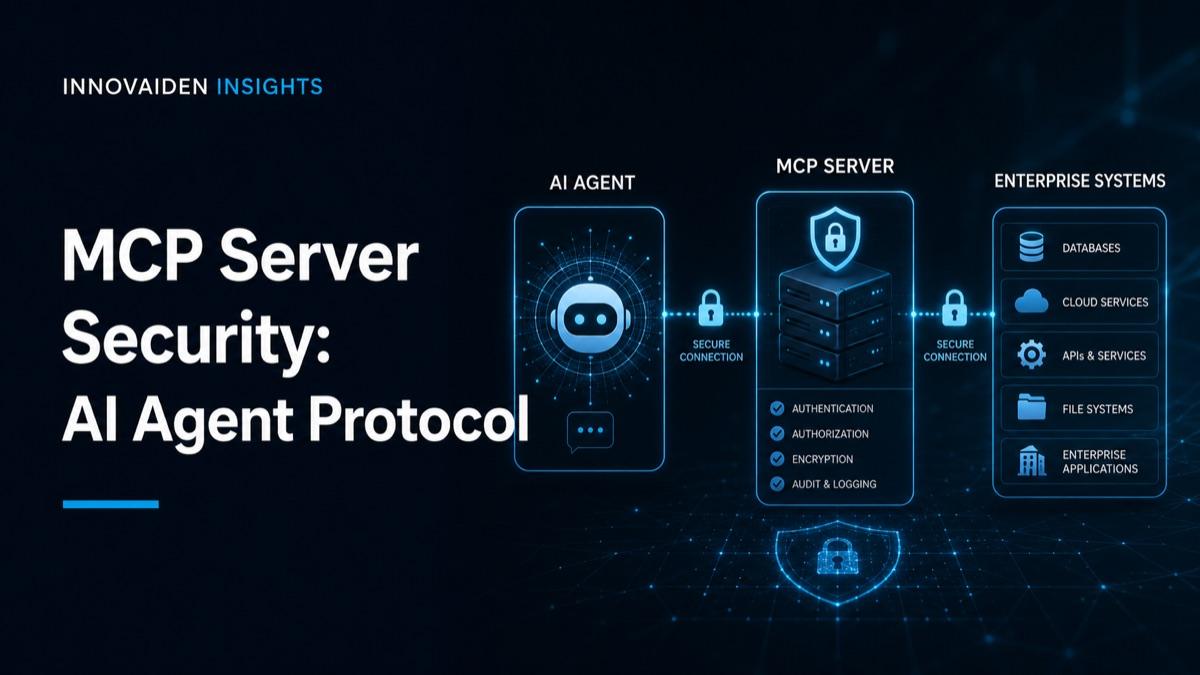
MCP Server Security: The Protocol Connecting AI Agents to Your Infrastructure
The Model Context Protocol (MCP) is becoming the standard way AI agents connect to external tools, data sources, and infrastructure. Originally developed by Anthropic and now adopted by WordPress.com, Cursor, and dozens of other platforms, MCP allows agents to read files, query databases, invoke APIs, and interact with any system that exposes an MCP server. That connectivity is the value. It is also the attack surface.
Key Takeaways
- Ox Security disclosed a systemic STDIO command-injection flaw across MCP SDKs in April 2026 (CVE-2026-30623, -22252, -22688, -30615) affecting 7,000+ servers and 150M+ package downloads
- MCPJam Inspector: remote code execution vulnerability scored CVSS 9.8
- mcp-atlassian: server-side request forgery (CVE-2026-27825, CVE-2026-27826)
- Trend Micro identified 1,467 internet-exposed MCP servers with no client authentication or traffic encryption, nearly triple the 492 it counted in July 2025
What MCP Actually Does
MCP is a protocol that lets AI agents discover and invoke tools exposed by servers. A typical MCP server might expose tools for reading Jira tickets, querying a database, sending Slack messages, or accessing a file system. The agent discovers what tools are available, selects the appropriate one based on its current task, and invokes it with parameters it constructs at runtime.
This is fundamentally different from traditional API integration. Traditional APIs serve defined endpoints with structured request/response patterns that security teams can model and monitor. MCP servers expose capabilities that agents discover and invoke dynamically. The access pattern is unpredictable by design. Security controls built for known API call patterns do not cover this dynamic invocation model.
Real Vulnerabilities, Not Theoretical Risks
The following vulnerabilities were disclosed in 2026 and affect MCP deployments in production:
| Vulnerability | Severity | Impact |
|---|---|---|
| STDIO command injection across MCP SDKs (CVE-2026-30623, -22252, -22688, -30615) | Critical, systemic | Ox Security's April 2026 disclosure: a flaw in how MCP SDKs invoke local processes lets a malicious server payload execute arbitrary commands on the client. Affects 7,000+ MCP servers and SDK packages with 150M+ cumulative downloads — including LiteLLM. |
| MCPJam Inspector RCE | CVSS 9.8 | Remote code execution on the MCP inspection tool, allowing full server compromise |
| mcp-atlassian SSRF (CVE-2026-27825, CVE-2026-27826) | High | Server-side request forgery allowing attackers to reach internal services through the Atlassian connector |
| Unauthenticated public MCP servers | Variable | Admin panels, debug endpoints, and API routes exposed without authentication across thousands of internet-facing servers |
These are not edge cases. They are the predictable result of deploying a new protocol category at speed without the security controls that mature protocol categories (HTTPS, SSH, database protocols) accumulated over decades. For the broader context on how AI development tooling supply chains are being targeted, MCP servers are the newest surface in the same pattern.
A Practical Control Set for MCP
| Control | Rationale | Implementation |
|---|---|---|
| Authentication on every server | No MCP server should accept anonymous connections | Require token-based or certificate-based authentication. Default-deny for unauthenticated requests. |
| Network isolation | MCP servers should not be internet-facing | Deploy behind VPN or private network. If external access is required, use an authenticated reverse proxy with rate limiting. |
| Per-tool permission scoping | Agents should only access the tools their task requires | Configure MCP servers to expose only the minimum tool set per agent. Do not expose administrative or destructive tools to general-purpose agents. |
| Tool invocation logging | Every tool call must be attributable and auditable | Log which agent called which tool, with what parameters, returning what result. Feed logs into the same monitoring pipeline as other agent actions. |
| Supply chain vetting | MCP servers are third-party code with infrastructure access | Apply the same vetting, version pinning, and review process as any third-party dependency. Do not install MCP servers from unvetted registries. |
MCP in the Broader Agent Security Architecture
MCP server security is not a standalone concern. It connects directly to three other domains in the AI agent deployment security framework: access control (MCP tools inherit the agent's permissions), supply chain integrity (MCP servers are supply chain components), and monitoring (MCP tool invocations must be logged and reviewed).
For organizations already managing AI agent identity and IAM, MCP servers add a new credential surface. Every MCP server that an agent connects to requires a credential, and that credential must be scoped, rotated, and revocable on the same lifecycle as any other agent identity.
The MCP Security Assessment Guide includes the server audit checklist, the permission-scoping template, and the supply chain vetting criteria for MCP marketplace components.
Assess Your MCP Security Exposure
Innovaiden works with leadership teams deploying AI agents across their organizations, from initial setup and training to security framework alignment and governance readiness. Reach out to discuss how we can help your team.
Get in TouchFrequently Asked Questions
What is the Model Context Protocol and why does it matter for security?
The Model Context Protocol (MCP) is an open standard, originally developed by Anthropic, that connects AI agents to external tools, data sources, and services. It allows agents to read files, query databases, invoke APIs, and interact with infrastructure. Every MCP connection is a trust boundary that, if compromised, gives an attacker the same access the agent has.
What real MCP vulnerabilities have been discovered in 2026?
MCPJam Inspector had a remote code execution vulnerability scored CVSS 9.8. The mcp-atlassian connector had server-side request forgery vulnerabilities (CVE-2026-27825, CVE-2026-27826). Trend Micro's scanning found 1,467 internet-exposed MCP servers running with no client authentication or traffic encryption, nearly triple the 492 it counted in July 2025.
How does MCP differ from traditional API security?
Traditional APIs serve defined endpoints with structured request/response patterns. MCP servers expose capabilities that AI agents discover and invoke dynamically at runtime. The agent decides which tools to call based on its context, meaning the access pattern is unpredictable. Security controls designed for known API call patterns do not cover this dynamic invocation model.
What controls should organizations apply to MCP server deployments?
Four controls: authentication on every MCP server (no anonymous access), network isolation (MCP servers should not be internet-facing), permission scoping per tool (agents should only access the specific tools their task requires), and logging of every tool invocation (which agent called which tool, with what parameters, returning what result).
How does MCP security relate to AI supply chain risk?
MCP servers are supply chain components. An organization that installs an MCP server from a public registry is trusting third-party code with access to its infrastructure. The OpenClaw crisis demonstrated that agent framework marketplaces are actively targeted. MCP servers should be subject to the same vetting, pinning, and review process as any third-party dependency.
Related Insights
Sources
- Anthropic - Model Context Protocol Specification
- Trend Micro - MCP Security: Network-Exposed Servers Are Backdoors to Your Private Data (Part 1, July 2025)
- Trend Micro - Update on Exposed MCP Servers: Threat Widens to the Cloud (Part 2)
- Trend Micro - Beware of MCP Hardcoded Credentials (Part 3)
- SecurityWeek - MCPJam Inspector RCE Disclosure
- CVE Database - CVE-2026-27825, CVE-2026-27826
- OWASP - 2026 Top 10 for LLM Applications
- Ox Security — The Mother of All AI Supply Chains: Systemic Vulnerability at the Core of the MCP. April 2026.