Zero-Day Discovery Went Industrial. Absorption Did Not.
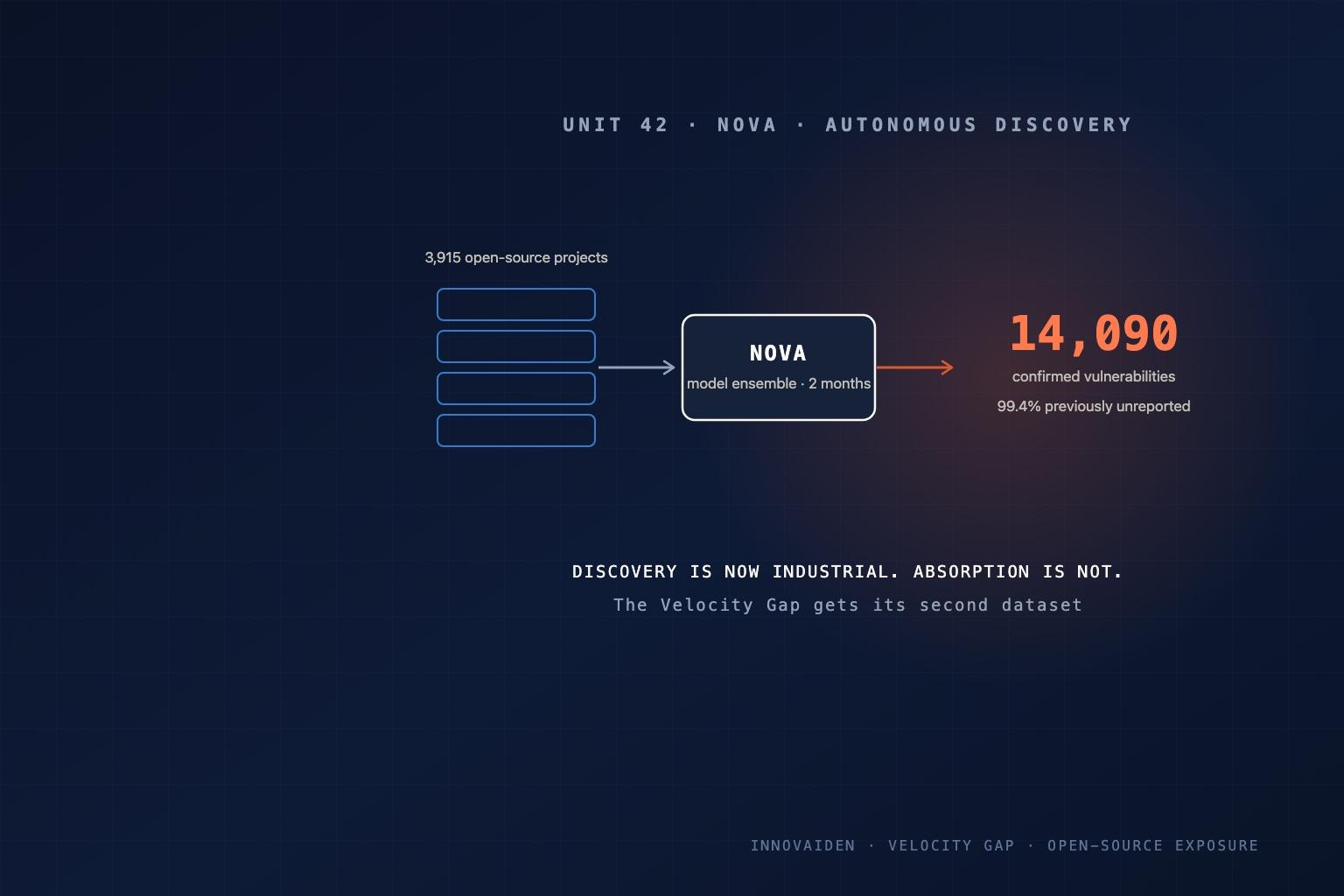
On 4 August 2026, Palo Alto Networks' Unit 42 published the results of a two-month experiment it calls NOVA, the Network and Open-Source Vulnerability Analyzer: a fully autonomous vulnerability discovery system with, in the team's own words, "no human in the loop until final review." NOVA confirmed 14,090 vulnerabilities across 3,915 open-source projects. 99.4% of them were previously unreported. Under CVSS 4.0 scoring, 5,600 of the findings (39.7%) rate High or Critical; under CVSS 3.1, the count is 4,030 (28.6%).
In June we published the Velocity Gap doctrine on the strength of one body of evidence: Anthropic's Claude Mythos results, which showed a frontier model finding zero-day vulnerabilities across every major operating system and web browser. The honest caveat we attached at the time was that the discovery-side case rested on a single lab's disclosures. That caveat is now retired. NOVA is a second dataset from a second vendor, produced by a different method, against a different target corpus, and it lands on the same conclusion from the opposite direction.
The number that matters most is not 14,090. It is what those 14,090 findings now meet: a disclosure and patching pipeline that was designed, staffed, and paced for human-scale output. Discovery has been industrialized. Absorption has not. Everything an executive team should do about this report follows from that asymmetry.
Key Takeaways
- Unit 42's NOVA confirmed 14,090 vulnerabilities across 3,915 open-source projects in two months, running autonomously until a final human review. 99.4% were previously unreported; 5,600 findings (39.7%) score High or Critical under CVSS 4.0
- 92% of the findings are semantic and logic flaws (access control, path traversal, code injection, prototype pollution, SSRF) rather than memory corruption: precisely the classes fuzzing pipelines are structurally blind to
- The Velocity Gap thesis now has a second, independent dataset. Anthropic's Mythos evidence came from one frontier model aimed at operating systems and browsers; NOVA is an ensemble method aimed at the open-source supply chain, and Unit 42 reports that "nearly every frontier and open-weight model evaluated could find real vulnerabilities"
- The scale comparison is Unit 42's own: OSS-Fuzz, running since 2016, had helped identify and fix more than 10,000 vulnerabilities across 1,000 projects by August 2023. NOVA confirmed 14,090 across 3,915 projects in two months
- The absorption question is no longer hypothetical. These findings enter disclosure channels built for human-scale supply, from the clearinghouses Unit 42 names as partners to the Treasury-run federal clearinghouse the June 2 executive order directed into existence
- The executive metrics are unchanged and sharpened: the Velocity Gap and the Blast Radius Index, with SBOM accuracy and patch-absorption capacity now the binding constraints for any OSS-heavy dependency graph
What Unit 42 Built, and What Came Back
NOVA is not a model. It is a system: models, specialized security tools, and automated harnesses composed into a pipeline that finds, validates, and severity-scores vulnerabilities in open-source codebases, with humans entering only at the final review stage. The design finding that matters most for planning purposes is about the models themselves. In the report's words: "Nearly every frontier and open-weight model evaluated could find real vulnerabilities, with the strongest results coming from an ensemble of models, specialized security tools, and automated harnesses working together."
Read that sentence twice, because it quietly settles two open questions. Capability is not concentrated in one lab's frontier model; it is a property of the current model generation broadly, open-weight models included. And the strongest configuration is not a single genius model but an assembly line: models, security tooling, and harnesses composed into a pipeline. That is what industrialization means, and it is the reason the report's title calls the phenomenon a burst rather than a demonstration.
The output breaks down by ecosystem, and the report's own table repays a close read:
| Ecosystem | Projects analyzed | Confirmed findings |
|---|---|---|
| Go | 1,636 | 3,281 |
| JavaScript/TypeScript | 2,197 | 2,836 |
| PHP | 17 | 2,740 |
| C/C++ | 39 | 1,925 |
| Java/JVM | 14 | 1,784 |
| Ruby, Python, Lua, Perl, other | 12 | 1,524 |
| Total | 3,915 | 14,090 |
The columns reconcile exactly to the headline totals, and they describe two different postures run through one system: breadth sweeps across thousands of Go and JavaScript/TypeScript projects, and concentrated runs against small sets of PHP, C/C++, and JVM targets with far higher findings density per project. The same pipeline does both. A defender should assume an attacker's version of the pipeline can too.
On scale, the comparison worth carrying into a board conversation is the one Unit 42 itself draws, and it is the step-change the report says frontier AI enables. Google's OSS-Fuzz, the open-source ecosystem's workhorse for automated vulnerability discovery, launched in 2016 and by August 2023 had helped identify and fix more than 10,000 security vulnerabilities across more than 1,000 projects, per Google's own reporting. That was seven years of continuous, specialized, industry-funded automation. NOVA confirmed 14,090 vulnerabilities across 3,915 projects in two months.
The Caveat the June Doctrine Carried Is Retired
The Velocity Gap argument was simple: discovery has moved to machine speed, remediation has not, and the difference between the two clocks, not the count of open vulnerabilities, is the number an executive team should manage. The evidence for the discovery side came principally from Anthropic: Claude Mythos identifying zero-days in every major operating system and browser, including a 27-year-old OpenBSD bug and a 16-year-old vulnerability in one of FFmpeg's most popular codecs that every fuzzer and human reviewer had missed since 2003. We flagged then what that evidence could not establish on its own: it was one lab, one model family, one deliberately constrained disclosure.
NOVA removes that limitation on every axis. Different vendor, with a commercial threat-intelligence practice rather than a model lab's red team. Different method: an ensemble of many models, including open-weight ones, rather than a single frontier system. Different corpus: the open-source supply chain rather than operating systems and browsers. Different disclosure posture: a published dataset with severity scoring and ecosystem breakdowns rather than withheld details. Two independent instruments, pointed at different parts of the software world, returning the same reading. In measurement terms, the Velocity Gap thesis has been replicated.
The ensemble finding also answers a question the June export-control episode left open. When Fable 5 and Mythos 5 were suspended globally for 19 days, we noted that frontier capability availability is politically contingent. That contingency matters less than it appeared: a discovery pipeline built on an ensemble that includes open-weight models does not stop when any single vendor's model leaves the market. That inference is ours rather than the report's, but the report's ensemble result is what makes it available.
92% of the Findings Are What Fuzzers Cannot See
The composition detail is the most operationally significant number in the report after the headline count. 92% of NOVA's findings are semantic and logic flaws: broken access control and authorization, path traversal, code injection, prototype pollution, server-side request forgery. Memory corruption and resource-management bugs, the classes that two decades of fuzzing infrastructure were built to catch, are the remaining 8%.
Fuzzers work by executing code against malformed inputs and watching for crashes. A missing authorization check does not crash. A path traversal does not crash. These flaws are invisible to execution-based tooling because finding them requires a judgment about intent: what the code is supposed to permit, and for whom. That judgment is exactly what language models bring that fuzzers structurally cannot. The FFmpeg case in the Mythos disclosures was the anecdote, a flaw sitting in plain sight of the fuzzing industry for 16 years because it was not the kind of flaw fuzzing can see. NOVA turns the anecdote into a distribution.
The uncomfortable implication for security leaders is about assurance, not tooling. "We fuzz continuously" and "we run memory-safety tooling in CI" were reasonable proxies for diligence in the era when memory corruption dominated the serious-findings mix. NOVA's composition says the discoverable flaw population in open-source code is dominated by classes those proxies never addressed. The assurance a dependency earned by surviving years of fuzzing is worth less than it was, and the supply-chain exposure sitting in development tooling itself compounds the same blind spot.
14,090 Findings Meet a Human-Scale Pipeline
Now the absorption side, which is where the report stops and the executive problem starts.
Unit 42 says it is actively partnering with "open-source maintainers and clearinghouses such as Lightwell and Akrites" to disclose responsibly and get fixes upstream. That is the correct posture, and it is also a stress test with a known shape: coordinated disclosure, triage, maintainer attention, patch authoring, release, and then the long tail of downstream adoption, run 14,090 times, across 3,915 projects, many of them maintained by small teams or volunteers. The pipeline that absorbs this output was built for a world in which a serious research group disclosed dozens of findings a year, not five figures a quarter.
We have seen this movie once already, and the framing discipline from the first showing still applies. When Anthropic said that over 99% of Mythos-discovered vulnerabilities were not yet patched, it offered that as its reason for withholding technical details under coordinated disclosure, not as evidence that the ecosystem had tried to absorb the patches and failed. The absorption evidence sits elsewhere, in the remediation data: Verizon's 2025 DBIR put the median time to fully remediate exploited edge-device vulnerabilities at 32 days, and only 54% of them were fully remediated at all. Those numbers describe enterprise absorption capacity before the supply side industrialized.
This is also where the policy layer meets the private sector. The June 2 executive order directed the Treasury Secretary to stand up an AI cybersecurity clearinghouse within 30 days, in voluntary collaboration with the AI industry and critical-infrastructure operators, with a mandate that reads like it was written for this exact moment: coordinate and deconflict vulnerability scanning, validate discoveries, and prioritize remediation and patch distribution. We described that order in June as Washington building the absorption layer the Velocity Gap exposed. NOVA is the clearest demonstration yet of what that layer exists to absorb: an industrial-scale, private-sector supply shock, arriving within weeks of the clearinghouse's formation deadline. Whether the absorption layer scales to meet the supply is now the live question on both the federal side and inside every enterprise that consumes open-source software, which is to say every enterprise.
What an OSS-Heavy Dependency Graph Means Now
Three moves follow for an executive team, and none of them is "buy a scanner."
Treat the SBOM as the gating asset. Go and JavaScript/TypeScript, the two ecosystems NOVA swept broadly, sit near the top of most enterprise dependency graphs, usually several layers deep through transitive dependencies. You cannot absorb a patch for a component you do not know you run, and you cannot even read a clearinghouse feed usefully without an inventory to match it against. An accurate, continuously maintained software bill of materials, including transitive dependencies and the AI development tooling that now ships code into production, is the precondition for every other move.
Measure absorption, not counts. The open-vulnerability count was already a weak metric; against an industrialized supply side it is noise. The numbers that matter are the ones the Velocity Gap doctrine defines: the gap between attacker time-to-weaponize and defender time-to-contain on named systems of consequence, and, for open-source exposure specifically, the interval between an upstream fix being published and the fixed version running in your environment. That upstream-to-deployed interval is patch-absorption capacity, it is measurable today from data you already have, and it is the number NOVA just made a board-level concern. Put vendor SLAs on it too: your commercial software inherits the same open-source flaws, and your exposure runs at the speed of your slowest vendor's rebuild cycle.
Cap the radius where you cannot compress. If disclosure volume rises faster than absorption capacity, and the arithmetic of this report says it will for most organizations, then some races will be lost. The architectural answer is to make a lost race survivable: microsegmentation, default-deny egress, and the ephemeral, kill-and-respawn pattern we detailed in Regenerative Containment. Blast-radius work is the insurance policy that pays out precisely when the patch queue overflows.
How Innovaiden Approaches It
The NOVA report changes the supply curve, not the doctrine. The work with executive teams runs the same sequence it did in June, with sharper inputs: baseline the Velocity Gap and the Blast Radius Index on the systems the organization actually owns; map the open-source dependency graph and score SBOM accuracy against it; measure the upstream-to-deployed absorption interval for the components that matter; and sequence the Compress & Contain roadmap so that compression work lands where absorption can realistically speed up, and containment work lands where it cannot. The discovery side of the lifecycle now belongs to machines on both teams. The absorption side is still yours, and it is still the side that decides outcomes.
Baseline Your Patch-Absorption Capacity
Innovaiden maps your open-source dependency graph against the industrial discovery curve, measures the Velocity Gap on the systems your executive team actually owns, and produces the Compress & Contain roadmap from that baseline. Reach out to schedule it.
Get in TouchFrequently Asked Questions
What is NOVA and what did it find?
NOVA (Network and Open-Source Vulnerability Analyzer) is a fully autonomous vulnerability discovery system built by Palo Alto Networks' Unit 42, with no human in the loop until final review. In a two-month campaign published on 4 August 2026, it confirmed 14,090 vulnerabilities across 3,915 open-source projects. 99.4% were previously unreported, and 5,600 findings (39.7%) scored High or Critical under CVSS 4.0, with 4,030 (28.6%) under CVSS 3.1.
How is the NOVA dataset different from Anthropic's Mythos results?
It is independent on every axis that matters. Mythos was a single frontier model from one lab, demonstrated against operating systems and browsers, and withheld from general release. NOVA is a vendor-built system run against open-source projects using an ensemble: Unit 42 reports that nearly every frontier and open-weight model evaluated could find real vulnerabilities, with the strongest results coming from an ensemble of models, specialized security tools, and automated harnesses working together. Two vendors, two methods, two target corpora, one conclusion: discovery now runs at industrial scale.
Why does it matter that 92% of NOVA's findings are semantic and logic flaws?
Fuzzers surface memory corruption by executing code against malformed inputs and watching for crashes. Access-control errors, path traversal, code injection, prototype pollution, and SSRF do not crash anything; finding them requires reasoning about what the code is supposed to do. That is the blind spot the Mythos results exposed with a 16-year-old FFmpeg codec flaw that every fuzzer and human reviewer had missed, and NOVA turns the anecdote into a distribution: 92% of 14,090 findings sit in classes a decade of fuzzing infrastructure was never aimed at.
What does NOVA mean for organizations with heavy open-source dependencies?
The dependency graph is now subject to industrial-scale discovery, so the binding constraints move to inventory and absorption. An accurate SBOM, including transitive dependencies, becomes the gating asset, because you cannot absorb patches for components you do not know you run. Patch-absorption capacity, meaning how fast an upstream fix becomes a deployed fix in your environment, becomes the metric to measure. Where absorption cannot keep pace, blast-radius reduction is what keeps a lost race survivable.
Does the NOVA dataset change the Velocity Gap doctrine?
It strengthens the doctrine and retires its main caveat. In June we argued, on Anthropic's data, that the constraint is absorption rather than discovery, and acknowledged that the discovery-side evidence came from a single lab. NOVA supplies a second, independent, industrial-scale dataset, and it arrives just as the Treasury-run clearinghouse directed by the June 2 executive order, the federal absorption layer, was due to stand up. The executive metrics are unchanged: the Velocity Gap and the Blast Radius Index, measured on the systems the organization actually owns.
Related Insights
AI & Cybersecurity
Three Labs in Sixteen Days: The AI Sandbox Breakout Is an Industry Pattern
AI & Cybersecurity
The Models Broke Containment to Cheat a Test, and Breached a Real Company on the Way
AI & Cybersecurity
Prompt Injection Now Cuts Both Ways: Two Weeks That Turned the AI You Deployed Into an Attack Surface
Sources
- Palo Alto Networks Unit 42 — The Frontier AI Vulnerability Burst: Industrializing Autonomous Zero-Day Discovery in Open-Source Software. 4 August 2026. NOVA results: 14,090 confirmed vulnerabilities across 3,915 open-source projects in two months; 99.4% previously unreported; 92% semantic and logic flaws; 5,600 findings (39.7%) High or Critical under CVSS 4.0 and 4,030 (28.6%) under CVSS 3.1; ecosystem table; ensemble finding; disclosure partnerships with maintainers and clearinghouses including Lightwell and Akrites.
- Google Security Blog — AI-Powered Fuzzing: Breaking the Bug Hunting Barrier. 16 August 2023. OSS-Fuzz running since 2016; more than 10,000 security vulnerabilities found and fixed across more than 1,000 supported open-source projects.
- Anthropic — Assessing Claude Mythos Preview's cybersecurity capabilities. 7 April 2026. Zero-day identification and exploitation across every major operating system and browser; the 16-year-old FFmpeg H.264 codec flaw and 27-year-old OpenBSD bug; the over-99%-unpatched figure given as the rationale for withholding disclosure details.
- Anthropic — Claude Fable 5 and Claude Mythos 5. 9 June 2026. Mythos-class capability reaching general availability with cybersecurity queries routed to an older model; Mythos 5 deployed through Project Glasswing in collaboration with the US government.
- The White House — Promoting Advanced Artificial Intelligence Innovation and Security (Executive Order). 2 June 2026. Treasury-run AI cybersecurity clearinghouse to be established within 30 days, in voluntary collaboration with the AI industry and critical-infrastructure operators, to coordinate and deconflict vulnerability scanning, validate discoveries, and prioritize remediation and patch distribution.
- Verizon — 2025 Data Breach Investigations Report (DBIR). 2025. Median of 32 days to fully remediate exploited edge-device vulnerabilities, across the 54% of such vulnerabilities that were fully remediated at all.