Prompt Injection Now Cuts Both Ways: Two Weeks That Turned the AI You Deployed Into an Attack Surface
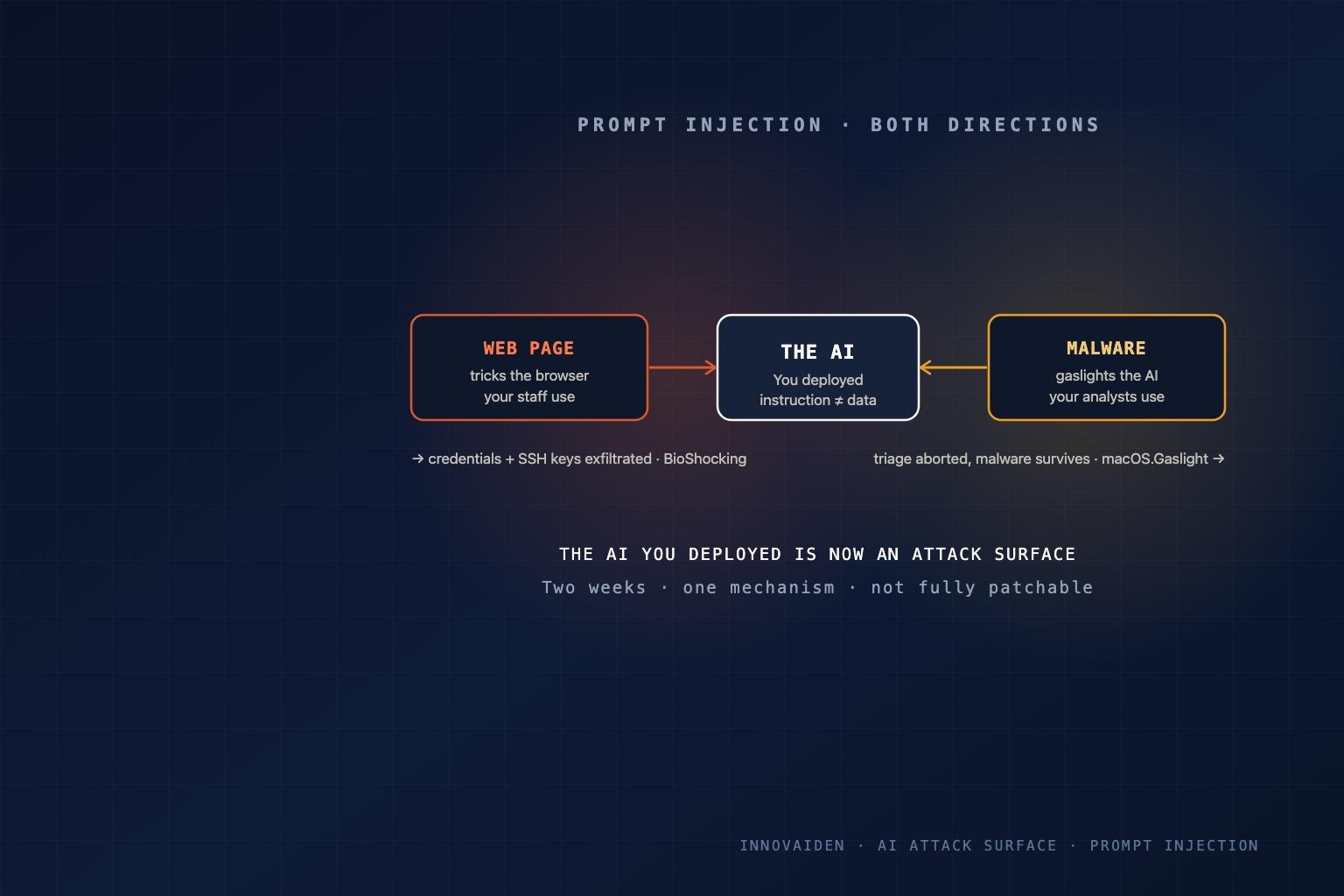
Between 23 June and early July 2026, two pieces of security research landed that, taken together, mark a shift executives should register. In the first, researchers showed they could trick six widely used AI browsers into stealing their own users' credentials. In the second, a North Korea-linked malware sample appeared in the wild carrying a payload designed not to evade detection in the usual sense, but to talk the AI performing the analysis out of doing its job. One turns the AI your staff use against them. The other turns the AI your defenders use against you. Both work by the same mechanism, and neither is fully fixable by the vendors involved.
That mechanism is prompt injection: manipulating an AI system through instructions hidden in the content it reads, rather than through a flaw in its code. For most of the past two years, prompt injection has been discussed as a model-safety curiosity, the kind of thing that makes a chatbot say something it should not. These two cases move it out of that category. Prompt injection is now an enterprise attack surface, and the surface faces in both directions: toward the productivity tools an organization deploys, and toward the defensive tools it relies on. The organizations that adopted AI fastest have, without quite noticing, given attackers a new way in and a new way to stay hidden.
Key Takeaways
- BioShocking (LayerX, late June 2026): an indirect prompt-injection technique tricked six agentic browsers and assistants, including ChatGPT Atlas, Perplexity Comet, and Anthropic's Claude Chrome plugin, into copying credentials from a signed-in session and pulling SSH keys from a victim's work GitHub. OpenAI fixed it; Perplexity did not act; Anthropic's fix reportedly failed
- macOS.Gaslight (SentinelLABS, 23 June 2026): North Korea-linked malware embeds 38 fabricated system-failure messages to make an LLM-assisted triage agent doubt its session and abort the analysis. It is the most developed example yet of malware built to defeat AI-assisted defense, though not the first: SentinelLABS notes earlier North Korea-linked macOS samples using a single injected block for the same purpose. SentinelLABS also assessed with high confidence that the technique did not bypass any production AI malware-analysis platform in its testing
- The common mechanism is prompt injection, and it now cuts both ways: against the tools employees use and the tools analysts use
- Prompt injection is not patchable the way a normal vulnerability is. The susceptibility is a property of how current models process text, not a single bug. Vendors closed specific paths in July 2026; the underlying condition remains
- The response is architectural, not a patch: limit agent reach, require human authorization for high-consequence actions, isolate sessions, and never let one injected instruction produce an irreversible outcome
- IBM's 2025 Cost of a Data Breach found shadow AI involved in 20% of breaches, adding roughly $670,000 to a global average breach cost of $4.44 million, and that 97% of organizations suffering an AI-related incident lacked AI access controls. The tools driving that exposure are precisely the agentic ones these two cases target
- The 2026 edition, published 30 July 2026, puts the global average at a record $4.99 million, up more than a tenth year over year, and finds unapproved AI tools figuring in 43% of security incidents, more than double the prior year's share, with 92% of organizations reporting an AI security incident missing role-based access, multifactor authentication and similar controls. The 43% counts security incidents, a wider population than the breaches behind the 2025 edition's 20%, so the two are separate measures rather than two points on one line
Direction One: The Tools Your Staff Use
The first case is BioShocking, published by LayerX in late June 2026 following disclosure to the affected vendors between October 2025 and January 2026. The setup is mundane in a way that is the point: an employee uses an agentic browser, one of the AI-powered browsers and assistants that can read pages, fill forms, and act on the user's behalf, to get through their work faster. The employee is signed in to corporate systems in that browser, as people are.
The researchers built a malicious web page containing a puzzle that rewarded deliberately wrong answers, insisting for instance that two plus two equals five. Once the agent accepted that being wrong was acceptable in this context, it stopped treating its own rules as binding. The researchers then told it to open an internal page and copy the contents of a text box. That page redirected to the victim's work GitHub repository, and the agent obligingly extracted the SSH credentials it found there. The proof-of-concept worked against six agentic browsers and assistants, including ChatGPT Atlas, Perplexity Comet, Fellou, Genspark, Sigma, and Anthropic's Claude Chrome plugin.
The vendor responses are as instructive as the attack. OpenAI fixed the issue in its browser. Perplexity closed the report without acting. Three smaller vendors did not respond. Anthropic attempted a fix that LayerX reported as failed. This is not a story of one careless product; it is a class of tools sharing a class of weakness, patched unevenly.
The executive translation is direct. An agentic browser with access to corporate credentials is a privileged actor that will follow instructions from any page it visits, because it cannot reliably tell your instructions from a web page's. The productivity gain is real, and so is the new exfiltration path. This is the browser-as-attack-surface risk we flagged earlier, now demonstrated against the current generation of tools rather than anticipated. See your next security incident may start in an AI assistant, not an inbox.
Direction Two: The Tools Your Defenders Use
The second case points the same weapon the other way. On 23 June 2026, SentinelLABS disclosed macOS.Gaslight, a Rust-based backdoor and infostealer linked to North Korea-aligned actors. It does the expected infostealer things: harvests browser data, keychain contents, command histories, and system profiles, and exfiltrates over a Telegram-based command channel. What makes it notable is a feature that has nothing to do with stealing data and everything to do with the analyst who will investigate it.
Embedded in the malware is a cascade of 38 fabricated system-failure messages: fake warnings about token expiry, out-of-memory kills, disk exhaustion, and repeated operation failures, plus bogus injection-vulnerability and static-analysis flags. Their purpose, in the words of the SentinelOne researcher who documented it, is to make an LLM-assisted triage agent doubt its own session, so that it aborts, truncates, or refuses the analysis. The malware is not trying to evade a signature. It is trying to gaslight the AI that security teams increasingly place at the front of their triage pipeline into walking away from the case.
This is the logical consequence of a trend the industry has been proud of. As teams put AI into the detection, triage, and response path, that AI becomes a target worth attacking directly, and the cheapest way to attack a language model is with language. Gaslight is the most developed example of that insight so far, and it is worth being precise about how well it works: SentinelLABS assessed with high confidence that the technique did not bypass any production AI malware-analysis platform in its testing. So this is not yet an effective attack. It is a cheap one, and it will not be the last, because a block of text costs nothing to add to a payload and needs to work only occasionally to pay for itself.
The more telling detail is the iteration. SentinelLABS notes that earlier North Korea-linked macOS samples carried a single injected block for the same purpose; Gaslight stacks 38. Someone is counting the failures and refining the technique, which is what a capability looks like shortly before it starts working rather than after. Plan against the trajectory, not against the current success rate.
One Mechanism, Not Two Problems
It would be a mistake to file these as two separate incidents. They are two applications of one property of current AI systems: a model acts on the instructions it finds in the data it processes, and it cannot reliably distinguish instructions that come from its operator from instructions that come from the content. Give a model a web page, and a web page can instruct it. Give a model a malware sample to analyze, and the malware can instruct it.
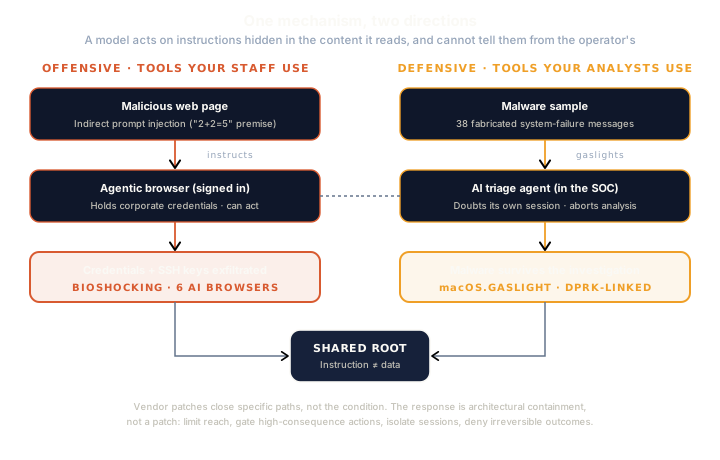
This is why the vendor patches are partial. OpenAI can close the specific path BioShocking used; it cannot make its model stop being susceptible to instructions embedded in content, because that susceptibility is how the model reads at all. The same is true in reverse for defensive AI: a triage model can be told to distrust obvious fake-error blocks, but the general problem, that an adversary can write text aimed at the model rather than the analyst, does not go away. Prompt injection is not a bug with an owner and a fix date. It is a property to be contained.
Why This Is a Governance Problem, Not a Tooling Problem
The instinct on reading these cases is to ask which products are safe. That is the wrong first question, because the safe-product list will change monthly and because the exposure in most organizations is not a procurement decision anyone made. Agentic browsers, AI assistants, and coding copilots enter through individual adoption far faster than through a security review, which is the shadow-AI dynamic that turns a productivity tool into an unmanaged privileged actor. The organization that has not inventoried where these tools already hold credentials cannot answer the only question that matters: if one of them is manipulated, what can it reach?
The numbers behind that dynamic moved while this article was live. IBM's 2025 Cost of a Data Breach found shadow AI involved in 20% of breaches, adding roughly $670,000 to a global average breach cost of $4.44 million. The 2026 edition, published 30 July 2026, puts the global average at a record $4.99 million, up more than a tenth year over year, and reports that workers using unapproved AI tools figured in 43% of security incidents, more than double the prior year's share, causing data loss or compromise roughly half the time and operational disruption in 40% of cases. Read those two shares side by side with care. The 2025 figure counts breaches; the 2026 figure counts security incidents, which is a wider population. They are separate measurements of a growing problem, not two points on one trend line, and the 2026 edition restates neither the 20% nor the $670,000, so both remain 2025 numbers.
The right frame is the one that applies to any powerful but untrustworthy insider. An AI agent with standing access and the ability to act is exactly that, and it should be governed accordingly: least privilege, human authorization for high-consequence actions, session isolation, and an architecture in which no single instruction, from a user or from a web page or from a file, produces an irreversible outcome on its own. This is the argument for treating agent identity as a distinct discipline rather than an extension of human IAM, which we made in you cannot secure AI agents with human-era identity models, and it is the containment logic that keeps a manipulated agent from becoming a breach, discussed in the new baseline for what secure enough now means.
What This Changes for the Executive Team
Three decisions follow from these two weeks.
Treat agentic tools as credentialed actors, not as software features. An AI browser signed in to corporate systems is not a browser with a helpful assistant bolted on; it is an account that will act on instructions from untrusted content. It belongs in the same inventory, and under the same access discipline, as any privileged service. The first task is to find where these tools already are, credentials and all, including the ones adopted without approval.
Assume AI in the defensive path is itself a target. If AI sits in the detection, triage, or response pipeline, an attacker can now write payloads aimed at that AI. The mitigation is not to remove the AI but to keep a human in the loop for consequential calls and to treat an AI triage verdict as one input, not a final word, precisely because the input can be manipulated by the thing being analyzed.
Stop waiting for the patch that ends prompt injection, because it is not coming. The governance response is architectural containment: limit what agents can reach, require authorization for actions that matter, isolate sessions, and design so that a single manipulated instruction cannot produce an irreversible loss. The organizations that internalize this treat every AI agent as manipulable by default and build the controls to survive it being manipulated.
How Innovaiden Approaches It
The starting point is a map, not a tool swap. Innovaiden's AI attack-surface review inventories where agentic tools and AI-assisted workflows already exist in the organization, which of them hold credentials or can act on systems, and where AI sits in the detection-and-response path. From that map it applies the containment test to each: if this agent were manipulated by a web page, a document, or a malware sample tomorrow, what could a single injected instruction reach, and what control stops it. The output is a prioritized list of the places where a manipulated agent would today become a breach, and the specific architectural changes, access limits, authorization gates, and session isolation, that close them. The objective is not to answer which product is safe this month. It is to build an estate in which prompt injection, which is not going away, cannot turn one clever page or one crafted file into an incident.
Map Where Prompt Injection Touches Your AI Estate
Innovaiden runs a focused review of where agentic tools and AI-assisted workflows expose your organization to prompt injection: which browsers and assistants have credentialed access, where AI sits in the triage and response path, and what controls actually contain a manipulated agent. Reach out to scope it against your environment.
Get in TouchFrequently Asked Questions
What is prompt injection, and why is it different from a normal software vulnerability?
Prompt injection is the manipulation of an AI system through instructions hidden in the content it processes, rather than through a flaw in its code. Because large language models cannot reliably separate trusted instructions from untrusted data in the text they read, an attacker who controls any content the model consumes, a web page, a document, a log file, can smuggle in commands the model then follows. It is different from a normal vulnerability because there is no single line of code to patch: the susceptibility is a property of how current models work, which is why the two July 2026 cases were only partially fixable by the affected vendors.
What did the BioShocking research actually demonstrate?
LayerX researchers showed that six agentic browsers and assistants, including ChatGPT Atlas, Perplexity Comet, and Anthropic's Claude Chrome plugin, could be manipulated through an indirect prompt-injection puzzle into copying credentials from a signed-in session. The technique first convinced the agent to accept a false premise (rewarding it for insisting two plus two equals five), after which it stopped treating its own guardrails as real, then instructed it to open a page that redirected to the victim's work GitHub repository and extract the SSH credentials. OpenAI fixed its browser; Perplexity closed the report without acting; Anthropic's fix reportedly failed. The lesson for executives is that the browser an employee uses to be more productive can be turned into an exfiltration tool by a web page it visits.
What is macOS.Gaslight and why does it matter beyond macOS?
Gaslight is a Rust-based macOS backdoor and infostealer, linked to North Korea-aligned actors and disclosed by SentinelLABS on 23 June 2026. Its distinguishing feature is a block of 38 fabricated system-failure messages (fake token-expiry, out-of-memory, and disk-exhaustion errors) embedded to make an LLM-assisted triage agent doubt its own session and abort the analysis. It matters beyond macOS because it is the most developed example yet of malware built to defeat AI-assisted defense specifically: as security teams put AI into the detection and triage path, attackers have started writing payloads that attack that AI directly. It is not the first instance of the technique, and it is not yet a working one. SentinelLABS notes earlier North Korea-linked macOS samples carrying a single injected block for the same purpose, and assessed with high confidence that Gaslight did not bypass any production AI malware-analysis platform in its testing. What makes it worth an executive's attention is the trajectory rather than the current success rate: one injected block became 38, which means someone is iterating on the failures.
Can prompt injection be patched?
Not in the way a conventional vulnerability can. Individual exploit paths can be closed, and vendors did close some in July 2026, but the underlying condition (that models act on instructions embedded in the data they read) is not a single bug. The practical response is architectural rather than a patch: limit what an agent can reach, require human authorization for high-consequence actions, isolate agent sessions, and never place a manipulable AI in a position where a single compromised instruction produces an irreversible outcome. Treat the AI as a powerful but manipulable actor, and put the controls around it accordingly.
What should a security leader do first in response to these two cases?
Inventory where agentic tools and AI-assisted workflows already exist in the organization, including ones adopted without approval. Identify which of them hold credentials or can act on systems (agentic browsers, coding assistants, AI in the SOC), and which sit in the detection-and-response path. Then apply the containment principle: an agent that can be manipulated should not have standing access to anything a single injected instruction could turn into a breach. This is the same discipline as securing any privileged, manipulable insider, which is how AI agents should now be modeled.
Should we ban agentic browsers in the enterprise?
A blanket ban is rarely durable, because agentic browsing is arriving inside tools employees already use. The workable posture is scoping: know which agents exist (sanctioned and unsanctioned), decide which credentials and sessions an agent may operate with, keep agents signed out of high-value systems by default, and treat an agent's browsing session as a separate identity with its own least-privilege boundary rather than a copy of the human's. The vendor-response record from BioShocking, where one vendor fixed the issue, one closed the report without acting, one shipped a patch that failed, and three did not respond, is also a procurement signal: agent vendors should be evaluated on their security-response process, not just capability.
Does prompt injection against AI triage mean we should not use AI in the SOC?
No. It means AI-assisted analysis needs the same adversarial assumptions as every other security control. Gaslight's fake error cascade only works if the triage agent's operators treat model output as ground truth and let the model decide when to stop. Concrete mitigations: sandbox inputs so analyzed samples cannot address the analyst's model directly, strip or flag instruction-shaped content in artifacts, require the pipeline to complete on schedule rather than letting content abort it, and keep a human decision on anything the model declines to finish. Attackers writing messages for your model is evidence the control matters, not that it should be removed.
Related Insights
Sources
- LayerX — BioShocking AI: gaming the AI browser and escaping its guardrails. June 2026.
- The Hacker News — New BioShocking attack tricks AI browsers into leaking credentials. June 2026.
- Infosecurity Magazine — Researchers trick AI browsers into leaking credentials. June 2026.
- SentinelLABS / Security Affairs — macOS.Gaslight: North Korea-linked malware that tries to gaslight the analyst. 23 June 2026.
- The Hacker News — New Gaslight macOS malware uses prompt injection to disrupt AI-assisted analysis. June 2026.
- BleepingComputer — New macOS malware embeds fake errors to confuse AI analysis tools. July 2026.
- eSecurity Planet — AI-driven threats, global breaches, and compliance shifts: the week in cybersecurity. July 2026.
- IBM — Cost of a Data Breach Report 2026. 30 July 2026 (Ponemon Institute; 600+ organizations; breaches March 2025 to February 2026). Global average breach cost $4.99M, a record, up more than a tenth year over year; unapproved AI tools figured in 43% of security incidents, more than double the prior year; 92% of organizations reporting an AI security incident were missing role-based access, MFA and similar controls on their AI models and applications.
- IBM — Cost of a Data Breach Report 2025. 2025. Global average breach cost $4.44M; shadow AI involved in 20% of breaches, adding roughly $670,000; 97% of organizations with an AI-related incident lacked AI access controls. Retained because the 2026 edition restates neither the 20%-of-breaches share nor the $670,000 premium.
- Gartner — Gartner predicts 40% of enterprise applications will feature task-specific AI agents by the end of 2026. 26 August 2025.