Washington Is Building the Patch-Absorption Layer the Velocity Gap Exposed
On 2 June 2026, the White House issued an executive order titled "Promoting Advanced Artificial Intelligence Innovation and Security." Most of the immediate coverage read it through a political lens. The more useful reading is operational, because underneath the framing the order does something specific and, for anyone who has followed the machine-speed-vulnerability story, familiar. It directs the federal government to build the two mechanisms that the private-sector events of the last two months revealed were missing.
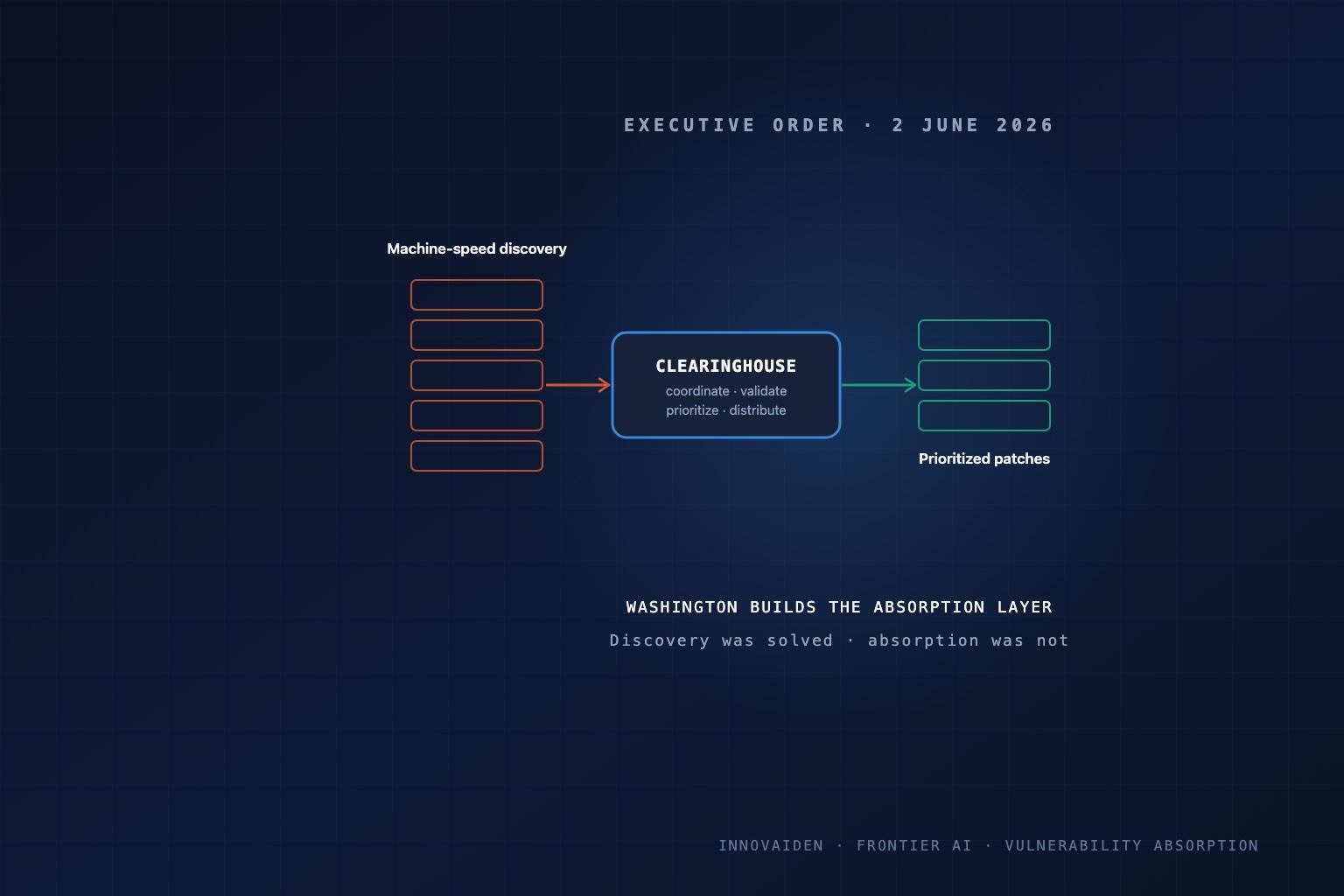
The first is a coordination-and-absorption layer for vulnerabilities. Within 30 days, the order directs the Treasury Secretary, in consultation with the National Cyber Director and working with the Secretary of War through the Director of the NSA and the Secretary of Homeland Security through the Director of CISA, to stand up an "AI cybersecurity clearinghouse" in voluntary collaboration with the AI industry and critical-infrastructure operators, to coordinate and deconflict vulnerability scanning, validate discoveries, and prioritize remediation and patch distribution. The second is a pre-release gate on cyber-capable frontier models: a classified benchmarking process to assess frontier-model cyber capabilities, paired with a voluntary framework under which developers give the government access to leading models 30 days before releasing them more broadly.
Read against the recent record, this is the government building, in public and at national scale, the exact two things that the Mythos-to-Fable sequence and the Velocity Gap analysis identified as the binding constraints. Discovery has moved to machine speed; the absorption layer had not. The order is an attempt to build the absorption layer.
Key Takeaways
- The June 2 executive order directs a Treasury-run AI cybersecurity clearinghouse (to form within 30 days, by ~2 July) to coordinate vulnerability scanning, validate discoveries, and prioritize remediation and patch distribution with critical-infrastructure operators
- It establishes a classified benchmark for frontier-model cyber capability (NSA / CISA / Treasury) and a voluntary pre-release framework: developers give the government access to leading models 30 days before wider release. Deliverables on a 60-day timeline (~1 August)
- It directs the Attorney General to prioritize criminal enforcement of AI-enabled cyberattacks
- The clearinghouse is the federal build of the absorption layer our Velocity Gap analysis identified as missing: with machine-speed discovery, the bottleneck is coordination and patch distribution, not finding the flaws
- The benchmarking framework is the government version of the withhold-then-release pattern already seen with Claude Mythos and Project Glasswing
- Participation is voluntary and not a licensing regime, but it signals where vulnerability-management and disclosure expectations are heading. The organizations that benefit are the ones that can already receive, validate, and deploy patches at speed
The Clearinghouse Is the Absorption Layer
The through-line of the last two months of frontier-AI security news has been a single asymmetry: models can now discover vulnerabilities faster than the ecosystem can turn discoveries into deployed patches. The evidence has been consistent, from the withholding of Claude Mythos over its autonomous discovery of thousands of zero-days, to Anthropic's statement that over 99% of them remained unpatched, which it gave as its reason for withholding technical details under coordinated disclosure. That last figure is worth handling precisely, because it is easy to over-read: it describes a disclosure deliberately staged over time, not a set of vendors who tried to absorb the patches and failed. The evidence that absorption is genuinely slow sits elsewhere, in the remediation data — median times to fully remediate exploited systems still measured in weeks while exploitation begins in hours. Taken together, discovery is not the constraint. The constraint is the coordination, validation, and distribution work that sits between a found vulnerability and a fixed system, which is precisely the work this order is trying to institutionalise.
The clearinghouse is a direct attempt to build that missing function at national scale. Its mandate, in the order's own terms, is to coordinate and deconflict scanning, discover and validate vulnerabilities, and coordinate and prioritize remediation and patch distribution. That is a precise description of an absorption layer: not a tool that finds more vulnerabilities, but an institution that helps a fragmented ecosystem turn discoveries into patches faster and with less duplicated effort.
Whether it works is an open question that will turn on execution, participation, and funding. But the diagnosis behind it is correct, and it matches the one we set out in the Velocity Gap doctrine: when the discovery side runs at machine speed, the only variables left to move are how fast the exposure window closes and how far a single compromise can reach. A clearinghouse that compresses the coordination-to-patch timeline is, in effect, a national effort to shrink the Velocity Gap.
The Benchmark Is the Withholding Pattern, Formalized
The order's second mechanism addresses the other half of the story: the models themselves. A classified benchmarking process, run through the NSA and CISA with Treasury, is to assess the cyber capabilities of frontier models, and a voluntary framework asks developers to provide the government access to leading models 30 days before releasing them to anyone else.
This is the government formalizing a pattern the private sector already established. Anthropic withheld Mythos on the basis of its cyber capability, deployed it to a defensive consortium, and later released the Mythos-class Fable 5 publicly with safeguards, a public availability that was itself suspended worldwide on 12 June under export controls and is, as this is written, still suspended. The sequence demonstrated both that frontier models can be dangerously capable at vulnerability discovery and that access diffuses quickly. A government benchmark plus a 30-day pre-release window is the institutional version of the same logic: assess the cyber capability of a frontier model before it reaches broad availability, and create a defensive head start. It is voluntary and it is not a licensing regime, which limits its immediate teeth, but it establishes an expectation of pre-release engagement that did not exist in policy before.
The qualifier that belongs next to that assessment arrived five days ago, and it points in an uncomfortable direction. On 12 June 2026, following the application of export controls by the Department of Commerce, Anthropic suspended access to Claude Fable 5 and Mythos 5 for all users globally, on the grounds that it could not verify user nationality in real time. Those are the same Mythos-class models this order's framework is designed to assess before release. Mythos 5 was restored on 26 June to a set of approved US organisations after government review; the controls were lifted on 30 June and Fable 5 returned globally on 1 July, a suspension of 19 days.
So the government's capacity to act on frontier-model cyber capability was never really in doubt, and it does not depend on this order at all. Export control is a blunt instrument that removed two models from the world market in a day, without a voluntary framework, a benchmark, or a 30-day window. Reading the order's voluntariness as weakness therefore mistakes where the leverage sits. The clearinghouse and the pre-release window are the cooperative path; the export-control authority is the one that was actually used, and it operates on a timescale no enterprise migration plan can match. For an operator the practical implication is not about compliance posture at all. It is that a frontier model in your production stack can become unavailable overnight for reasons that have nothing to do with your vendor's reliability or your contract with them, which is a concentration risk that belongs in the same register as uptime and roadmap. For the capability shift that made this necessary, see what Mythos and recent AI-enabled operations mean for your threat model.
What It Does Not Do
It is worth being precise about the limits, because the order is easy to over-read in either direction. It does not impose mandatory pre-clearance, licensing, or reporting on AI developers; the frontier framework is voluntary. It does not create new obligations for most enterprises directly; the clearinghouse is a coordination body, not a regulator. And it does not, on its own, close the gap it diagnoses, because a coordination function only helps organizations that can already act on what it coordinates. A clearinghouse can validate and prioritize a vulnerability, but the patch still has to be received, tested, and deployed by the operator, on the operator's timeline.
That last point is the one that matters most for private-sector leaders. The order raises the value of an internal capability many organizations still lack: the ability to absorb a rising volume of validated vulnerabilities and turn them into deployed fixes quickly. The clearinghouse rewards organizations that already have that capability and does little for organizations that do not.
What This Changes for the Executive Team
Three implications follow for boards and executive teams, none of which require the order to have teeth to be real.
The direction of travel on vulnerability management is now visible. The federal government is investing in coordinated scanning, validation, and patch prioritization as national infrastructure. Expectations for how fast a serious organization detects, validates, and remediates will rise with it. The organizations positioned to benefit are the ones whose vulnerability-handling and coordinated-disclosure processes already work, and whose software and dependency inventories are accurate enough to act on a clearinghouse feed.
Frontier-model engagement is becoming a governed activity. Even under a voluntary framework, a government benchmark and a pre-release window signal that deploying or building on frontier models with cyber capability is moving from an unexamined procurement choice toward a governed one. Organizations building on frontier models should expect the provenance and capability profile of those models to become a diligence and governance question.
Absorption capacity is the asset to build. The consistent lesson across the Mythos disclosures, the Velocity Gap analysis, and now the executive order is that discovery is solved and absorption is not. The internal capability to receive, validate, and deploy fixes at speed is what converts all of this external machinery, consortiums, clearinghouses, benchmarks, into reduced risk. It is the one part of the picture entirely within an organization's control.
How Innovaiden Approaches It
Innovaiden reads policy shifts like this one for what they change operationally rather than politically. The relevant questions for an executive team are concrete: does the clearinghouse model change your disclosure and vulnerability-management obligations or expectations; is participation an advantage worth preparing for; and, most importantly, can your organization actually absorb and act on a rising volume of validated vulnerabilities at the speed the emerging model assumes. The work is a focused review of your vulnerability-handling and disclosure posture against where the federal model is heading, and a prioritized path to the absorption capacity that turns external coordination into lower real risk. The order is a signal. The advantage goes to the organizations that were already building toward what it signals.
Position Your Organization for the Clearinghouse Model
Innovaiden helps executive teams read what the June 2 executive order changes for their vulnerability-management, disclosure, and AI-governance posture, and whether participation in the emerging clearinghouse and benchmarking model is an advantage or an obligation to prepare for. Reach out to map it against your environment.
Get in TouchFrequently Asked Questions
What did the June 2 2026 executive order actually do?
The executive order, 'Promoting Advanced Artificial Intelligence Innovation and Security,' directs the federal government to build two things and prioritize a third. First, a Treasury-run AI cybersecurity clearinghouse, to be formed within 30 days in voluntary collaboration with the AI industry and critical-infrastructure operators, that coordinates and deconflicts vulnerability scanning, validates discoveries, and prioritizes remediation and patch distribution. Second, a classified benchmarking process to assess the cyber capabilities of frontier AI models, paired with a voluntary framework under which developers give the government access to leading models 30 days before wider release. Third, it directs the Attorney General to prioritize criminal enforcement against AI-enabled cyberattacks. Participation is voluntary and it is not a licensing regime.
Why does the clearinghouse matter to executives outside government?
Because it is the federal government building the absorption layer whose absence is the core risk in machine-speed vulnerability discovery. When frontier AI can find vulnerabilities faster than the ecosystem can patch them, the bottleneck is not discovery, it is coordination, validation, and patch distribution. The clearinghouse is an attempt to build that coordination function at national scale. For a critical-infrastructure operator or a large enterprise, it signals where vulnerability-management expectations are heading and creates a channel that will increasingly shape which vulnerabilities get prioritized and how fast patches move.
Is the frontier-model benchmarking framework mandatory?
No. The framework is expressly voluntary for developers and does not constitute a mandatory licensing or pre-clearance regime. Under it, participating developers provide the government access to leading-edge frontier models 30 days before releasing them to any other organization, and a classified benchmarking process, run through NSA, CISA, and Treasury, assesses the models' cyber capabilities. The deliverables were set on a 60-day timeline. The significance is directional: it establishes a government expectation of pre-release engagement for cyber-capable frontier models, which mirrors the withhold-then-release pattern the industry has already been navigating.
How does this connect to the Mythos and Fable model releases?
Directly. The withholding of Claude Mythos and the later public release of the Mythos-class Fable 5 established that frontier models can discover vulnerabilities at machine speed and that access to that capability diffuses on a cycle measured in weeks. The executive order is the government's response to the same reality: benchmark the cyber capability of frontier models before broad release, and build a national clearinghouse to coordinate the flood of discoveries into actual patches. It is policy catching up to a capability shift that the private sector demonstrated first.
What should a security or risk leader do about it now?
Treat the clearinghouse and benchmarking model as a signal about where vulnerability-management and disclosure expectations are heading, and get the internal capability in shape to meet them: a working vulnerability-handling and coordinated-disclosure process, an accurate software and dependency inventory, and the ability to absorb and act on a rising volume of validated vulnerabilities quickly. The organizations that will benefit from the clearinghouse are the ones that can already receive, validate, and deploy patches at speed. The order does not change what good looks like; it raises the stakes on already having it.
Related Insights
Sources
- The White House — Promoting Advanced Artificial Intelligence Innovation and Security (Executive Order). 2 June 2026.
- Latham & Watkins — President Trump signs executive order establishing AI cybersecurity and frontier model framework. June 2026.
- Skadden — New AI executive order calls for frontier model security, early government access, and AI-enabled cyber defense. June 2026.
- Holland & Knight — Executive order on artificial intelligence expands cybersecurity, federal oversight. June 2026.
- Pillsbury — White House executive order signals federal focus on frontier AI cybersecurity. June 2026.
- Wiley — New AI executive order addresses frontier models and cybersecurity vulnerabilities. June 2026.
- Federal News Network — AI executive order sets stage for new cybersecurity directives. June 2026.
- Anthropic — Service availability and US export controls. June 2026. Global suspension of Claude Fable 5 and Mythos 5 from 12 June 2026; Mythos 5 restored to approved US organisations 26 June; controls lifted 30 June; Fable 5 restored globally 1 July.