Black October 2026: The Verified Core Is Stolen Credentials
By the last week of October 2026, a name had attached itself to the month. The Daily Dot reported on 27 October that people in technology forums were calling a run of breaches and vulnerability disclosures "Black October", citing a Reddit thread in r/ArtificialInteligence with more than 1,300 upvotes in which one user described the previous 48 hours as the most serious in the history of cyber security. On 22 October an entertainment site ran the headline that AI agent swarms were hacking "half the internet". On 30 October the cloud security firm Wiz published a report titled "'Black October' for AI Developer Platforms", and a security vendor had adopted the label.
Boards are now being asked about it. The honest answer has two layers. One is a set of incidents documented by the affected vendors or the investigators who found them. The other is a viral layer of counts, superlatives and causal claims that the primary sources do not support. This piece separates them, then reads the verified layer for what it asks of an executive team and of a deal team.
Key Takeaways
- The verified core is a credential and update-channel story. LiteLLM, AOMEI, Cursor and ConnectWise each had a trusted distribution path abused: a release pipeline, an update server, an extension marketplace, a multi-tenant application identity.
- October was a disclosure month more than an incident month. The AOMEI tampering happened on 28 May, 16 July and 20 July 2026 and was published on 15 October. The key behind the LiteLLM release had sat in a public repository since 27 May
- Agent-driven attacks are real and measured in hundreds and thousands, not in shares of the internet. Reuters documented more than 100 websites breached out of more than 1,200 targeted. Microsoft documented sign-in attempts against more than 2,250 tenants
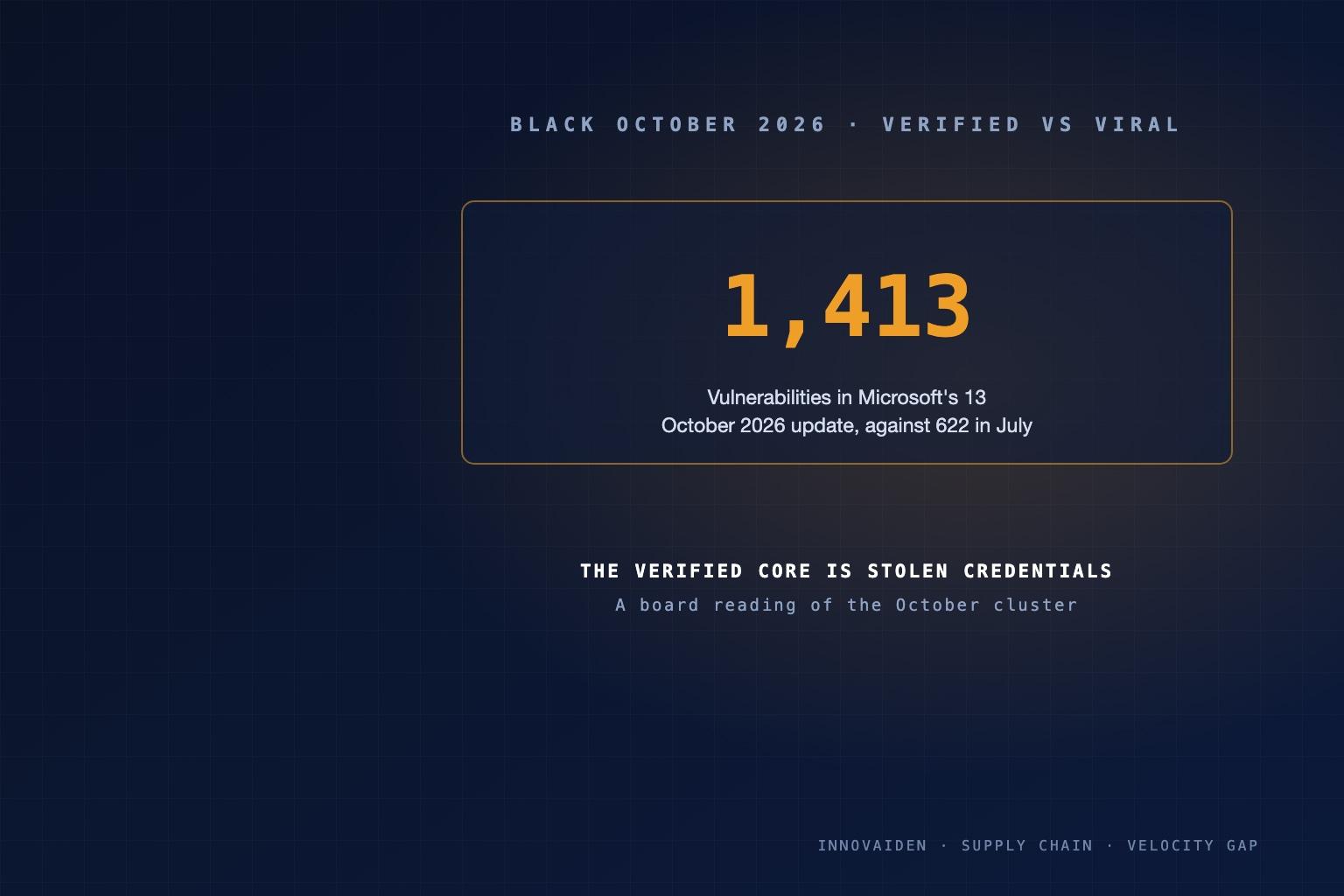
- The largest verified number is defensive. Microsoft's 13 October update addressed 1,413 vulnerabilities, against 622 in July. Microsoft's own statement on AI's role is one cautious sentence
- Some viral figures are true and misfiled. Binance did say about $6.3bn was stolen. No source we found ties that theft to AI agents or to the developer-platform incidents
- The control questions are old ones with new urgency: who can publish, which tokens can override which gates, how long a leaked key lives, and how fast a fix is absorbed
Which Black October Incidents Have a Primary Source?
We include only incidents we could pin to the affected vendor's own report, the investigating firm's report, or a named outlet's original reporting. The table is deliberately shorter than the lists in circulation.
| Incident | When it happened | When it was disclosed | What the source establishes |
|---|---|---|---|
| LiteLLM 1.107.0 | Key exposed 27 May; first used 10 October; malicious release 21 October 2026 | 21 October, root cause 23 October | LiteLLM: an administrative key committed to a public repository returned a GitHub organization owner's token, two more maintainer tokens were taken through CI, and a credential-stealing release reached PyPI, Docker Hub and GHCR |
| AOMEI update servers | 28 May, 16 July, 20 July 2026 | 15 October 2026 | Google Threat Intelligence Group and Mandiant: a cluster tracked as UNC7017 altered update configuration files for five to ten minutes at a time, delivering the CROSSROAD downloader and SHINYROAD backdoor |
| Cursor marketplace | 29 October 2026, roughly 11 hours | 29 October 2026 | Cursor: modified versions 2.1.312 and 2.1.313 of the Claude Code extension, not developed by Anthropic, attempted to install an attacker's SSH key and persistence. Cursor's notice does not state how they entered the marketplace |
| ConnectWise Cloud Backup | Agent activity from September; public reports 15 October 2026 | Microsoft attribution 21 October | Microsoft: China-state aligned Storm-0940 took control of ConnectWise cloud application identities and used the open-source ARTEX framework to attempt sign-ins to more than 2,250 tenants |
| Cairn campaign | From 25 September 2026 | Reuters, 19 October | Reuters: one operator's AI agents targeted more than 1,200 websites and breached more than 100. Reuters could not determine how much data was taken |
| AI developer platforms | 6 to 30 October 2026 | Wiz, 30 October | Wiz: at least nine platforms disclosed incidents. No single vulnerability or dependency links them |
| Chainalysis | "This month", per the company | 30 October, updated 2 and 4 November | Chainalysis: an external actor used "offensive agentic techniques" to gain unauthorized access. No attribution has been published |
| Binance | 29 October 2026 | 30 October | Binance, per Al Jazeera: about $6.3bn stolen, with an initial investigation pointing to an engineer's compromised laptop |
Three details in the primaries matter more than the headlines.
LiteLLM's two-person rule was satisfied by one attacker. LiteLLM's 23 October report describes a chain that started with what it calls human error: an administrative key for an internal alpha service was committed to a public repository on 27 May and never revoked. On 10 October an attacker used it, and an API response returned the GitHub CLI OAuth token of one of the project's two organization owners. Workflows then posted two further maintainers' tokens to an external endpoint. On 21 October the owner's token overrode branch protection, a second token approved the production gate, and a third deleted the run records. LiteLLM withdrew its first-day hypothesis that the tokens came from an internal deployment's logs. An external researcher's GitHub issue flagged the release within 20 minutes, and the artifacts were pulled in about two hours. It was, per Help Net Security, LiteLLM's second supply-chain compromise of 2026, a pattern we flagged in April in our analysis of AI development tooling as a supply-chain target.
AOMEI's tampering was built to defeat verification. Google describes the case as the first time it has encountered a software supply-chain compromise implemented with such short windows, which evade point-in-time triage and automated file scanning. A defender who checked the vendor's server minutes after an alert saw clean files. Mandiant notified AOMEI on 17 July 2026 and AOMEI responded on 29 July that corrective action had been taken. Google identified affected organizations in 11 countries and assesses the victimology as opportunistic and likely broader. Server-side remediation does not clean endpoints that already ran the update.
Chainalysis has not been attributed. The company's 30 October statement said it had no evidence of access to investigation content or credentials and that the incident was unrelated to the Binance theft. On 4 November it said an on-path attack had exposed a subset of customer passwords and took further products offline. Microsoft's Storm-0940 report concerns ConnectWise and does not mention Chainalysis.
Which Widely Repeated Claims Are Unsupported?
"AI agent swarms are hacking half the internet." The article under that headline, published by TVOvermind on 22 October, itself states that the incidents were not one coordinated attack and that there is no evidence a single AI system caused them. The measured figures are the Reuters and Microsoft ones above. Wiz reports that Fireworks AI, OpenCode and Warp reported indications of an agent swarm attack, and Anadolu Agency reported on 2 November that Warp's attribution had not been independently verified. Wiz adds that most of the incidents are still under analysis.
"The most serious 48 hours in history." The incidents on the lists were not compressed into two days. They span May to October. What arrived in one fortnight was disclosure. The Daily Dot's own caveat applies: a newly disclosed vulnerability does not necessarily mean an attack has taken place.
"Microsoft says AI found the bugs." Microsoft's 13 October update was a record: 1,413 vulnerabilities per CyberScoop, exceeding the 1,261 of the company's previous record year, 2020, in a single month. The Record counted 622 in July and 419 in August, and Krebs on Security put September at nearly 1,000. Krebs reported that Microsoft credits large language models for the volume. The Microsoft Security Response Center post published that day is narrower. Its one sentence on the subject reads: "As AI-assisted research contributes to vulnerability discovery, this kind of approach may become more useful." No share, model or count is given. The direction is clear. The magnitude is not Microsoft's claim.
Headline loss figures. The $6.3bn Binance figure has a source: the company. What lacks a source is its place in an AI narrative. Al Jazeera's 30 October report does not mention AI, and cites the blockchain intelligence firm TRM attributing the theft with high confidence to North Korea's TraderTraitor unit. We could not trace a second circulating figure, a wave of more than 170 compromised packages with 518 million downloads, to any October primary, and have left it out.
What the Verified Layer Says About AI
Two things are demonstrated. Commodity agent frameworks lower the cost of opportunistic intrusion: the researcher who found the Cairn activity estimated its cost at roughly $5,000, as Reuters reported and as we examined in our reading of the Cairn campaign. And a state-aligned actor now runs an open-source agent framework at volume, although Microsoft's detail is sobering in both directions: a four-day password spray against 327 accounts produced more than 151,000 failed logons and no successful authentication.
What is not demonstrated is autonomous mass compromise. The supply-chain incidents in the table ran through people's credentials and vendors' distribution channels. AI's clearest measurable effect sits on the other side of the ledger, in discovery volume. That is the trend we tracked in August, when Unit 42's NOVA system confirmed 14,090 vulnerabilities across 3,915 open-source projects in two months. A month with 1,413 Microsoft fixes is what that curve looks like when it reaches the patch queue.
What This Means for Patch Absorption
In the Velocity Gap doctrine we defined the gap as attacker time-to-weaponize minus defender time-to-contain, and argued that open-vulnerability counts should be retired as the board metric. October supplies the case. A team that treats 1,413 fixes as 1,413 units of work will fail. Fortra's Tyler Reguly told Krebs on Security that only 26 Microsoft vulnerabilities had appeared in the CISA Known Exploited Vulnerabilities catalog this year, and one flaw in the October batch, a Windows Shell security feature bypass, was already under exploitation. Microsoft's risk-cohort proposal recognises that customers need a way to assess CVEs in groups.
The capacity question for a board is therefore not how many patches were applied. It is how long an exploited fix takes to reach production on the systems that matter, and whether that interval is shrinking while volume more than doubles in three months.
What Changes for the Executive Team
Treat the release path as a privileged system. List every identity that can publish an artifact, change a release workflow or override branch protection. A second approver is not a control if one compromise yields both identities. Require hardware-backed reauthentication for owner actions and remove standing owner tokens from developer machines.
Put a lifespan on every credential. LiteLLM's key was still valid more than four months after it was exposed. Scan public repository history, including commits that were force-pushed over, and revoke anything found.
Constrain what updaters and marketplaces can deliver. The AOMEI and Cursor cases both ran through software that fetches and executes on its own schedule. Pin versions, delay adoption of new releases by a set period, restrict extension installation in developer tools to an approved list, and alert on unsigned child processes spawned by updaters.
Keep the evidence. Google's advice after AOMEI is to preserve endpoint-cached files instead of relying on a live check of the vendor's site. A procedure that closes an alert because the source looks clean needs rewriting.
What an Acquirer Should Ask the Target
Software supply-chain hygiene belongs inside the cybersecurity and technical-debt categories we set out in the five technology risks that determine M&A deal outcomes, and October gives it specific questions:
- Who can publish a production release, and can any single credential both alter the release workflow and approve it?
- How many long-lived developer and CI tokens exist, what scope does each carry, and when was each last rotated?
- Has public repository history been scanned for committed secrets, and was every finding revoked, not only removed?
- Which dependencies and container tags are pinned, and which float on "latest"?
- Did any system install LiteLLM 1.107.0, run AOMEI Backupper or AnyViewer between April and July 2026, or load the Claude Code extension in Cursor on 29 October? What was rotated afterwards?
- What is the measured time from upstream fix to production for the last three critical patches?
How Innovaiden Approaches It
The verified layer of Black October is a checklist. Innovaiden's Software Supply Chain Exposure Review walks the path from a developer credential to a published artifact, tests which tokens can override which gates, measures how long exposed keys stay valid, and baselines patch-absorption time on the systems an executive team or a deal thesis depends on. The output is a ranked list of the routes by which one stolen credential would reach your customers, and the changes that close them.
Test Your Software Supply Chain Against October's Verified Incidents
Innovaiden reviews the path from a developer credential to a published artifact in your estate or a target's: which tokens can override which controls, how long a leaked key stays valid, what your build and update channels would accept, and how fast an upstream fix becomes a deployed one. Reach out to scope it against your own pipeline or a live deal.
Get in TouchFrequently Asked Questions
What is Black October 2026?
Black October is an informal label for a cluster of security incidents and vulnerability disclosures made public in October 2026. The Daily Dot reported on 27 October that the term spread through online forums, including a Reddit thread in r/ArtificialInteligence with more than 1,300 upvotes. Wiz used the phrase on 30 October as the title of a report on AI developer platforms. It does not describe one campaign. Fox News, publishing a CyberGuy report on 30 October, described it as a series of cybersecurity emergencies rather than a single coordinated hacking campaign. Several of the incidents on the circulating lists began months before October and were only disclosed then.
Which Black October incidents are confirmed by a primary source?
Five have a vendor report, an investigator report or original reporting by a named outlet behind them. LiteLLM confirmed that a malicious version 1.107.0 was published to PyPI and container registries on 21 October 2026. Google Threat Intelligence Group reported on 15 October that a cluster it tracks as UNC7017 tampered with AOMEI update servers in May and July 2026. Cursor confirmed that modified Claude Code extension versions were in its marketplace for roughly 11 hours on 29 October. Microsoft attributed the ConnectWise Cloud Backup compromise to Storm-0940 on 21 October. Reuters reported on 19 October that one operator's AI agents breached more than 100 company websites. Chainalysis and Binance have also confirmed incidents.
Did AI agent swarms hack a large share of the internet in October 2026?
No primary source supports that. The two best-documented agent-driven operations are much smaller. Reuters reported that one operator using the open-source Cairn platform had targeted more than 1,200 websites since 25 September 2026 and breached more than 100. Microsoft reported that Storm-0940 used the open-source ARTEX framework to attempt sign-ins to more than 2,250 tenants, and that successful authentication does not necessarily indicate data was accessed. Wiz noted that three AI developer platforms reported indications of an agent swarm attack, but said there is no single vulnerability or dependency linking the nine incidents it tracked and that detailed technical information is largely unavailable.
What did Microsoft actually say about AI and the October 2026 Patch Tuesday?
Less than the headlines suggest. Microsoft's 13 October 2026 security update addressed 1,413 vulnerabilities, per CyberScoop's count, more than the 1,261 Microsoft disclosed in the whole of 2020, its previous record year. The Record counted 622 in July 2026. In a Microsoft Security Response Center post published the same day, the company's only reference to AI was one sentence: as AI-assisted research contributes to vulnerability discovery, grouping CVEs into risk cohorts may become more useful. Krebs on Security reported that Microsoft credits large language models for the volume of bug discovery. Microsoft's own post does not quantify that contribution.
What should an acquirer ask a target about its software supply chain after October 2026?
Ask for evidence, not policy. Who can publish a release, and can one credential both change the release workflow and approve it? How many long-lived developer tokens exist, what can each do, and when was each last rotated? Has the company scanned its public repository history for committed keys and revoked every one found? What does the build pull from public registries, is each dependency pinned, and how would the team know if an auto-updating tool fetched a tampered file for ten minutes? Finally, how many days does an upstream security fix take to reach production, measured, for the last three critical patches?
Related Insights
Sources
- LiteLLM — Contained: Oct 21, 2026 LiteLLM release v1.107.0 Compromised. 21 October 2026. Supports the version number, the PyPI window of 11:39 to 13:23 UTC, the Docker Hub and GHCR exposure, and the payload description.
- LiteLLM — The attack chain behind the v1.107.0 LiteLLM release. 23 October 2026. Supports the 27 May key exposure, the 10 October first use, the three GitHub tokens, the withdrawn log hypothesis, detection within 20 minutes and artifacts live for about two hours.
- Help Net Security — LiteLLM hit by second supply chain attack this year, users urged to rotate credentials. 22 October 2026. Supports the description of the incident as LiteLLM's second supply-chain compromise of 2026.
- Google Threat Intelligence Group — Investigating Ephemeral Supply Chain Tampering. 15 October 2026. Supports UNC7017, CROSSROAD and SHINYROAD, the tampering windows of 5 to 10 min on 28 May, 16 July and 20 July 2026, the 17 and 29 July notification dates, the 11 countries and the triage advice.
- BleepingComputer — Hackers hijack AOMEI update servers to secretly spread malware. 19 October 2026. Supports the account of the AOMEI tampering and the limits of server-side remediation.
- Cursor — Security notice: malicious version of Anthropic.claude-code (2.1.312 and 2.1.313) identified in the Cursor VS Code Extension Marketplace. 29 October 2026, updated 30 October 2026. Supports versions 2.1.312 and 2.1.313, the window of about 2:27am to 1:35pm PT, the SSH key and persistence behaviour, and the statement that the versions were not developed by Anthropic.
- Microsoft Security Blog — AI-driven, large-scale nation-state campaign using ARTEX enables supply chain compromise. 21 October 2026. Supports the Storm-0940 attribution, ARTEX as an open-source framework, attempted sign-ins to more than 2,250 tenants, and the password-spray figures of 327 accounts and more than 151,000 failed logons.
- CyberScoop — Microsoft pins ConnectWise supply-chain attack to China-state aligned threat group. 21 October 2026. Supports the sequence of the ConnectWise compromise and Microsoft's caveat that successful authentication does not necessarily indicate data access.
- Reuters via Honolulu Star-Advertiser — How one hacker used AI agents to break into over 100 company websites. 19 October 2026. Supports more than 1,200 websites targeted since 25 September 2026, more than 100 breached, the roughly $5,000 cost estimate, and Reuters' statement that it could not determine the extent of data extraction.
- Microsoft Security Response Center — Using risk cohorts to prioritize security updates. 13 October 2026. Supports the quoted sentence on AI-assisted research and the risk-cohort proposal.
- CyberScoop — Microsoft drops an actively exploited zero-day among record high of 1,413 vulnerabilities. 14 October 2026. Supports the count of 1,413, the previous annual record of 1,261 set in 2020, and the exploited Windows Shell flaw.
- Krebs on Security — Microsoft Patches More Than 1,400 Security Flaws. 13 October 2026. Supports the statement that Microsoft credits large language models, September's nearly 1,000 fixes, and Tyler Reguly's figure of 26 Microsoft vulnerabilities in the CISA catalog.
- The Record — Microsoft's massive Patch Tuesday releases continue as AI reshapes bug discovery. 12 August 2026. Supports the counts of 622 vulnerabilities in July 2026 and 419 in August 2026.
- Wiz — "Black October" for AI Developer Platforms. 30 October 2026. Supports the count of at least nine platforms between 6 and 30 October, the reported indications of agent swarm attacks, and the statement that no single vulnerability or dependency links the incidents.
- Anadolu Agency — TIMELINE - AI at center of October cyberattack wave targeting tech giants, developer platforms. 2 November 2026. Supports the report that Warp's agent swarm attribution had not been independently verified.
- Chainalysis — Chainalysis Security Incident Information. 30 October 2026, updated 2 and 4 November 2026. Supports the "offensive agentic techniques" wording, the statement that the incident was unrelated to the Binance theft, and the 4 November on-path attack update.
- Al Jazeera — Binance says $6.3bn stolen in biggest crypto heist in history. 30 October 2026. Supports the $6.3bn figure, the compromised engineer laptop and TRM's attribution.
- The Daily Dot — Is AI making cyberattacks harder to stop? "Black October" sparks a debate about threat to humanity and digital security. 27 October 2026. Supports the Reddit thread, its upvote count, the 48-hours claim and the caveat on disclosed vulnerabilities.
- TVOvermind — AI Agent Swarms Are Hacking "Half The Internet" In "Black October" Phenomenon. 22 October 2026. Cited only as the specimen of the viral headline and for its own statement that the incidents were not one coordinated attack.
- Fox News — AI-powered cyberattacks fuel "Black October" fears. 30 October 2026. Supports the description of the term as a series of emergencies and not a single coordinated campaign.