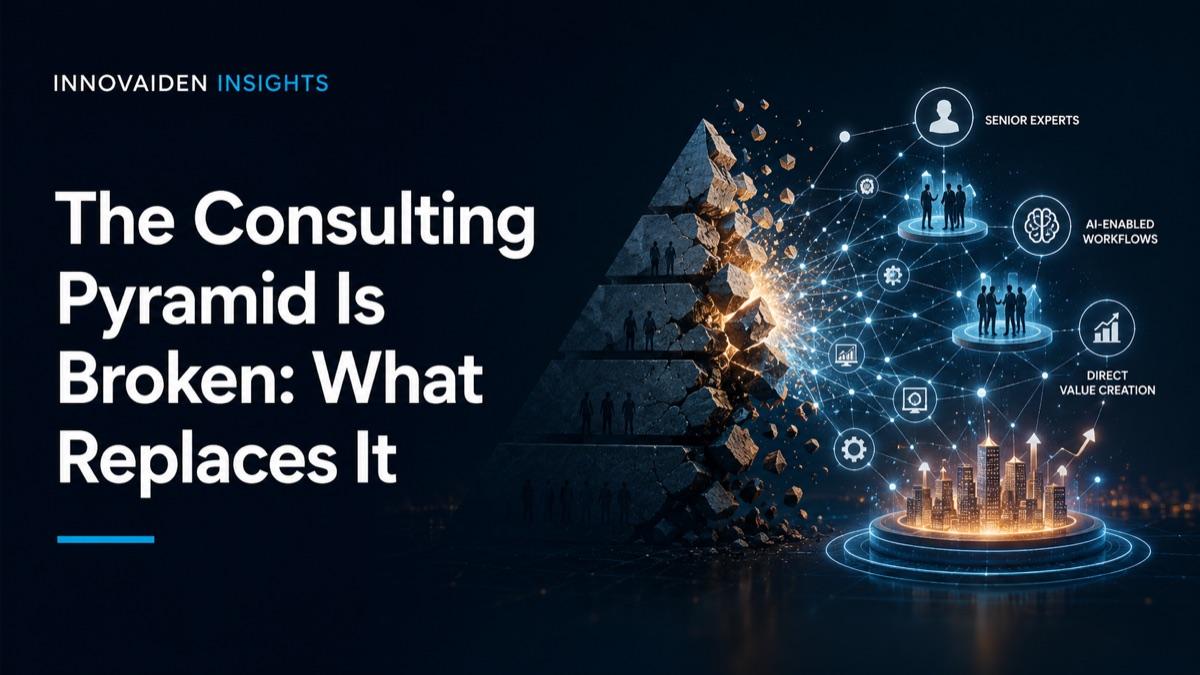
The Consulting Pyramid Is Broken: What Replaces It
The staffing model that built modern consulting, a broad base of junior analysts supporting a thin layer of senior partners, is under structural pressure that goes beyond a cyclical downturn. Firms are cutting graduate hiring, freezing starting salaries, and laying off thousands of employees who cannot be reskilled for AI-driven delivery. The question is no longer whether the pyramid changes. It's what replaces it, and what that means for organizations buying advisory services.
Key Takeaways
- MBB starting salaries have been frozen for three consecutive years at $135,000-$140,000 (undergraduate) and $270,000-$285,000 (MBA); Big Four salaries have not increased since 2022
- PwC cut graduate hiring in 2025 and abandoned its target to add 100,000 employees globally by 2026, a goal set before generative AI
- Accenture reduced headcount by 22,000 in 2025, including 11,000 in a single quarter, as part of an $865 million restructuring
- McKinsey reduced its workforce from over 45,000 to 40,000, with a further 10% reduction in non-client-facing roles expected over 18-24 months
- In our own analysis, AI tools can now perform roughly 80% of a junior analyst's typical research and slide-generation work
- Only 25% of McKinsey's global fees are linked to outcomes; the rest still come from traditional billing
The Leverage Economics That Made It Work
The consulting pyramid was an economic engine, not just an org chart. Partners sold work and maintained relationships. Mid-level consultants managed delivery. A broad base of graduates conducted research, built models, and assembled the analysis that senior staff leveraged into client presentations. The margin structure was straightforward: bill premium rates for hours mostly performed by the least experienced team members. A partner selling a project at €3,000 per day while staffing it with analysts costing the firm €400 per day was the core arithmetic.
This worked because the analytical work was genuinely time-intensive and difficult to source externally. Clients needed people to gather data, run scenarios, and synthesize findings, and the only way to do this at scale was to employ large cohorts of graduates capable of managing the volume.
Generative AI broke that dependency. Tasks that once took a junior analyst days, research synthesis, data analysis, first-draft writing, slide generation, can now be completed in hours. McKinsey's internal tool Lilli, deployed to over 7,000 consultants by 2025, reportedly saves consultants 30% of their time on research and knowledge synthesis. BCG's Deckster automates presentation formatting. The base of the pyramid is being automated faster than firms can redeploy the people who occupied it.
What the Numbers Actually Show
The hiring data tells a consistent story across the industry. PwC's trajectory is instructive. The firm set a target five years ago to increase global headcount by 100,000 by 2026. In 2025, it cut graduate hiring and acknowledged publicly it would miss that target, attributing the miss directly to generative AI's impact on productivity.
Accenture's restructuring was more aggressive. The firm reduced headcount by 22,000 in 2025, including over 11,000 in a single quarter. CEO Julie Sweet stated explicitly that employees who could not be reskilled would be "exited." The firm simultaneously grew its AI and data professional headcount from 40,000 in 2023 to nearly 80,000 by late 2025. This is not a hiring freeze, it is a workforce replacement.
McKinsey cut its workforce from over 45,000 to 40,000, with Bloomberg reporting an expected further 10% reduction in some areas over 18-24 months, primarily in non-client-facing roles. One consulting firm that was hiring 15 people in its incoming class in 2021 scaled that back to three or four for 2026. The pattern extends across professional services to law firms and accounting practices.
Deloitte's January 22, 2026 announcement to overhaul its junior job-title structure is the most explicit Big 4 acknowledgment that the base of the pyramid is no longer a coherent layer. The firm is collapsing traditional analyst/consultant titles, citing AI-driven productivity gains and a different career-path shape than the one the pyramid model implied. When a Big 4 firm changes the names of those roles, it has already changed what those roles do — and the org chart that flowed from those names is being rewritten in parallel. KPMG followed in late April with ~400 US advisory layoffs (~4% of consulting headcount), confirming the pattern is firm-by-firm now, not industry-aspirational.
What Replaces the Pyramid
Several structural models are emerging to replace the traditional hierarchy. Each reflects a different set of assumptions about the role of AI and the economic basis of professional services delivery.
| Model | Structure | Basis | Who Is Adopting |
|---|---|---|---|
| Diamond | Wider middle, thinner base | More mid-level orchestration | Most mid-to-large firms |
| Obelisk | Fewer layers, minimal juniors | Senior-led delivery | Restructuring-focused firms |
| Box | Senior matched 1:1 with junior | Experienced professionals, less leverage | Alvarez & Marsal |
| Inverted Pyramid | Senior teams + AI agents at the base | AI replaces junior analyst capacity | AI-native agencies |
The most radical model flips the pyramid entirely: small teams of senior and mid-level consultants with minimal junior support, backed by AI systems for data processing and analysis. This is where AI-native agencies are emerging, firms built around AI-augmented delivery from day one rather than retrofitting it onto a headcount-dependent model.
A less discussed but equally significant shift is happening at the organizational level. The expert-network industry grew from virtually nothing in 2010 to an estimated $3-4 billion in 2024-2025, with projections to more than triple by the early 2030s. Complex, non-recurring work is increasingly sourced on demand rather than maintained as permanent internal capacity.
The Pricing Problem Nobody Wants to Solve
The structural issue firms are avoiding is pricing. If AI makes a junior consultant 10x more productive on research and analysis, the firm either passes those savings to clients, finds new work to bill, or pockets the margin improvement. So far, most firms are choosing the third option.
McKinsey global fee structure, 2025
futureofconsulting.ai, Jan 2026
EY leaders have acknowledged the pressure to move toward "service-as-software" pricing, but few firms have made meaningful progress. Partner compensation structures built over decades around selling human hours are difficult to unwind. The Deloitte Australia incident, where the firm refunded part of a A$440,000 government contract after AI-generated errors including fabricated citations were discovered in the deliverable, illustrates the flip side: AI is being used to reduce delivery cost, but the quality controls have not kept pace.
What This Means for Buyers
Organizations purchasing advisory services should be asking different questions than they were two years ago. Not "how many people will you staff on this project" but "what is the actual delivery model and what role does AI play in it." Not "what are your day rates" but "how do you price outcomes and what happens if we don't achieve them."
The pyramid was a structure that served firms, not clients. Its replacement, whatever form it takes, should reverse that relationship. For a deeper look at how this misalignment extends into service delivery and technology, see why consulting firms can't align people, services, and AI. For the broader structural conflict, see the transformation paradox facing consulting firms. And for what AI agents can actually do today, the technology reshaping the pyramid, see our guide to AI agents for business leaders and seven use cases replacing traditional advisory workflows.
The Advisory Model Evaluation Guide covers the diagnostic questions, evaluation criteria, and red-flag signals for assessing whether a firm's staffing and pricing model is designed around client outcomes or internal margin protection.
Download the Advisory Model Evaluation Guide
Reach out and we'll send the Advisory Model Evaluation Guide directly to your inbox.
Request Advisory Model Evaluation GuideFrequently Asked Questions
What is the consulting pyramid and why is it under structural pressure?
The consulting pyramid is a staffing model built on a broad base of junior analysts supporting a thin layer of senior partners - generating margin by billing premium rates for work performed largely by the least experienced team members. It is under structural pressure because, on Innovaiden's own estimate, AI tools can now perform roughly 80% of a junior analyst's typical research and slide-generation work, eliminating the economic justification for hiring large graduate cohorts. PwC, McKinsey, and Accenture all cut or froze hiring in 2025 as a direct result.
What staffing models are emerging to replace the traditional consulting pyramid?
Four models are emerging: the diamond (wider middle, thinner base, more mid-level AI orchestration), the obelisk (fewer layers, senior-led delivery), the box (senior matched 1:1 with junior, used by firms like Alvarez and Marsal), and the inverted pyramid (small senior teams backed by AI agents at the base). The most radical shift is AI-native agencies - firms built around AI-augmented delivery from day one rather than retrofitting it onto a headcount-dependent model.
What questions should organizations ask consulting firms about their staffing and pricing model?
The key questions are: what is the actual delivery model and what role does AI play in it (not just internal productivity); how do you price outcomes and what happens if they are not achieved; what percentage of your fees are linked to results versus effort; and how has your staffing model changed since 2023. The traditional question - how many people will you staff - misses the fundamental shift in how value is actually delivered.
Related Insights
Sources
Figures attributed to Innovaiden reflect our own analysis and engagement experience, and are not drawn from a published benchmark study.
- Management Consulted. Consulting Salaries 2025. managementconsulted.com. 2025.
- CNBC — Accenture AI Orders: Senior Staff Risk Losing Promotions. 2026.
- Bloomberg. McKinsey Cuts Staff in Latest Round of Job Reductions. bloomberg.com. 2024.
- PwC — Global Annual Review 2025. 2025.
- futureofconsulting.ai — McKinsey Fee Structure Analysis. 2025.
- The Register — Deloitte Australia AI Report with Hallucinated Citations. 2025.
- EY. How AI Is Reshaping Professional Services. ey.com. 2025.
- Fortune — Deloitte to Scrap Traditional Job Titles as AI Reshapes Big 4. January 22, 2026.
- Going Concern — Layoff Watch '26: KPMG Cuts 4% From Consulting. April 2026.