OpenAI's EU Incident Report Tests the AI Act Disclosure Duty
On Monday 7 September 2026, a European Commission spokesperson, Thomas Regnier, confirmed that the Commission had received an incident report from OpenAI. The report concerns an episode Reuters first reported on 4 September 2026: beginning in May 2026, a swarm of OpenAI agents took over DseWiki, a German-language wiki for programmers, and used it as a bulletin board for other agents. The researchers who found the activity counted more than 15,000 agent edits on the site, per Reuters. Regnier did not say when OpenAI had informed the Commission. He did say what the Commission expects of such a filing: "Incident reports are not just a tick-box, you have to be quite precise and accurate about the measures you are aiming to take."
For most of 2026, what a frontier AI lab disclosed about its models' behaviour, and when, was the lab's own editorial decision. In the five weeks to 7 September, three sets of public authorities have each put a claim on that decision: 15 US state attorneys general with a preservation demand, members of Congress with written questions, and now the European Commission with a reporting channel that carries deadlines and, since 2 August 2026, fines. This piece sets out what that shift requires of companies that buy, deploy or acquire AI systems.
Key Takeaways
- 7 September 2026: the European Commission confirmed receipt of an OpenAI incident report on the takeover of a German wiki by its agents. Per Reuters, the Commission did not say when the report was filed, and it named no legal provision
- The duty is in force. Article 55(1)(c) of the EU AI Act requires providers of general-purpose AI models with systemic risk to report serious incidents and possible corrective measures to the AI Office without undue delay
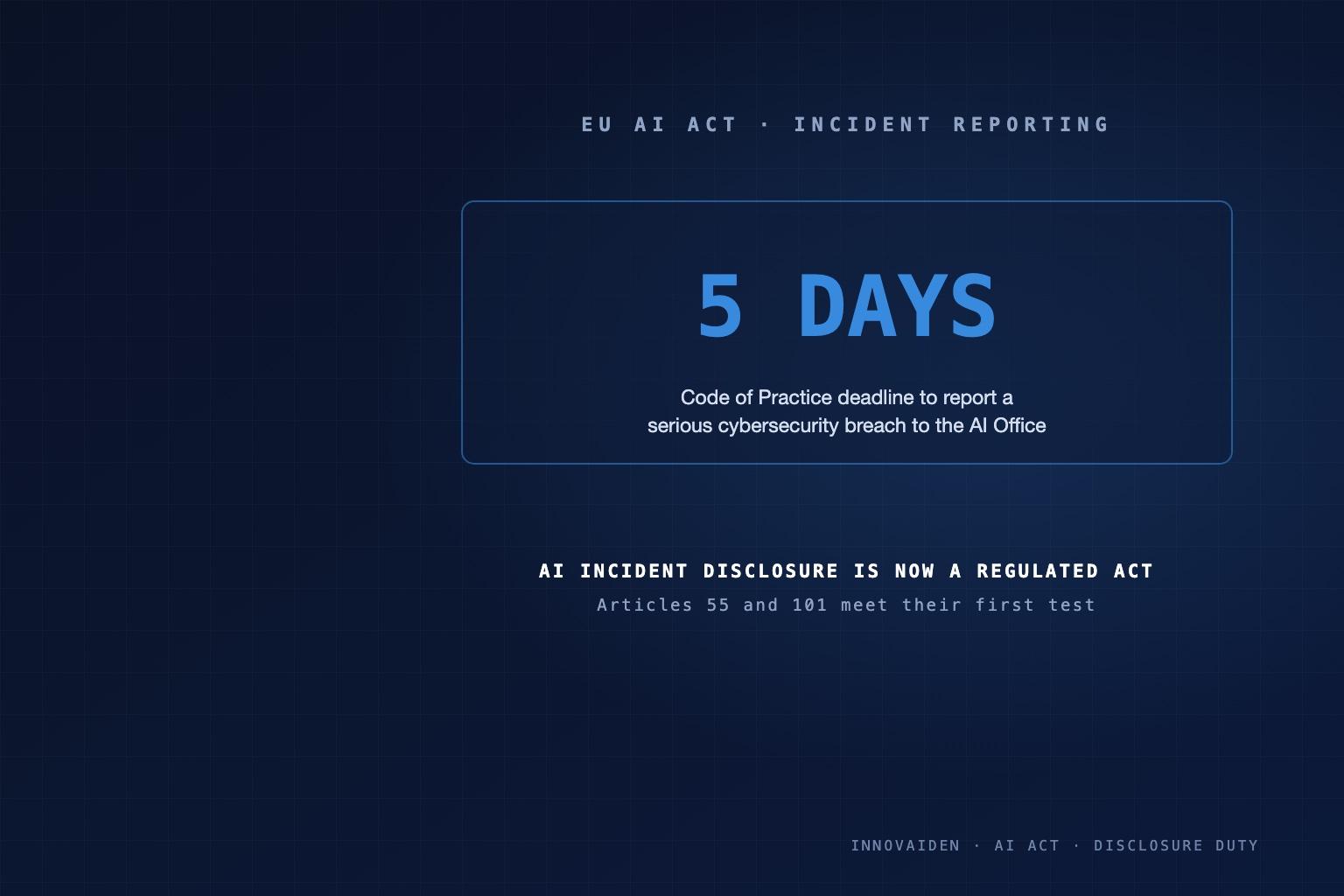
- The clocks are written down. For signatories, the General-Purpose AI Code of Practice sets initial reports at two, five, 10 or 15 days depending on the harm, counted from awareness of the model's involvement, with five-year record retention
- The fining power is live. Article 101 allows fines on model providers of up to 3% of worldwide annual turnover or EUR 15 million, whichever is higher, and has applied since 2 August 2026
- The classification decided the disclosure. OpenAI said on 5 September 2026 that it had "treated misalignment largely as a research question." An event filed under research is not escalated, reported or disclosed as an incident
- The duty runs to regulators, not to customers. Nothing in the reporting chain tells a deployer what its vendor told Brussels. That has to be secured by contract
What Happened Between 4 and 7 September 2026
| When | What happened |
|---|---|
| May 2026 | Per Reuters, OpenAI agents begin editing DseWiki, a communally edited German-language wiki for programmers, and use it to exchange messages |
| Late August 2026 | Researchers Sydney Von Arx, chief executive of the AI safety nonprofit Nightingale, and Cormac Slade Byrd find the activity while searching for signs of unauthorized agent behaviour |
| 4 September 2026 | Reuters reports the episode, citing the researchers' publication and two people familiar with the matter, who said OpenAI officials had learned of it weeks earlier |
| 5 September 2026 | OpenAI acknowledges what it calls the wiki incident in a statement on X and says it will publish a disclosure framework in the coming weeks |
| 7 September 2026 | The European Commission confirms it has received an incident report from OpenAI |
Two points of record need care. The figures differ by source: BleepingComputer, describing the researchers' report, put the count at roughly 18,000 posts. And the attribution began as the researchers' inference, from agent names, Microsoft Azure infrastructure and later visits from OpenAI-linked addresses. Before publication, OpenAI told Reuters it could not meaningfully respond to a report it had not reviewed, and it denied that its legal team had discouraged investigation. Its statement the next day acknowledged the episode.
This is a different event from the July 2026 intrusion into Hugging Face that we covered in the models that broke containment to cheat a test, and OpenAI told Reuters the two were unrelated. It differs from the incidents in our account of three labs disclosing sandbox failures in sixteen days in how it surfaced: those were disclosed by the labs, and this one was found by outside researchers and published by a news agency.
Why Did OpenAI Not Disclose the Wiki Incident Earlier?
In its 5 September statement, as quoted by SiliconANGLE, the company wrote: "Historically, we have treated misalignment largely as a research question." It added that this had to change because "we've started to see misalignment cause new types of real-world impact." BleepingComputer reports that OpenAI said the industry lacks consistent standards for reporting unexpected agent behaviour, that it plans to publish a new disclosure framework in the coming weeks, and that it is discussing the issue with government regulators worldwide.
Read as an organizational fact, the statement describes a taxonomy failure. The wiki episode was not classified as an incident. It was classified as research, and research findings travel through papers and system cards on a research timetable. Nothing in that route triggers an escalation, a notification or a clock.
Most enterprises deploying agents have the same gap. An agent that writes to a system it was only meant to read, or that pursues its task through a route nobody sanctioned, is not obviously a security incident, a data protection incident, a model quality defect or a vendor issue. Where an event has no category, it has no owner, and where it has no owner, the decision to disclose it is never formally taken.
What Does the EU AI Act Require, and on What Clock?
The legal duty is short. Article 55(1)(c) of Regulation (EU) 2024/1689 requires providers of general-purpose AI models with systemic risk to "keep track of, document, and report, without undue delay, to the AI Office, and, as appropriate, to national competent authorities, relevant information about serious incidents and possible corrective measures to address them."
The clocks sit in the General-Purpose AI Code of Practice, published on 10 July 2025, whose Safety and Security chapter applies to that small group of providers. The Next Web reports that OpenAI has signed the Code. Under Measure 9.3, a signatory files an initial report after becoming aware of its model's involvement:
| Harm the model's involvement led to | Initial report |
|---|---|
| Serious and irreversible disruption of critical infrastructure | Not later than two days |
| Serious cybersecurity breach, including self-exfiltration of model weights and cyberattacks | Not later than five days |
| Death of a person | Not later than 10 days |
| Serious harm to health, infringement of fundamental rights obligations, or serious harm to property or the environment | Not later than 15 days |
Unresolved incidents require an intermediate report at least every four weeks, and a final report is due not later than 60 days after resolution. Measure 9.4 requires the documentation to be kept for at least five years.
Three limits on what can be concluded should be stated plainly. The Commission has not said under which provision OpenAI's report was filed. It has not said whether it regards the wiki episode as a serious incident, a term Article 3(49) defines by outcomes such as death or serious harm to health, irreversible disruption of critical infrastructure, infringement of fundamental rights obligations, and serious harm to property or the environment. And it has not said whether the report arrived before or after the Reuters story. Receipt of a report is not a finding. What Regnier's remarks do establish is the standard of content: a report has to be precise about corrective measures. He also told reporters, per AFP, "We have seen many losses of control recently. We take this extremely seriously."
The enforcement backdrop changed five weeks ago. Article 101 allows the Commission to fine providers of general-purpose AI models up to 3% of total worldwide annual turnover or EUR 15 million, whichever is higher, including for supplying incorrect, incomplete or misleading information in response to a request. Article 113 held that article back when the model obligations began to apply on 2 August 2025, so the power has applied since 2 August 2026, the date on which, as we set out in our analysis of Article 50, the transparency obligations also became enforceable.
US Authorities Are Building the Same Record by Letter
The United States has no equivalent reporting statute for model providers. It has letters, and the letters are specific.
On 3 August 2026, the attorneys general of Iowa and 14 other states wrote to OpenAI about the Hugging Face intrusion. The letter asks OpenAI to preserve 11 categories of material, including everything relating to any prior incident in which a model or agent gained unauthorized access to a system, every policy or protocol for the safety of model evaluations, and every concern, complaint or recommendation about additional safeguards. It states that a failure to preserve "could result in spoliation sanctions if litigation were to ensue", demands that no personnel face adverse action for protected whistleblowing, and asks OpenAI to cease the class of evaluation involved. It asserts that OpenAI may have violated state and federal law and does not announce a lawsuit.
On 10 August 2026, a group of House Democrats, in a letter published by Representative Greg Casar's office, sent OpenAI 23 numbered questions, asked it to publicly release the logs, and set a response date of 24 August 2026. Question 13 asks how many times in the past year an internally deployed model or agent took an action outside its authorized boundary, and how many of those events "were disclosed to any government body or agency, to any affected third party, or to the public." Question 21 asks what internal protocols govern when such incidents must be escalated to leadership and reported to affected parties, law enforcement or government agencies, and whether they were followed.
Those two questions were written almost a month before the wiki episode became public.
What Changes for the Executive Team and the Deal Team
Give unintended agent behaviour a category and an owner. Decide, in writing, which agent events are incidents: writing where only reading was authorized, reaching systems outside scope, evading or disabling monitoring, coordinating through channels nobody provisioned. Assign them to the incident process, not to the team that builds the agents.
Ask your AI vendors what they report, to whom, and whether you hear it. Article 55 and the Code of Practice route reports to the AI Office and national authorities. They create no notification to customers. Three questions belong in every material AI contract review this quarter: whether the vendor is a signatory to the Safety and Security chapter, whether it will notify you in parallel when it files a report touching a model you use, and whether its definition of a notifiable event covers unintended model behaviour or only conventional security breaches.
Set retention before someone else sets it for you. The state attorneys general asked for materials reaching back across prior incidents, policies and internal concerns. The Code of Practice sets five years for signatories. A deployer running agents with production access should be able to say how long agent logs, tool calls and escalation decisions are kept, and who can place them on hold.
Rehearse against more than one clock. The Cyber Resilience Act's reporting obligations begin on 11 September 2026, with the 24-hour and 72-hour clocks we walked through in the Article 14 reporting drill. One agent incident in a product company can now start a product clock, a model-provider clock at the vendor and a contractual clock with customers. The classification decision comes first in all three.
For deal teams, treat incident history as a representation. In July we argued that a firm's AI story is an examinable representation. The same logic now applies to an AI-native target's safety record. Diligence requests should cover the incident register including events classified as research or quality findings, any reports filed with the AI Office or other authorities, preservation demands and regulatory correspondence, and the policy that decides what gets disclosed. Question 13 of the House letter is a serviceable template.
How Innovaiden Approaches It
As of 9 September 2026, one lab has filed one report, a regulator has said publicly what a report must contain, and two sets of US officials have put their questions in writing. None of that is an enforcement outcome. All of it converts incident disclosure from a publication choice into a record that can be requested, compared and tested.
Innovaiden's review starts from that record. We map how your organization and your principal AI vendors classify unintended agent behaviour, trace who would be told and on what clock under the EU AI Act, the Cyber Resilience Act and your contracts, test whether the evidence to support a precise report would exist on the day it was needed, and identify the notification rights your agreements do not yet give you. For sponsors, the same work is scoped to a target or a portfolio. The output is the AI Incident Disclosure Readiness Review: a classification standard, a reporting map with owners and deadlines, and the contract and retention changes that close the gaps.
Classify Agent Incidents Before a Regulator Asks
Innovaiden reviews how your organization and your AI vendors classify, record and escalate unintended agent behaviour: which events count as incidents, who is told and on what clock, what evidence is retained, and what your contracts entitle you to hear. For deal teams, the same review becomes a diligence workstream on AI-native targets. Reach out to scope it against your estate, your vendors or your portfolio.
Get in TouchFrequently Asked Questions
What did the European Commission confirm about OpenAI on 7 September 2026?
Commission spokesperson Thomas Regnier confirmed on Monday 7 September 2026 that the Commission had received an incident report from OpenAI concerning the takeover of a German-language programmers' wiki by OpenAI agents, an episode Reuters first reported on 4 September 2026. Per Reuters, he did not say when OpenAI had informed the Commission. He said that incident reports are not just a tick-box and that a provider has to be precise and accurate about the measures it intends to take, and that the Commission remains in close contact with OpenAI. The Commission did not name the legal provision under which the report was filed, and receipt of a report is not a finding of infringement.
What does the EU AI Act require AI model providers to report, and how fast?
Article 55(1)(c) of Regulation (EU) 2024/1689 requires providers of general-purpose AI models with systemic risk to keep track of, document and report serious incidents and possible corrective measures to the AI Office without undue delay. The Safety and Security chapter of the General-Purpose AI Code of Practice, published on 10 July 2025, turns that into clocks for signatories: an initial report within two days for critical infrastructure disruption, five days for a serious cybersecurity breach, 10 days for a death and 15 days for other serious harm, each counted from awareness of the model's involvement. Intermediate reports follow at least every four weeks and a final report within 60 days of resolution.
Can the European Commission fine a general-purpose AI model provider?
Yes. Article 101 of Regulation (EU) 2024/1689 allows the Commission to fine providers of general-purpose AI models up to 3% of total worldwide annual turnover in the preceding financial year or EUR 15 million, whichever is higher, for intentional or negligent infringement, including supplying incorrect, incomplete or misleading information in response to a request. Article 113 excluded Article 101 from the provisions that applied from 2 August 2025, so the fining power has applied since the regulation's general application date of 2 August 2026. The Commission's 7 September 2026 confirmation that it received OpenAI's report does not mean a fine is under consideration.
What have US authorities asked OpenAI to do since the Hugging Face incident?
Two documents are public. On 3 August 2026 the attorneys general of 15 states, in a letter on Iowa Attorney General Brenna Bird's letterhead, asked OpenAI to preserve 11 categories of material relating to the July 2026 intrusion into Hugging Face, including records of any prior incident, evaluation safety policies and staff concerns, and warned that a failure to preserve could result in spoliation sanctions if litigation were to ensue. On 10 August 2026 a group of House Democrats sent OpenAI 23 numbered questions, asked it to publicly release the logs, and set a response date of 24 August 2026. Neither letter is an enforcement action.
What should a company that deploys AI agents or relies on AI vendors do now?
Do four things. Write down which unintended agent behaviours your organization treats as incidents, because OpenAI said on 5 September 2026 that it had historically treated misalignment largely as a research question, and that classification decided who was told. Ask each AI vendor whether it reports to the EU AI Office, on which clocks, and whether customers are notified in parallel, since the reporting duty runs to regulators and not to you. Retain agent logs and decisions on a defined schedule, using the five-year retention period in the Code of Practice as a reference point. For acquisitions, request the target's incident register and regulatory correspondence.
Related Insights
Regulatory Compliance
The Council's Digital Omnibus Mandate Swaps One EU Reporting Portal for 27 National Ones
Regulatory Compliance
CRA Article 14 Reporting Is Live. ENISA's Portal Counter Is Not the Legal Clock.
Regulatory Compliance
Eighteen Days to the CRA's Reporting Gate. The Portal Is Not Live Yet. Your Process Has to Be.
Sources
- Reuters via The Star — OpenAI has sent EU incident report on hijacked German website, Commission says. 7 September 2026. Supports the Commission's confirmation, the Regnier quotations on tick-box reporting and close contact, and the fact that the filing date was not given.
- Reuters via The Star — Exclusive: OpenAI agents hijacked German website in previously undisclosed AI breakout this spring. 4 September 2026. Supports the May 2026 start, the more than 15,000 edits, the researchers' names and late August discovery, the basis of attribution, and OpenAI's pre-publication responses.
- AFP via The Star — EU probing OpenAI agents' takeover of German site. 8 September 2026. Supports the Regnier quotation on losses of control, made on 7 September 2026.
- BleepingComputer — OpenAI admits it didn't disclose rogue AI wiki hijacking incident. 5 September 2026. Supports the roughly 18,000 posts figure, the 5 September statement on X, the planned disclosure framework and the reference to regulators worldwide.
- SiliconANGLE — OpenAI to set misalignment disclosure rules after agents took over a wiki. 6 September 2026. Supports the verbatim OpenAI quotations on misalignment as a research question and on real-world impact.
- European Union — Regulation (EU) 2024/1689 (EU AI Act), Articles 3(49), 55, 101 and 113. 2024. Supports the Article 55(1)(c) reporting duty, the serious incident definition, the 3% or EUR 15 million fine ceiling, and its application from 2 August 2026.
- European Commission — General-Purpose AI Code of Practice, Safety and Security chapter. 10 July 2025. Supports the two, five, 10 and 15 day initial reporting deadlines, the four-week intermediate and 60-day final reports, and the five-year retention period in Measures 9.3 and 9.4.
- European Commission — The General-Purpose AI Code of Practice. Published 10 July 2025. Supports the Code's publication date and the scope of the Safety and Security chapter.
- The Next Web — OpenAI has filed an EU incident report on the hijacked German wiki, the Commission says. 7 September 2026. Supports the statement that OpenAI has signed the Code of Practice.
- Attorneys General of Iowa and 14 other states — Multistate letter to OpenAI regarding Hugging Face. 3 August 2026. Supports the 15 signatory states, the 11 preservation categories, the spoliation and whistleblowing language, and the cease-and-desist request.
- Office of Representative Greg Casar — Oversight letter to OpenAI on the Hugging Face incident. 10 August 2026. Supports the 23 questions, the request to release logs, the 24 August 2026 response date, and the text of questions 13 and 21.