The EU AI Act's August 2 High-Risk Deadline Just Moved. Here Is What Actually Comes Due.
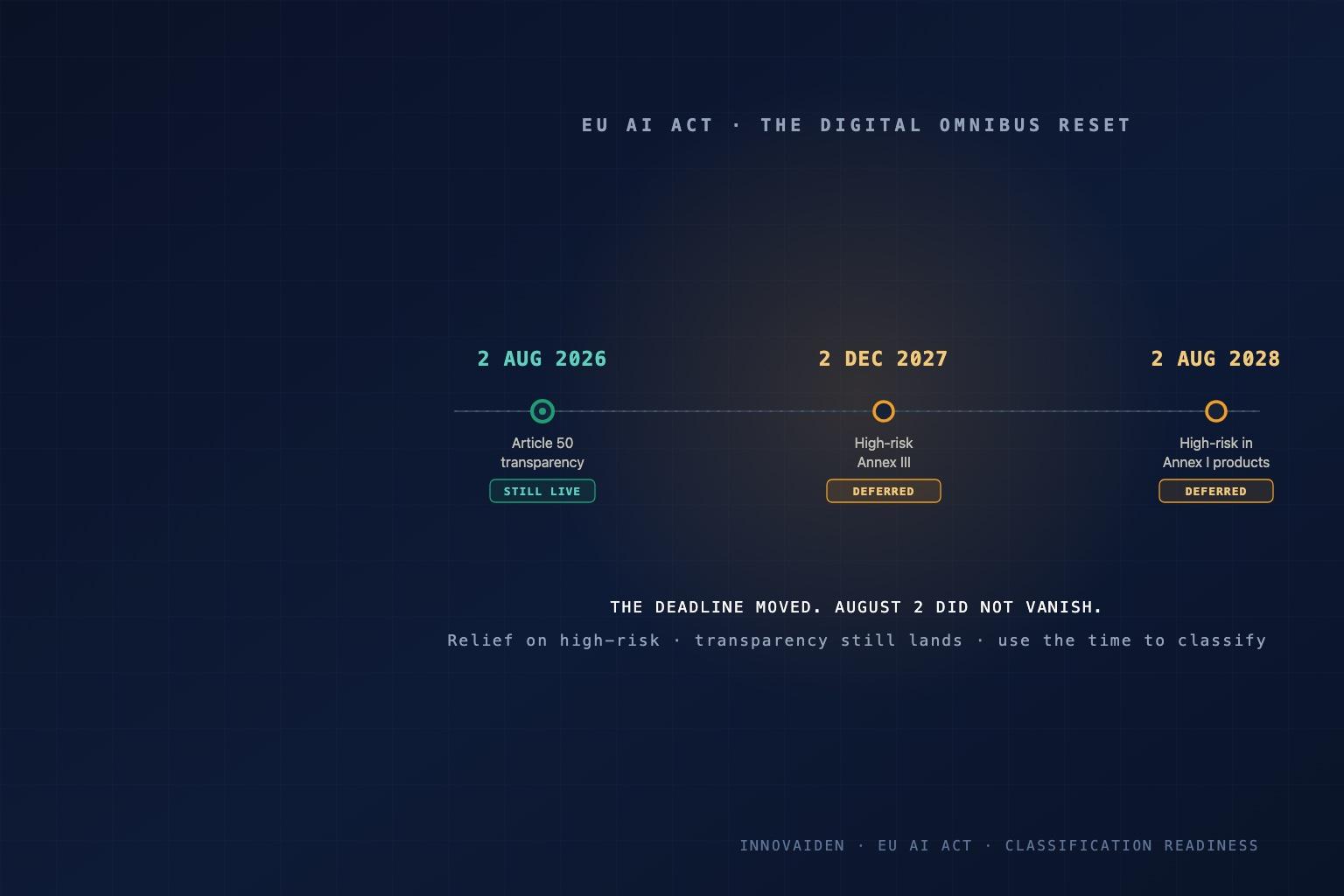
For most of the past year, 2 August 2026 was the date that organized enterprise AI compliance planning. It was the day the EU AI Act's obligations for high-risk systems were scheduled to take effect, and it drove a great deal of budget, roadmap, and board attention. As of last week, that date has moved. On 29 June 2026, the Council of the EU gave final approval to the Digital Omnibus on AI, the first substantive amendment to the AI Act since its 2024 adoption, and the high-risk obligations that anchored everyone's planning are now deferred to 2027 and 2028.
The temptation is to read this as a reprieve and stand down. That reading is wrong on the facts and wrong on the strategy. It is wrong on the facts because 2 August 2026 is not cancelled: the Article 50 transparency obligations were not deferred, and they still take effect on schedule. It is wrong on the strategy because the deferral extends the deadline for the single task most organizations have not finished and cannot skip, working out which of their AI systems are in scope and which are high-risk. The deferral is relief on the hardest obligations. It is not a reason to stop the work; it is time to do it properly.
Key Takeaways
- On 29 June 2026 the Council gave final approval to the Digital Omnibus on AI (Parliament endorsed 16 June; provisional agreement 7 May), the first amendment to the AI Act since 2024
- High-risk obligations are deferred: stand-alone Annex III systems to 2 December 2027; AI embedded in Annex I regulated products to 2 August 2028
- 2 August 2026 is not cancelled. The Article 50 transparency obligations (disclosing AI-generated content, informing people they are interacting with AI) still take effect on schedule. One narrow carve-out: Article 50(2) machine-readable marking of AI-generated content is deferred to 2 December 2026 for systems already on the market before 2 August
- The Omnibus also expanded prohibited practices: new prohibitions on nudifier and CSAM-generating AI, effective 2 December 2026
- Penalties are unchanged: up to €35M or 7% of global turnover for prohibited practices; up to €15M or 3% for other obligations, including high-risk and transparency
- The deferral is relief, not reprieve. The extended time should go to the foundational task, determining which AI systems are in scope and high-risk, which every later obligation depends on and which most organizations have not completed
What Moved, and What Did Not
The Digital Omnibus is a simplification package, negotiated to relieve timeline pressure that industry and several Member States argued was unrealistic given the state of harmonized standards and guidance. It reached provisional agreement on 7 May 2026, was formally endorsed by the European Parliament on 16 June, and received the Council's final green light on 29 June. Publication in the Official Journal is expected in July, with entry into force shortly after.
The substance that matters for planning is a clean split. The high-risk obligations, the heavy compliance machinery of risk management, data governance, technical documentation, human oversight, and conformity assessment, are deferred on two tracks: stand-alone high-risk systems under Annex III move to 2 December 2027, and AI embedded in products already regulated under Annex I product-safety law move to 2 August 2028. This is genuine relief, because the high-risk regime is where the real work and cost concentrate.
What did not move is as important as what did. The Article 50 transparency obligations remain effective 2 August 2026. Any AI system that interacts with people or generates or manipulates content carries a near-term disclosure duty on the original schedule, regardless of whether it is high-risk.
There is one carve-out inside that, and it matters for planning even though it is narrow. The Article 50(2) obligation to mark AI-generated content in a machine-readable format is deferred by four months, to 2 December 2026, for systems already placed on the market before 2 August 2026. So the disclosure duties land in August as scheduled, but an existing deployed system gets until December to implement machine-readable marking specifically. New systems placed on the market from 2 August get no such grace. If your August compliance plan treats all of Article 50 as a single cliff, it is slightly overstated in one direction for legacy systems and correct for everything else, and the December date is worth putting in the same diary entry as the new prohibition below.
And the Omnibus expanded the prohibited-practices list rather than only relaxing obligations, adding prohibitions on AI used to generate non-consensual intimate imagery and child sexual abuse material, effective 2 December 2026. An organization that reads "high-risk deferred" as "AI Act paused" will miss both a live August obligation and a new December prohibition. For the classification rules the high-risk determination turns on, see the EU's draft guidelines on high-risk classification.
Why the Deferral Is Relief, Not Reprieve
The strategic error the deferral invites is to treat extra time as permission to defer the work. The opposite is true, because the task the extra time most helps with is the one that gates everything else and that almost no one has finished: knowing which AI systems you operate, and which of them are high-risk.
Every high-risk obligation, whenever it lands, presupposes that the organization can answer that question. Risk management, documentation, human oversight, and conformity assessment are all obligations attached to systems classified as high-risk, and none of them can be built until the classification exists. In our experience, the classification work, not the controls, is where organizations are furthest behind, because it requires an accurate inventory of AI systems (including the ones adopted without approval), a mapping of each against the Annex III categories and the exemptions, and a defensible written determination for each. That is months of work for a real estate, and it is exactly what the December 2027 and August 2028 dates now give room to do properly rather than in a panic.
This is the same pattern we have flagged across the EU regulatory wave: the binding constraint is rarely the controls and almost always the evidence. It was the argument in the Cyber Resilience Act context, where the gap is proof rather than capability, covered in the CRA's first obligation gate and what readiness requires, and it holds here. The deferral is worth precisely as much as the classification work an organization does with it.
The Cross-Framework View
The Digital Omnibus is one piece of a wider EU simplification effort, and reading it in isolation understates its significance. The same effort consolidated incident reporting toward a single entry point, which we covered in the EU's single entry point and why the operator still needs a crosswalk. And the AI-system inventory and classification work that the AI Act now gives more time for is the same evidence base that shapes an organization's exposure under NIS2, DORA, the Cyber Resilience Act, and the revised Cybersecurity Act. The mapping across those regimes is in Five Frameworks, One Vendor.
The practical implication is that the deferral should not be filed as an AI Act calendar change and forgotten. The work it frees up time for, a clean inventory of AI systems and a defensible classification of each, is cross-framework infrastructure. Done once and well, it serves the AI Act's 2027 and 2028 deadlines, the August 2026 transparency obligation, and the overlapping demands of the other four regimes at the same time.
What This Changes for the Executive Team
Three decisions follow from the deferral.
Do not stand down; re-aim. The August 2026 board narrative was almost certainly built around the high-risk deadline. It needs updating, not deleting. The near-term obligation is now Article 50 transparency, due 2 August 2026, and the medium-term obligation is high-risk compliance on the new 2027 and 2028 dates. The work continues; its sequence changes.
Spend the extra time on classification, not on waiting. The deferral is only valuable if it is used to complete the AI-system inventory and high-risk classification that the later obligations require. An organization that arrives at December 2027 without that work done will have converted eighteen months of relief into the same panic on a later date.
Treat the inventory as cross-framework infrastructure. The AI-system inventory and classification is not AI Act overhead; it is the shared evidence base for the AI Act, the CRA, NIS2, DORA, and the revised CSA. Fund it as infrastructure that serves all of them, and the deferral becomes a genuine strategic gift rather than a deferred obligation.
How Innovaiden Approaches It
Innovaiden helps organizations use the deferral for exactly what it is worth. The work is a scope-and-readiness review that settles the questions the later deadlines will still demand answers to: which AI systems do you operate, which are in scope, which are high-risk under Annex III as amended, and what does a defensible written classification for each look like. It confirms the Article 50 transparency obligations that still land on 2 August 2026 are met, and it builds the classification evidence as cross-framework infrastructure rather than single-regulation overhead. The objective is to reach the 2027 and 2028 deadlines with the foundational work already done, and to have used the relief the Digital Omnibus granted instead of merely receiving it.
Use the Deferral to Close the Classification Gap
Innovaiden helps organizations use the Digital Omnibus deferral for what it is worth: settling which AI systems are in scope and which are high-risk, meeting the Article 50 transparency obligations that still land on 2 August 2026, and building the classification evidence the extended deadlines will still demand. Reach out to scope it against your AI estate.
Get in TouchFrequently Asked Questions
Did the EU AI Act's August 2, 2026 deadline get cancelled?
No. It got narrowed. On 29 June 2026 the Council of the EU gave final approval to the Digital Omnibus on AI, which the European Parliament had endorsed on 16 June, following a provisional agreement on 7 May. The package defers the obligations for high-risk AI systems, but it does not defer everything. The Article 50 transparency obligations, which cover disclosure requirements such as labelling AI-generated content and informing people when they are interacting with an AI system, remain in force from 2 August 2026 on the original schedule. So there is still an August 2 deadline; it is simply a narrower one than the original text implied.
What exactly was deferred, and until when?
The high-risk obligations were split into two tracks. For stand-alone high-risk systems under Annex III, the obligations are deferred to 2 December 2027. For AI embedded in products already regulated under Annex I (product-safety legislation), they are deferred to 2 August 2028. This is the part of the AI Act that carries the heaviest compliance burden (risk management, data governance, technical documentation, human oversight, conformity assessment), so the deferral is a material change to the timeline that most organizations were planning against.
So does the deferral mean we can stop AI Act work until 2027?
No, for three reasons. First, the Article 50 transparency obligations still apply from 2 August 2026, so any AI system that interacts with people or generates content has a near-term obligation regardless of the high-risk deferral. The one exception inside Article 50 is narrow and worth knowing: the Article 50(2) requirement to mark AI-generated content in a machine-readable format is deferred to 2 December 2026 for systems already placed on the market before 2 August 2026, while everything placed on the market from 2 August onward is bound on the original date. Second, the deferral gives more time for the single hardest and most foundational task, determining which of your AI systems are in scope and which are high-risk, which most organizations have not completed and which every later obligation depends on. Third, the Omnibus also expanded the list of prohibited practices, with new prohibitions on nudifier and CSAM-generating systems effective 2 December 2026. The right response to relief on the hard obligations is to spend the extra time on the classification work, not to shelve it.
What are the penalties, and do they still apply?
Yes. The AI Act's penalty structure is unchanged by the deferral, only the dates the obligations attach. Violations of the prohibited-practices rules carry fines up to €35 million or 7% of global annual turnover, whichever is higher. Non-compliance with other obligations, including the high-risk requirements and the Article 50 transparency duties, carries fines up to €15 million or 3%. The deferral moves when the high-risk obligations bite; it does not reduce what happens when they do.
How does this connect to the other EU regulations we are tracking?
The AI Act does not act alone, and the same AI-system inventory and classification work feeds the organization's posture under NIS2, DORA, the Cyber Resilience Act, and the revised Cybersecurity Act. The Digital Omnibus is part of a broader EU simplification effort that also consolidated incident reporting toward a single entry point. Treating the AI Act deferral as an isolated calendar change misses the point: the classification and evidence work it gives you time for is the same work that reduces exposure across the whole cross-framework picture.
Related Insights
Regulatory Compliance
Eighteen Days to the CRA's Reporting Gate. The Portal Is Not Live Yet. Your Process Has to Be.
Regulatory Compliance
EU AI Act Article 50 Is Now in Force. It Is the Deadline That Did Not Move.
Regulatory Compliance
Brussels Stopped Treating AI Governance and Cyber Compliance as Two Programs
Sources
- Council of the EU — Artificial intelligence: Council and Parliament agree to simplify and streamline rules. May 2026.
- Gibson Dunn — EU AI Act Omnibus agreement: postponed high-risk deadlines and other key changes. 2026.
- Hogan Lovells — EU legislators agree to delay for high-risk AI rules. 2026.
- Latham & Watkins — AI Act update: EU resolves to change rules and extend deadlines. 2026.
- Covington (Inside Privacy) — EU AI Act update: timeline relief, targeted simplification, and new prohibitions. June 2026.
- DLA Piper — The Digital AI Omnibus: proposed deferral of high-risk AI obligations under the AI Act. 2026.
- Regulation (EU) 2024/1689 (EU AI Act), Article 99 — penalties. 2024.